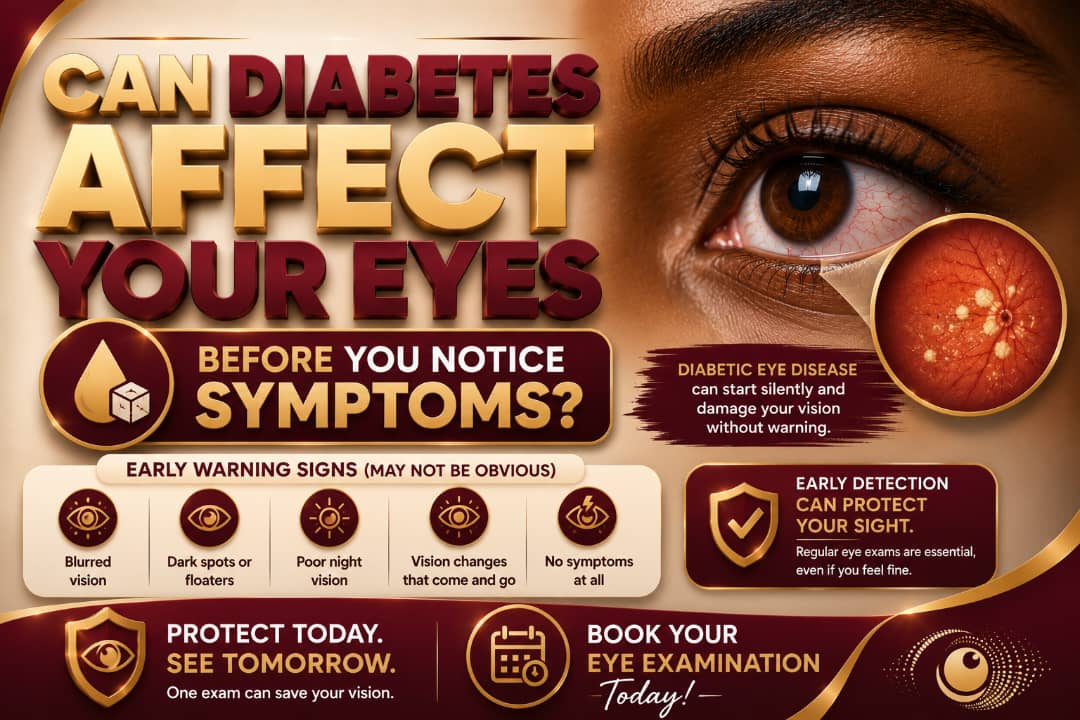
Can Diabetes Affect My Eyes Even If I Can See Clearly?
Yes. Diabetes can damage your eyes long before you notice any changes in your vision. In fact, many people with diabetic eye disease can still read, drive and see reasonably well while damage is already happening inside the eye, that's why every person living with diabetes should have a comprehensive dilated eye examination at least once a year, even if their vision seems perfectly normal.
Can Diabetes Affect My Eyes Even If I Can See Clearly?
Yes.
This is one of the most important things every person living with diabetes should understand:
You can have diabetic eye disease and still see clearly.
You may still:
- Read your phone
- Recognise faces
- Drive
- Watch television
- Work comfortably
- See 6/6 on a vision chart
and still have early changes developing in the retina.
That is why waiting for blurry vision before having your eyes checked is not a safe strategy.
The better question is not:
“Can I still see?”
It is:
“Has diabetes started affecting my eyes?”
Quick Answer
Diabetes can affect the retina before you notice symptoms.
Early diabetic retinopathy may cause:
No pain.
No redness.
No obvious blurry vision.
That is why people living with diabetes need retinal examinations at appropriate intervals even when their eyesight feels completely normal.
How often you need an examination depends on:
- The type of diabetes
- How long you have had it
- Your previous retinal findings
- Blood sugar control
- Blood pressure
- Pregnancy
- Whether diabetic retinopathy is already present
Book Appointment
How Does Diabetes Affect Your Eyes?
Your eye contains a light-sensitive layer called the retina.
Think of the retina like the camera sensor inside a phone.
Light enters your eye.
The retina receives that light.
It converts the information into signals that travel to your brain.
That is how you see.
The retina needs a healthy network of tiny blood vessels to function properly.
Over time, diabetes can damage those vessels.
They may:
- Become weakened
- Leak fluid or blood
- Become blocked
- Develop abnormal new blood vessels in advanced disease
These changes are called diabetic retinopathy.
What Is Diabetic Retinopathy?
Diabetic retinopathy is damage to the retinal blood vessels caused by diabetes.
Early disease may be mild.
As it progresses, the retina may develop:
- Small areas of bleeding
- Leakage
- Swelling
- Reduced blood supply
In more advanced disease, abnormal new blood vessels may develop.
These vessels are fragile and can bleed inside the eye.
The key problem is that early diabetic retinopathy may not affect your vision enough for you to notice it.
So eyesight alone cannot tell you whether the retina is healthy.
Can I Have Diabetic Retinopathy With Perfect Vision?
Yes.
This is exactly why diabetic retinal examinations matter.
A person can say:
“Doctor, I can see perfectly.”
and still have early retinal changes.
Your central vision may remain good because the part of the retina responsible for detailed vision has not yet been significantly affected.
But an examination may reveal changes elsewhere.
That gives you an opportunity to act before vision is seriously affected.
What Symptoms Can Diabetes Cause in the Eyes?
As diabetic eye problems progress, you may notice:
- Blurry vision
- Vision that changes from day to day
- Difficulty reading
- Dark spots
- New floaters
- Reduced night vision
- Distorted vision
- Colours appearing less vivid
- Missing areas of vision
- Partial or severe vision loss
But remember:
Having no symptoms does not mean there is no diabetic eye disease.
Why Does My Vision Change When My Blood Sugar Changes?
Blood sugar can temporarily affect the focusing power of the natural lens inside your eye.
This can make your vision feel:
- Blurry
- Different from one day to another
- Clearer at some times and worse at others
You may even feel that your glasses prescription suddenly stopped working.
That does not necessarily mean you need new glasses immediately.
If blood sugar is significantly unstable, the eye's focusing power may temporarily change.
This is one reason repeatedly making new glasses during major blood sugar fluctuations may not solve the problem.
If your prescription keeps changing, read Why Do I Keep Changing My Glasses Prescription?.
Does Blurry Vision Mean I Have Diabetic Retinopathy?
Not necessarily.
Diabetes can affect vision in several different ways.
Blur may result from:
- Blood sugar fluctuations
- A changing glasses prescription
- Cataract
- Dry eye
- Diabetic macular swelling
- Diabetic retinopathy
- Another unrelated eye condition
So blurry vision in someone with diabetes should be investigated rather than automatically labelled diabetic retinopathy.
If your vision repeatedly becomes blurry and then clear again, read Why Does My Vision Go Blurry Then Clear Again?.
Can Diabetes Cause Cataracts?
Diabetes is associated with an increased risk of cataract and cataracts may occur earlier in people living with diabetes.
A cataract means the natural lens inside the eye becomes cloudy.
Possible symptoms include:
- Blurry vision
- Glare
- Halos
- Poor night vision
- Colours becoming less vivid
- Frequent prescription changes
If headlights have become increasingly difficult to tolerate, read Why Do Headlights Blind Me at Night?.
Can Diabetes Increase Glaucoma Risk?
Diabetes is associated with an increased risk of glaucoma.
But glaucoma and diabetic retinopathy are different diseases.
Diabetic retinopathy primarily damages the retina and its blood vessels.
Glaucoma primarily damages the optic nerve.
Both can develop before a person notices obvious visual symptoms.
That is another reason a good eye examination should look beyond the glasses prescription.
If you are concerned about glaucoma, read How Do I Know If I Have Glaucoma?.
Can Diabetes Cause Dry or Irritated Eyes?
People with diabetes may also experience eye-surface problems, including dry-eye symptoms.
These may include:
- Burning
- Grittiness
- Watering
- Irritation
- Fluctuating vision
But do not assume every uncomfortable eye symptom in someone with diabetes is directly caused by diabetes.
Allergy, Harmattan, screen use, eyelid problems and other conditions can also contribute.
Who Is More Likely to Develop Diabetic Retinopathy?
Risk generally increases with:
- Longer duration of diabetes
- Poor blood sugar control
- High blood pressure
- Abnormal blood lipids
- Pregnancy in someone with pre-existing diabetes
- Existing diabetic retinal disease
This does not mean someone with well-controlled diabetes can stop having retinal examinations.
Good control reduces risk.
It does not make the risk zero.
Does Good Blood Sugar Control Protect My Eyes?
Yes.
Managing diabetes well is one of the most important things you can do to reduce the risk of diabetic complications.
Your overall care may include:
- Keeping blood sugar within the targets agreed with your medical team
- Controlling blood pressure
- Managing cholesterol and other blood lipids
- Taking prescribed medication properly
- Attending medical reviews
- Avoiding smoking
- Maintaining healthy lifestyle habits
Eye care is only one part of diabetes care.
Your optometrist, physician and other healthcare professionals each have different roles.
If My HbA1c Is Good, Do I Still Need an Eye Examination?
Yes, when retinal screening is due.
Good diabetes control is excellent and lowers risk.
But it does not replace looking at the retina.
Think about it this way:
Good blood sugar control reduces the chance of damage.
The eye examination checks whether damage is actually present.
You need both.
Book Appointment
How Often Should Someone With Diabetes Have Their Eyes Checked?
This deserves a precise answer.
If You Have Type 2 Diabetes
An initial comprehensive dilated eye examination is generally recommended at the time diabetes is diagnosed.
Why?
Because type 2 diabetes may have been present for some time before diagnosis.
If You Have Type 1 Diabetes
For adults with type 1 diabetes, an initial comprehensive dilated retinal examination is generally recommended within about five years after the onset of diabetes.
After Your First Examination
The schedule depends on what is found.
If one or more examinations show no diabetic retinopathy and diabetes indicators are well controlled, some people may be considered for retinal examination every 1–2 years.
If diabetic retinopathy is present, examinations are generally needed at least annually.
If the retinopathy is progressing or threatening vision, much more frequent monitoring may be necessary.
The correct question is therefore not:
“Does everyone with diabetes come every year?”
It is:
“Based on my retinal findings and diabetes control, when should I come back?”
What About Diabetes During Pregnancy?
Pregnancy deserves special attention in people who already have diabetes.
Pregnancy can increase the risk of diabetic retinopathy progressing.
If you have pre-existing type 1 or type 2 diabetes and are planning pregnancy or become pregnant, discuss appropriate retinal monitoring with your medical and eye-care teams.
This is different from gestational diabetes, which begins during pregnancy and has different retinal-screening considerations.
What Happens During a Diabetic Eye Examination?
A diabetic eye assessment should look beyond whether you need glasses.
Depending on your situation, it may include:
- Medical and diabetes history
- Visual acuity
- Glasses prescription assessment
- Eye pressure
- Examination of the front of the eyes
- Retinal examination
- Optic nerve assessment
- Dilated examination when appropriate
- Retinal photography where useful
- Additional testing or referral if something abnormal is found
Not everybody needs exactly the same additional tests.
The examination should be based on what your eyes require.
Why Do You Sometimes Dilate the Pupils?
Dilating drops temporarily enlarge your pupils.
This allows a wider view of the retina.
For someone with diabetes, examining the retina properly is particularly important because early damage may occur without symptoms.
Dilating drops can temporarily cause:
- Blurry near vision
- Increased sensitivity to light
Your optometrist should explain when dilation is required.
Can a Normal Eye Test Rule Out Diabetes?
No.
An eye examination can sometimes reveal retinal changes that raise concern about diabetes or its complications.
But an eye examination does not diagnose diabetes itself.
Diabetes requires appropriate medical testing such as blood glucose and other investigations.
If suspicious findings are seen, medical assessment may be recommended.
What Happens If Early Diabetic Retinopathy Is Found?
Finding early diabetic retinopathy does not automatically mean you are going blind.
Depending on the stage, management may include:
- Improving diabetes control
- Improving blood-pressure control
- Managing cholesterol
- Closer retinal monitoring
- Referral where necessary
Some early diabetic retinal changes do not immediately require eye procedures.
But they do tell us that diabetes has begun affecting the retina and that monitoring becomes more important.
Can Diabetic Retinopathy Be Treated?
Yes.
Treatment depends on the stage and type of disease.
More advanced or sight-threatening diabetic retinal disease may require specialist treatment from an ophthalmologist.
Treatment may include:
- Injections into the eye
- Laser treatment
- Surgery in certain advanced cases
The purpose of treatment is usually to prevent or reduce further vision loss.
This is why early detection matters.
Can Diabetic Retinopathy Be Reversed?
This needs careful wording.
Do not think of diabetic retinopathy as something that can simply be:
“washed away”
or
“cured with eye drops.”
Good diabetes management may reduce the risk of progression, and some retinal changes can improve.
Specialist treatments can also control particular complications.
But established retinal damage is not something we should promise to completely reverse.
The goal is to protect as much useful vision as possible.
What Is Diabetic Macular Oedema?
The macula is the central part of your retina responsible for detailed vision.
Diabetes can cause fluid to leak into this area.
This is called diabetic macular oedema.
It may cause:
- Central blurry vision
- Distortion
- Difficulty reading
- Difficulty recognising faces
Macular involvement is one reason diabetic retinal disease can become sight-threatening.
What If I Suddenly See Floaters and I Have Diabetes?
Do not automatically dismiss sudden new floaters.
In advanced diabetic retinopathy, abnormal blood vessels can bleed inside the eye.
But floaters also have many other causes.
Seek prompt eye assessment if you suddenly experience:
- Many new floaters
- Flashes of light
- A dark curtain or shadow
- Sudden reduction in vision
Read Why Do I See Black Spots Floating in My Vision?.
Can I Wait Until My Vision Becomes Blurry?
No.
That defeats the main purpose of diabetic retinal screening.
We want to identify changes before you lose useful vision.
Waiting until your eyesight becomes noticeably poor may mean the condition has already progressed.
Diabetic eye care is therefore different from saying:
“Come when something hurts.”
I Have Had Diabetes for Years and Never Had an Eye Check. Is It Too Late?
No.
The right action is to arrange an appropriate retinal examination now.
Do not avoid the examination because you are worried about what might be found.
If the retina is healthy, you gain reassurance and a monitoring plan.
If early changes are present, you can act.
If more advanced disease is present, timely specialist care becomes even more important.
Not knowing does not protect your vision.
What If My Eyes Are Healthy?
That is excellent news.
The examination has still been useful.
You now know:
- Your current retinal status
- Your vision
- Whether your prescription needs attention
- Whether other eye problems are present
- When your next diabetic retinal examination should happen
That provides a baseline against which future examinations can be compared.
What Should I Bring to My Diabetic Eye Appointment?
It helps to bring:
- Your current glasses
- A list of your medicines
- Information about your diabetes
- Any previous eye reports if available
- Details of previous eye treatments
- Any questions you want answered
If you know your recent HbA1c or other diabetes measurements, that information may also help provide context.
When Should Someone With Diabetes Seek Urgent Eye Care?
Do not wait for your routine diabetic examination if you develop:
- Sudden significant loss of vision
- A sudden shower of new floaters
- Flashes of light
- A curtain or shadow over your vision
- Severe eye pain
- A very red painful eye
- Sudden double vision
- Sudden neurological symptoms
These require prompt assessment.
How Much Does a Diabetic Eye Examination Cost in Abuja?
The cost depends on which examination and additional tests are required.
You can see our current guide explaining eye test costs in Abuja and what is included.
Where Can I Get a Diabetic Eye Check in Abuja?
At Blossom Vision Eye Clinic in Games Village, Abuja, we can assess your vision and eye health and examine for signs that diabetes may be affecting the eyes.
Depending on the findings, we may:
- Recommend monitoring
- Discuss your eye-health findings
- Advise medical follow-up
- Arrange additional testing
- Refer for ophthalmological treatment when necessary
The purpose is simple:
Find problems early, before they take away vision unnecessarily.
Frequently Asked Questions
Can diabetes affect my eyes even if I can see clearly?
Yes. Early diabetic retinopathy may cause no noticeable visual symptoms.
Can I have diabetic retinopathy with 6/6 vision?
Yes. Good central visual acuity does not automatically mean the retina has no diabetic changes.
How does diabetes damage the eyes?
Diabetes can damage small retinal blood vessels, causing leakage, blockage and, in advanced disease, abnormal new blood-vessel growth.
Does everyone with diabetes need an eye exam every year?
Not necessarily. The interval depends on diabetes type, retinal findings and overall control. Some people with repeatedly normal examinations may be considered for 1–2 yearly review, while people with retinopathy may require annual or much more frequent examinations.
When should someone with type 2 diabetes have their first eye examination?
A comprehensive dilated eye examination is generally recommended around the time type 2 diabetes is diagnosed.
When should someone with type 1 diabetes have their first diabetic eye examination?
For adults with type 1 diabetes, the first comprehensive dilated retinal examination is generally recommended within about five years after onset.
Can controlling my blood sugar protect my eyesight?
Good glucose control significantly reduces the risk of diabetic complications, but it does not replace regular retinal assessment.
Can diabetes make my glasses prescription change?
Significant blood-sugar fluctuations can temporarily alter the eye's focusing power, making vision and prescription measurements unstable.
Can diabetic retinopathy be treated?
Yes. Management depends on severity. Some people require monitoring and better systemic control, while sight-threatening disease may require specialist injections, laser treatment or surgery.
Should I wait until my vision becomes blurry?
No. Early diabetic retinal changes can occur before you notice visual symptoms.
Where can I get a diabetic eye check in Abuja?
Blossom Vision Eye Clinic provides comprehensive eye examinations in the Games Village/Kaura District area of Abuja.
Don't Use Clear Vision as Proof That Diabetes Has Not Affected Your Eyes
This is the main message I want every person living with diabetes to remember:
Seeing clearly today does not automatically mean the retina is healthy.
That does not mean you should be frightened.
It means you should be proactive.
Good blood sugar control.
Good blood-pressure control.
Appropriate medical care.
And retinal examinations at the interval recommended for your individual eyes.
At Blossom Vision Eye Clinic in Games Village, Abuja, we can examine your vision and retina, explain what we find in simple language and recommend the appropriate next step.
If you have diabetes and cannot remember when your retina was last properly examined, book a diabetic eye assessment.