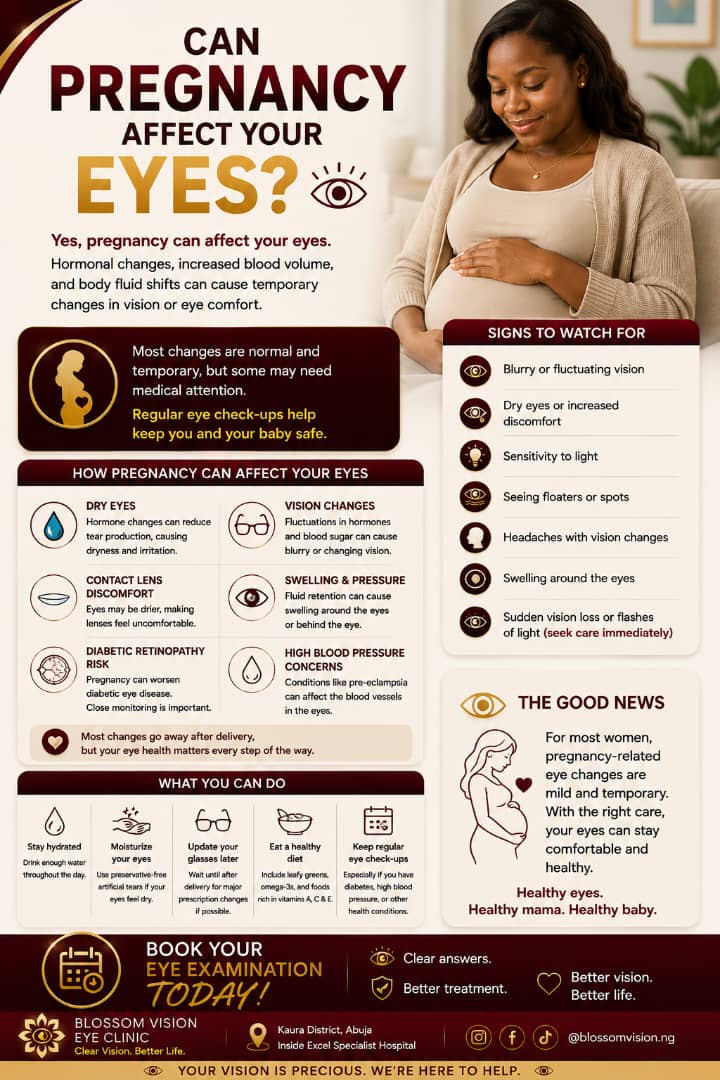
Can Pregnancy Affect Your Eyes?
Yes. Pregnancy can affect your eyes due to hormonal changes. You may experience dry eyes, blurred vision, changes in your glasses prescription or increased sensitivity to light. While many changes are temporary, sudden vision changes during pregnancy require immediate medical attention because they may indicate a serious medical condition.
Can Pregnancy Affect Your Eyes?
Pregnancy changes almost every part of your body.
You may expect:
- Morning sickness
- Tiredness
- Food cravings
- Back pain
- Swollen feet
But then one morning you notice:
“Why is my vision suddenly a little blurry?”
Or:
“Why are my contact lenses irritating me now?”
Or:
“Why do my eyes suddenly feel dry?”
And naturally you start wondering:
“Can pregnancy affect my eyes?”
Yes.
Pregnancy can affect the eyes and vision.
Hormonal changes, fluid changes and changes in the tear film and cornea can temporarily affect how your eyes feel and sometimes how clearly you see.
The reassuring part is that many pregnancy-related eye changes are temporary.
But there is another side to this story:
Not every vision change during pregnancy should be blamed on pregnancy.
Some visual symptoms can be warning signs of serious pregnancy complications such as pre-eclampsia.
Knowing the difference matters.
Quick Answer: Can Pregnancy Change Your Eyesight?
Yes.
During pregnancy, some women may experience:
- Dry or gritty eyes
- Watery eyes
- Temporary blurry vision
- Contact-lens discomfort
- Small changes in glasses prescription
- Changes in how the cornea behaves
Pregnancy can affect tear-film function and can cause changes in corneal thickness or curvature. These changes may contribute to dry-eye symptoms, temporary refractive changes and contact-lens intolerance.
But if you develop:
sudden blurry vision
flashing lights or spots
loss of vision
double vision
or:
vision changes with a severe persistent headache
contact your maternity team or seek urgent medical assessment.
These can be warning signs of pre-eclampsia or another serious medical problem.
Book Appointment
Why Can Pregnancy Affect the Eyes?
Pregnancy produces major changes in:
- Hormones
- Blood volume
- Fluid balance
- Blood pressure
- Metabolism
Your eyes are part of your body, so they are affected by some of these changes too.
For example, pregnancy can influence:
the tear film
which keeps the surface of your eyes moist,
and:
the cornea
which is the clear front window of your eye.
Even small temporary changes in these structures can affect comfort or vision.
1. Can Pregnancy Cause Dry Eyes?
Yes.
Pregnancy can affect tear-film function and contribute to dry-eye symptoms.
You may notice:
- Burning
- Grittiness
- Sandy feeling
- Irritation
- Watering
- Temporary blurry vision
- Increased awareness of your contact lenses
Something that often confuses patients is:
“If my eyes are dry, why are they watering?”
Dry and irritated eyes can produce reflex tears.
So it is possible to experience:
dryness + watering
at the same time.
Why Are My Eyes Suddenly Gritty During Pregnancy?
Dry-eye irritation may make your eyes feel as though there is:
sand
dust
or:
something inside them.
But do not automatically diagnose yourself with dry eye.
Persistent:
- Pain
- Significant redness
- Light sensitivity
- Reduced vision
needs assessment because other eye conditions can cause similar symptoms.
2. Can Pregnancy Cause Blurry Vision?
It can.
Pregnancy-related changes in the cornea and other optical structures can temporarily alter refraction in some women. Studies do not suggest that every pregnant woman experiences a prescription change, but temporary refractive shifts have been reported.
You might notice:
“My glasses don't seem as sharp as before.”
Or:
“Distance is slightly blurrier.”
Or:
“My vision keeps changing.”
But this requires an important warning.
Do Not Assume Every Blurry Eye During Pregnancy Is Normal
Blurred vision has many possible causes.
Pregnancy itself is only one possibility.
Others include:
- Dry eye
- Prescription changes
- Migraine
- Diabetes-related changes
- Retinal disease
- High blood pressure
- Pre-eclampsia
- Other eye or neurological conditions
The pattern matters.
Mild gradual blur that behaves like a prescription or dry-eye change is very different from:
sudden significant visual loss
or:
new flashing lights + severe headache + pregnancy.
3. Can My Glasses Prescription Change During Pregnancy?
Possibly.
Changes in corneal thickness, curvature and fluid balance can temporarily change refraction in some women.
This may make your normal glasses feel:
- Slightly weak
- Slightly too strong
- Less comfortable than before
But I would not tell every pregnant woman:
“Don't buy glasses until after delivery.”
That is too rigid.
Instead:
If the change is small and manageable, it may make sense to wait and reassess once the vision has stabilised.
If the blur is significantly affecting:
- Work
- Driving
- Reading
- Daily activities
an updated or temporary prescription may still be appropriate.
The decision should be made after assessing the actual eyes.
Will My Prescription Return to Normal After Delivery?
Often, pregnancy-related changes improve after pregnancy.
But there is no guarantee that every prescription change will completely disappear immediately after delivery.
Some corneal changes may persist for a period postpartum and may also be influenced by breastfeeding.
So rather than saying:
“Wait exactly three months.”
it is better to say:
“Let's check whether your prescription has stabilised.”
4. Why Are My Contact Lenses Suddenly Uncomfortable During Pregnancy?
This is a recognised pregnancy-related problem.
Pregnancy may alter:
- Tear-film stability
- Corneal thickness
- Corneal curvature
and these changes can contribute to contact-lens intolerance.
A woman who previously wore lenses comfortably all day may suddenly say:
“After four hours, I cannot stand them anymore.”
You may notice:
- Dryness
- Burning
- Grittiness
- Increased lens awareness
- Reduced wearing time
- Fluctuating vision
Do not force yourself to continue wearing uncomfortable lenses.
Switching temporarily to glasses may be more comfortable.
Your separate Why Do My Contact Lenses Feel Uncomfortable? article should link naturally from here once its exact published URL is confirmed.
What If My Contact Lens Eye Becomes Red and Painful?
That is different.
A contact-lens wearer who develops:
redness + pain + light sensitivity + reduced vision
needs prompt eye assessment.
Do not simply say:
“It must be pregnancy hormones.”
Contact-lens-related corneal infection can threaten vision.
Remove the lens and have the eye assessed.
5. Can Pregnancy Make My Eyes More Sensitive to Light?
Some women may become more aware of light sensitivity, particularly if dry eye or migraine is also present.
But I would not describe photophobia, the medical word for uncomfortable light sensitivity, as a routine harmless pregnancy symptom.
If light suddenly becomes very uncomfortable, especially with:
- Eye pain
- Redness
- Reduced vision
- Severe headache
- Flashing lights or visual disturbances
seek assessment.
Those accompanying symptoms matter more than pregnancy itself.
6. Can Pregnancy Cause Headaches and Vision Changes?
Pregnancy can be associated with headaches for many reasons.
But:
A severe or persistent headache together with new vision changes requires particular attention.
ACOG lists headache that does not go away and changes in eyesight among warning signs of pre-eclampsia.
Do not simply lie down and assume:
“Pregnant women get headaches.”
Tell your obstetric or maternity team.
7. What Is Pre-Eclampsia?
Pre-eclampsia is a serious pregnancy-related disorder involving high blood pressure and possible organ dysfunction.
It generally develops after 20 weeks of pregnancy, although related complications can also occur after delivery.
Possible warning symptoms include:
- Changes in vision
- Seeing spots
- Persistent headache
- Swelling of the face or hands
- Upper abdominal or shoulder pain
- Nausea or vomiting later in pregnancy
- Difficulty breathing
Some women may have very few symptoms.
That is one reason antenatal blood-pressure checks are so important.
What Do Pre-Eclampsia Vision Changes Look Like?
People may describe:
“I keep seeing flashing lights.”
“There are spots in my vision.”
“Everything suddenly looks blurry.”
“I can't focus properly.”
“Part of my vision is missing.”
ACOG specifically identifies blurry vision, inability to focus, double vision, bright spots, flashes and temporary blind spots among concerning pregnancy-associated visual changes.
These symptoms should not be handled as:
“Maybe you need stronger glasses.”
The pregnant patient needs appropriate medical assessment.
Is Pre-Eclampsia Only a Problem Before Delivery?
No.
This is very important.
Pre-eclampsia can also develop after childbirth, including during the first weeks postpartum.
So a woman who recently delivered and develops:
- Severe headache
- New visual changes
- Flashing lights
- Facial or hand swelling
- Breathing difficulty
should not assume:
“The pregnancy is over, so it can't be pre-eclampsia.”
Contact the appropriate medical team urgently.
8. Can High Blood Pressure During Pregnancy Affect the Eyes?
Yes.
Severe hypertension can affect retinal circulation and cause visual symptoms.
But an eye examination should not replace:
- Blood-pressure measurement
- Antenatal review
- Obstetric assessment
The eye may provide clues.
The obstetric and medical team must manage the underlying blood-pressure problem.
Your separate Can High Blood Pressure Affect Your Eyes? article should eventually link from here once its exact published URL is confirmed.
9. What If I Had High Blood Pressure Before Pregnancy?
Tell both your maternity team and your eye-care provider.
Pre-existing hypertension can affect pregnancy management.
And if retinal vascular changes are present, coordination between eye care and medical care becomes important.
Do not stop or change blood-pressure medication yourself because you become pregnant.
Medication decisions belong with the clinician managing your pregnancy and hypertension.
Book Appointment
10. Can Pregnancy Affect Diabetic Eye Disease?
Yes.
This is especially important for women who had type 1 or type 2 diabetes before becoming pregnant.
Pregnancy can increase the risk of development or progression of diabetic retinopathy in people with pre-existing diabetes.
The 2026 American Diabetes Association Standards recommend an eye examination before pregnancy and in the first trimester for people with pre-existing type 1 or type 2 diabetes, with further monitoring during pregnancy and for up to a year postpartum based on retinal findings.
If you entered pregnancy already living with diabetes, your eye-health monitoring deserves special attention.
Read Can Diabetes Affect My Eyes Even If I Can See Clearly?.
What If I Develop Gestational Diabetes?
This distinction matters.
Gestational diabetes means diabetes first diagnosed during pregnancy.
According to current American Diabetes Association guidance, women who develop gestational diabetes do not need diabetic-retinopathy examinations solely because of gestational diabetes, because they do not appear to have the same pregnancy-related risk of developing diabetic retinopathy as women with pre-existing type 1 or type 2 diabetes.
That does not mean gestational diabetes is unimportant.
It still requires proper antenatal and medical management.
And any actual vision problem still deserves assessment.
11. Can Pregnancy Affect Glaucoma?
Pregnancy can affect intraocular pressure, and studies have often found that eye pressure decreases somewhat during pregnancy.
But a pregnant woman who already has glaucoma still needs individual monitoring.
The particularly important issue is medication.
Do not stop glaucoma drops simply because:
“I'm pregnant now.”
And do not continue or change treatment without telling the clinicians involved.
Pregnancy can change the balance between treating the mother's eye disease and limiting medicine exposure to the developing baby.
Management may need coordination between the ophthalmologist or optometrist and obstetric team.
12. Can Pregnancy Cause Floaters?
Pregnancy does not make every new floater harmless.
A few longstanding floaters may be unrelated to the pregnancy.
But:
sudden many new floaters
especially with:
flashes
a curtain
a shadow
or:
loss of vision
needs urgent retinal assessment.
Pregnancy should never be used as an excuse to ignore retinal warning symptoms.
Read Why Do I See Black Spots Floating in My Vision?.
13. Can Pregnancy Cause Sudden Vision Loss in One Eye?
Sudden significant visual loss in one eye is not a normal pregnancy change.
It requires urgent medical or ophthalmic assessment.
Pregnancy is associated with changes in circulation and clotting, and serious retinal, optic-nerve or neurological conditions can occasionally occur.
The important message is not to diagnose the exact cause at home.
If one eye suddenly loses significant vision:
seek urgent care.
14. Can Pregnancy Affect Both Eyes Differently?
Yes.
Not every pregnancy-related or coincidental eye problem affects both eyes equally.
So if:
one eye suddenly becomes much blurrier than the other
do not automatically think:
“It is just hormones.”
A new large difference between the two eyes deserves assessment.
15. Can Pregnancy Cause Double Vision?
New double vision during pregnancy needs attention.
It may occasionally relate to neurological, vascular or other medical problems rather than an ordinary prescription change.
ACOG includes double vision among concerning visual changes in pregnancy.
If double vision starts suddenly, particularly with:
- Severe headache
- Weakness
- Numbness
- Difficulty speaking
- Loss of balance
- Very high blood pressure
seek urgent medical care.
16. Are Eye Examinations Safe During Pregnancy?
Pregnancy does not mean your eyes cannot be examined.
Most components of an ophthalmic examination can be performed during pregnancy. Published reviews also support the use of pupil dilation when it is clinically necessary, although medication decisions should still take pregnancy into account.
The simple rule is:
Tell your eye-care provider that you are pregnant.
Also tell them:
- How many weeks pregnant you are
- What medications you take
- Whether you have hypertension
- Whether you have diabetes
- Whether you have glaucoma
- Whether your obstetric team has identified any pregnancy complication
That information helps us make appropriate decisions.
Will You Dilate My Eyes if I Am Pregnant?
Not every eye examination requires dilation.
But pregnancy alone does not mean a medically necessary retinal examination should be avoided.
For example, if retinal disease or another sight-threatening problem is suspected, adequate retinal examination may be important.
Published reviews indicate that occasional diagnostic dilation can be used when clinically necessary during pregnancy.
The benefit and need should be considered in the individual patient.
17. Should I Avoid All Eye Drops During Pregnancy?
No.
But you also should not assume:
“Eye drops only stay in the eye, so they can't affect anything else.”
Some eye medications can be absorbed into the bloodstream.
If you are pregnant or breastfeeding, tell the clinician before starting prescription eye medication.
Do not:
- Stop essential prescribed medication yourself
- Start steroid eye drops yourself
- Use someone else's medication
- Keep using old prescription drops without review
The correct medication depends on both the eye condition and the pregnancy.
Can I Use Artificial Tears During Pregnancy?
Lubricating drops are commonly used for dry-eye symptoms, but there are many different formulations.
If you need frequent treatment or have significant symptoms, discuss the specific product with your healthcare professional.
And remember:
Eye drops should not be used to hide a serious visual symptom.
If you suddenly develop significant blur or visual disturbance, do not simply keep adding lubricants.
18. Should I Change My Contact Lenses During Pregnancy?
Not automatically.
If your current lenses remain:
- Comfortable
- Clear
- Properly fitting
there may be no reason to change them simply because you are pregnant.
But if comfort deteriorates, it may be better to:
- Reduce wearing time
- Use glasses more often
- Have the tear film and lens fit assessed
Do not continue wearing painful or red-eye-producing lenses.
19. Should I Have LASIK During Pregnancy?
Pregnancy is not the ideal time for refractive surgery such as LASIK because the cornea can undergo temporary and unpredictable pregnancy-related changes.
If you are considering refractive surgery, it is better to discuss timing after pregnancy and once your prescription and corneal measurements have stabilised.
20. What Can I Do for Mild Eye Discomfort During Pregnancy?
If symptoms are mild and there are no warning signs:
Rest From Screens
Especially if prolonged near work makes dryness or blur worse.
Blink Fully
Concentrated screen use can worsen tear-film problems.
Avoid Direct Air Conditioning
Dry airflow can aggravate eye-surface discomfort.
Use Your Glasses More
Especially if contact lenses have become uncomfortable.
Attend Your Antenatal Appointments
Eye symptoms cannot replace blood-pressure and pregnancy monitoring.
Tell Your Eye-Care Provider You Are Pregnant
Especially before prescription medication or treatment.
When Should I Book a Routine Eye Examination During Pregnancy?
Arrange an eye examination if:
- Your vision has gradually changed
- Your glasses no longer seem clear
- Dry-eye symptoms persist
- Contact lenses have become uncomfortable
- One eye seems consistently blurrier
- You have an existing eye condition
- Your doctor has recommended retinal monitoring
- You had type 1 or type 2 diabetes before pregnancy
A routine eye appointment is appropriate for stable, non-emergency symptoms.
But some symptoms should bypass the routine queue entirely.
When Are Vision Changes During Pregnancy an Emergency?
Seek urgent medical assessment for:
- Sudden significant blurry vision
- Sudden loss of vision
- New double vision
- Flashing lights or new bright spots
- Blind spots or missing vision
- Severe or persistent headache with visual changes
- Vision changes together with swelling of the face or hands
- Vision changes with upper abdominal pain
- Sudden weakness or numbness
- Difficulty speaking
- Severe eye pain
- A very red painful eye with reduced vision
ACOG identifies visual changes as an important warning sign of pre-eclampsia, particularly when they occur later in pregnancy or during the postpartum period.
What Should I Do if I'm Pregnant and Seeing Flashing Lights?
Do not immediately assume:
“Pregnancy hormones.”
Flashing lights can have different causes.
They may occur with:
- Migraine
- Pre-eclampsia-related visual disturbances
- Retinal problems
- Other neurological or ocular conditions
If the symptom is new, particularly with:
- Severe headache
- High blood pressure
- New floaters
- A curtain or shadow
- Reduced vision
seek prompt medical assessment.
What Happens During an Eye Examination?
At Blossom Vision Eye Clinic in Games Village, Abuja, we first need to understand the exact pattern of your symptoms.
We may ask:
- How many weeks pregnant are you?
- When did the visual problem start?
- One eye or both?
- Is the blur constant or fluctuating?
- Are there flashing lights?
- Are there new floaters?
- Do you have headaches?
- Do you have diabetes?
- Do you have high blood pressure?
- Are you taking medication?
- Are your contact lenses suddenly uncomfortable?
Depending on your needs, assessment may include:
- Visual acuity
- Prescription assessment
- Tear-film and dry-eye assessment
- Slit-lamp examination
- Eye pressure where appropriate
- Retina and optic-nerve assessment
- Retinal photography where clinically appropriate
- Additional assessment or referral where necessary
The aim is to determine whether the change looks like:
a common temporary pregnancy-related eye change
or:
something requiring further medical or specialist care.
What if We Suspect Pre-Eclampsia?
Then the priority is not selling glasses or eye drops.
If symptoms or findings suggest a possible pregnancy-related medical emergency, you need prompt assessment by your obstetric or emergency medical team.
The eye clinic does not manage pre-eclampsia.
We can recognise concerning eye symptoms or findings and direct you to the appropriate medical care.
How Much Does an Eye Examination Cost in Abuja?
You can see our current guide explaining eye test costs in Abuja and what is included.
But if you currently have sudden severe visual changes during pregnancy, do not delay urgent medical care because you are comparing routine eye-test prices.
Frequently Asked Questions
Can pregnancy affect your eyes?
Yes. Pregnancy-related hormonal and fluid changes can affect the tear film and cornea, sometimes causing dry eyes, contact-lens intolerance or temporary visual changes.
Can pregnancy cause blurry vision?
Yes, temporary refractive and tear-film changes can sometimes cause blur. But sudden or severe visual change needs medical assessment because pregnancy-related complications such as pre-eclampsia can also affect vision.
Can pregnancy change my glasses prescription?
It can temporarily change refraction in some women, although not every pregnant woman experiences this.
Should I buy new glasses during pregnancy?
It depends on how much your prescription has changed and how much it affects daily life. Mild temporary changes may be monitored; significant functional blur may still justify appropriate correction.
Can pregnancy cause dry eyes?
Yes. Pregnancy can alter tear-film function and contribute to dry-eye symptoms.
Why are my contact lenses uncomfortable now that I'm pregnant?
Changes in tear-film function and the cornea can reduce contact-lens tolerance during pregnancy.
Can pre-eclampsia affect vision?
Yes. Vision changes are among the recognised warning signs of pre-eclampsia.
What visual symptoms can happen with pre-eclampsia?
Patients may experience blurry vision, difficulty focusing, seeing spots, flashing or bright lights, blind spots or double vision.
Can pre-eclampsia happen after delivery?
Yes. It can also develop after childbirth, so new visual symptoms and severe headache during the postpartum period should not be ignored.
Does pregnancy make diabetic eye disease worse?
Pregnancy can increase the risk of development or progression of diabetic retinopathy in people who had type 1 or type 2 diabetes before pregnancy.
Does gestational diabetes automatically mean I need diabetic-retinopathy screening?
Not solely because of gestational diabetes. Current ADA guidance distinguishes gestational diabetes from pre-existing type 1 or type 2 diabetes for retinal screening during pregnancy.
Is an eye examination safe during pregnancy?
Most ophthalmic examinations can be performed during pregnancy. Tell your eye-care provider that you are pregnant so any medications or additional testing can be considered appropriately.
Can my eyes be dilated during pregnancy?
Diagnostic pupil dilation can be used when clinically necessary. The need and choice of medication should be considered for the individual patient.
When should I seek urgent medical attention?
Seek urgent care for sudden vision loss, significant new blur, flashing lights or blind spots, new double vision, severe headache with visual symptoms, neurological symptoms or visual changes associated with other warning signs of pre-eclampsia.
Pregnancy Can Change Your Eyes, But Don't Blame Everything on Pregnancy
This is the main message:
Some pregnancy-related eye changes can be temporary.
You may experience:
dry eyes
contact-lens discomfort
or:
small changes in your vision.
But pregnancy should never become an explanation for ignoring:
sudden vision loss
flashes or blind spots
new double vision
or:
severe headache with vision changes.
Those symptoms may need urgent medical assessment, particularly because pre-eclampsia can affect vision during pregnancy and even after childbirth.
At Blossom Vision Eye Clinic in Games Village, Abuja, we can assess stable eye and vision changes during pregnancy and identify findings that may require referral or coordination with your maternity team.
If your vision has gradually changed during pregnancy, arrange an eye assessment. If the change is sudden, severe or associated with concerning pregnancy symptoms, seek urgent medical care.