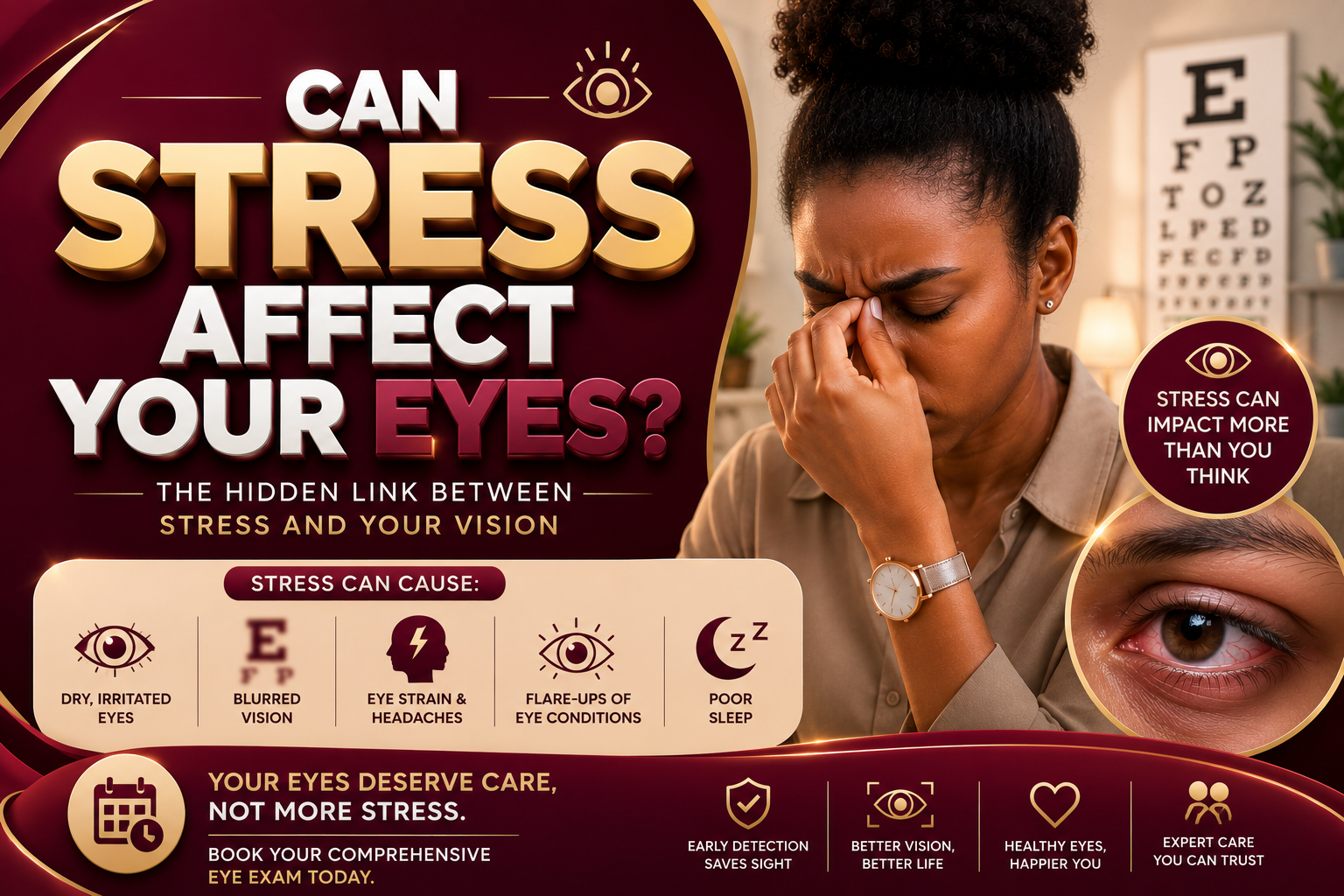
Can Stress Cause Blurry Vision?
Can Stress Cause Blurry Vision?
You have had a difficult week.
You are not sleeping properly.
Work has been overwhelming.
You have spent hours staring at your laptop and phone.
Then suddenly you notice:
“My vision feels blurry.”
“My eyes feel heavy.”
“My eyelid keeps jumping.”
“I keep getting headaches around my eyes.”
And you start wondering:
“Can stress really affect my eyes?”
The answer is:
Yes, stress can contribute to eye and vision symptoms.
But there is an important warning.
You should not automatically blame persistent or unusual vision changes on stress.
Stress may contribute to symptoms such as:
- Temporary blurry vision
- Eye strain
- Headaches
- Eyelid twitching
- Dry or irritated eyes
- Tired eyes
- Difficulty concentrating visually
But similar symptoms can also occur because of an incorrect glasses prescription, dry eye, migraine, diabetes-related changes or other eye and medical conditions.
So the goal is not to guess:
“This must be stress.”
The goal is to understand what is actually happening.
Quick Answer: Can Stress Cause Blurry Vision?
Stress can contribute to temporary blurry or uncomfortable vision, particularly when it is accompanied by:
- Poor sleep
- Fatigue
- Long hours on screens
- Headaches
- Reduced blinking
- Dry-eye symptoms
- Anxiety
Stress and fatigue are also recognised triggers for a common benign eyelid twitch called eyelid myokymia.
But persistent, sudden, painful or one-sided vision changes should not simply be blamed on stress.
Those symptoms deserve proper assessment.
Book Appointment
How Can Stress Affect My Eyes?
Stress rarely acts on the eyes in isolation.
Think about what often happens during a stressful period.
You may:
- Sleep less
- Spend longer working
- Drink more coffee
- Spend more time on your phone
- Take fewer breaks
- Concentrate intensely
- Blink less completely
- Develop headaches
- Feel mentally and physically exhausted
Several of those things can affect how comfortable and clear your vision feels.
That is why someone can genuinely notice more eye symptoms during stressful periods without stress necessarily being the only cause.
Why Does My Vision Become Blurry When I'm Stressed?
There are several possible explanations.
You May Be Tired
Fatigue can make visual tasks feel harder.
You may struggle to maintain concentration, particularly after long periods of reading or computer work.
Your Eyes May Be Dry
When you concentrate on screens, you may blink less or blink incompletely.
The National Eye Institute notes that prolonged screen viewing can reduce blinking and contribute to dry eye.
An unstable tear film can cause:
- Fluctuating blur
- Burning
- Grittiness
- Watering
- Heavy eyes
A useful clue is:
Blur → blink → vision becomes clearer → blur returns.
If that describes your vision, read Why Does My Vision Go Blurry Then Clear Again?.
You May Be Experiencing Digital Eye Strain
Long periods on computers, phones and tablets can cause:
- Blurred vision
- Eye strain
- Dry eyes
- Headaches
- Tired eyes
These are recognised symptoms of digital eye strain.
Stressful periods often mean longer working hours, so the two problems can easily occur together.
Read Why Do My Eyes Feel Tired After Using a Computer?.
Can Anxiety Cause Blurry Vision?
Anxiety and stress can sometimes occur alongside temporary changes in how people experience their vision.
But there is an important rule:
Do not diagnose anxiety simply because an eye examination has not yet been done.
If the blur is:
- Persistent
- Getting worse
- Affecting only one eye
- Associated with pain
- Associated with flashes or floaters
- Accompanied by neurological symptoms
then the cause needs proper investigation.
Can Stress Change My Glasses Prescription?
Usually, stress itself does not permanently change your refractive prescription.
You may feel that your glasses have suddenly become weaker because:
- Your eyes are dry
- You are fatigued
- Your focusing system is tired
- Your vision is fluctuating
- Your actual prescription has changed for another reason
So if your glasses suddenly feel wrong, do not immediately order stronger lenses.
Have the reason checked first.
If the numbers on your prescription actually keep changing, read Why Do I Keep Changing My Glasses Prescription?.
Why Do My Eyes Feel Heavy When I'm Stressed?
Heavy or tired eyes can occur after:
- Poor sleep
- Prolonged screen use
- Reading
- Dry eye
- General fatigue
Stress often brings several of these together.
You may spend the whole day working while exhausted, then continue using your phone at night.
By evening, your eyes feel as though they simply want to close.
If this happens regularly, read Why Do My Eyes Feel Heavy All the Time?.
Why Do My Eyes Hurt After a Stressful Day?
Pain or discomfort around the eyes can have several causes.
Possible contributors include:
- Headaches
- Migraine
- Digital eye strain
- Dry eye
- An uncorrected prescription
- Long periods of near work
- Lack of sleep
So I would not automatically say:
“The stress tightened your eye muscles.”
The better question is:
What kind of pain are you actually experiencing?
For example:
Is the pain:
- Inside the eye?
- Around the eyebrow?
- Behind the eye?
- Associated with headache?
- Associated with redness?
- Worse after using a computer?
- Associated with blurred vision?
Those details matter.
Why Does My Eyelid Keep Twitching When I'm Stressed?
This one has a much clearer connection.
A common eyelid twitch is called eyelid myokymia.
That simply means small involuntary contractions of the eyelid muscle.
Common triggers include:
- Stress
- Anxiety
- Fatigue
- Lack of sleep
- Caffeine
- Prolonged screen time
Most cases are harmless and settle by themselves.
You may notice:
“My lower eyelid keeps jumping.”
or:
“It feels like something is vibrating in my eye.”
Usually, reducing the trigger helps.
When Should I Worry About an Eye Twitch?
Arrange an assessment if the twitch:
- Persists for several weeks
- Becomes increasingly severe
- Causes the eyelid to close forcefully
- Spreads to other parts of the face
- Occurs with weakness or other neurological symptoms
- Is associated with significant eye problems
An ordinary occasional twitch after several sleepless nights is very different from persistent abnormal facial movement.
Does Coffee Make Eye Twitching Worse?
It can.
Caffeine is one of the recognised triggers associated with eyelid myokymia.
If you are:
- Very stressed
- Sleeping poorly
- Drinking several cups of coffee or energy drinks
- Spending all day on screens
you may be stacking several triggers together.
Reducing caffeine and improving sleep may help.
Can Stress Cause Dry Eyes?
The relationship is not as simple as:
Stress = dry eye.
But stress and dry-eye symptoms can occur together.
Stressful periods often involve:
- Poor sleep
- Long screen hours
- Reduced blinking
- Air-conditioned environments
- Less attention to breaks
Screen viewing itself can reduce blinking and contribute to dry eye.
Dry eyes may then cause:
- Burning
- Grittiness
- Watering
- Temporary blur
- Tired eyes
- Difficulty reading
Why Are My Eyes Watering If Stress Is Making Them Dry?
Dry eyes can paradoxically become watery.
When the eye surface becomes irritated, the eyes can produce extra reflex tears.
These tears may run down your face without correcting the underlying tear-film problem.
So you can genuinely say:
“My eyes are watering but they still feel dry.”
If watering happens especially while reading, see Why Do My Eyes Water When I Read?.
Stress and Screens: Why They Often Come Together
For many people, the bigger problem is not stress alone.
It is:
Stress + screens + poor sleep + no breaks.
Imagine an Abuja office worker who begins work at 8 am.
Laptop all morning.
WhatsApp throughout the day.
Phone during lunch.
More laptop work.
Traffic home.
Phone again before sleeping.
Then six hours of sleep.
The next morning, it starts again.
The person may develop:
- Headaches
- Dry eyes
- Blurry vision
- Burning
- Heavy eyes
- Eyelid twitching
It is tempting to call everything:
“stress.”
But the visual workload may also be contributing.
Does Stress Permanently Damage Your Eyes?
Ordinary day-to-day stress is not something we should routinely describe as permanently damaging the eyes.
Many stress-associated symptoms are temporary.
But that does not mean persistent visual symptoms should be ignored.
There are also specific medical conditions that can be associated with physiological stress, so “it's only stress” should never be used as a diagnosis without appropriate assessment.
Can Stress Cause Glaucoma?
I would be very careful with this claim.
Stress is not the way we normally explain why someone develops glaucoma.
Glaucoma has established risk factors including:
- Age
- Family history
- Eye pressure
- Optic-nerve characteristics
- Other individual factors
Someone with blurry vision during a stressful period should therefore not be told:
“Stress is giving you glaucoma.”
And someone who already has glaucoma should not be told that reducing stress replaces glaucoma treatment.
If you are concerned about glaucoma, read How Do I Know If I Have Glaucoma?.
Can Stress Cause Cataracts?
Stress should not be presented as a common direct cause of cataracts.
Cataract has other established risk factors and usually develops gradually.
The reason cataract matters in this article is different:
Cataract can also cause blurry vision.
So a person should not repeatedly blame persistent blur on stress without having the eye examined.
Book Appointment
What About Diabetes?
Diabetes can cause blurry or fluctuating vision.
Changes in blood sugar can temporarily affect how the natural lens focuses, while diabetes can also damage the retina over time.
That is very different from stress-related visual discomfort.
If you live with diabetes and your vision changes, do not assume stress is the explanation.
Read Can Diabetes Affect My Eyes Even If I Can See Clearly?.
How Do I Know If My Blurry Vision Is Stress or Something Else?
You usually cannot know with certainty just from the symptom.
Consider these questions:
Does it mainly happen after long screen use?
Does it improve after blinking or resting?
Does it happen during particularly stressful periods?
Is it in both eyes?
Is the vision completely normal at other times?
Those patterns may point toward fatigue, dry eye or digital strain.
But be more cautious if the blur is:
- Persistent
- Progressive
- Sudden
- Mainly in one eye
- Associated with pain
- Associated with distortion
- Associated with flashes or many new floaters
That deserves examination.
What Can I Do If Stress Is Making My Eyes Feel Worse?
Start with simple things.
Get Enough Sleep
Poor sleep can worsen fatigue, headaches and eyelid twitching.
Take Screen Breaks
Use the 20-20-20 rule:
Every 20 minutes, look about 20 feet away for at least 20 seconds.
This is commonly recommended for digital eye strain.
Blink Properly
Do not simply stare at the screen for long uninterrupted periods.
Blink fully and naturally.
Reduce Excessive Caffeine
Particularly if eyelid twitching is your main complaint.
Improve Your Screen Setup
Avoid unnecessary glare and extremely close viewing distances.
Do Not Ignore Your Prescription
If you are straining because you cannot see properly, rest alone will not correct the prescription.
Manage the Stress Itself
Exercise, sleep, rest, time away from work and appropriate mental-health support may all be useful depending on what is causing your stress.
Eye care treats the eye problem.
It should not pretend to replace appropriate care for significant anxiety or chronic stress.
Should I Use Eye Drops?
Do not automatically assume every stress-related eye symptom requires drops.
If dry eye is contributing, appropriate lubricating drops may help some people.
But eye drops will not correct:
- An incorrect glasses prescription
- Migraine
- Cataract
- Retinal disease
- Neurological problems
- Every cause of blurry vision
Treatment should match the cause.
When Should I Book an Eye Examination?
Arrange an examination if:
- Blur keeps returning
- Your glasses no longer seem clear
- One eye is worse
- You have persistent headaches with visual symptoms
- Your eyes remain painful or uncomfortable
- You experience significant night-driving problems
- Your symptoms continue even after the stressful period improves
- You are simply unsure what is causing the problem
You can see our guide to eye test costs in Abuja and what is included.
When Is Blurry Vision Urgent?
Do not wait for a routine appointment if you develop:
- Sudden significant vision loss
- A curtain or shadow over your vision
- A sudden shower of new floaters
- New flashes of light
- Severe eye pain
- A very red painful eye
- Sudden double vision
- Sudden vision problems with weakness, facial drooping or difficulty speaking
- Significant eye injury
Those symptoms should never simply be labelled:
“Stress.”
What Happens When We Check Stress-Related Eye Complaints?
At Blossom Vision Eye Clinic in Games Village, Abuja, the aim is not to look at you and say:
“You're stressed. Go home and sleep.”
We first need to determine if there is another explanation.
Depending on your complaint, the examination may assess:
- Visual acuity
- Glasses prescription
- Tear film and eye surface
- Eye movements and alignment
- Eye pressure
- Cornea
- Natural lens
- Retina
- Optic nerve
- Other areas where clinically appropriate
Only after examining the eyes can we make a sensible judgment about whether fatigue, dry eye, digital strain, prescription problems or another condition may be contributing.
Frequently Asked Questions
Can stress cause blurry vision?
Stress can contribute to temporary visual symptoms, especially when combined with fatigue, poor sleep, digital eye strain or dry eye. Persistent or sudden blurry vision should still be assessed.
Can anxiety affect my eyesight?
Anxiety can occur alongside temporary visual symptoms and may make people more aware of visual discomfort. Do not assume anxiety is the cause of persistent vision changes without appropriate assessment.
Can stress change my glasses prescription?
Stress does not usually permanently change your prescription, although fatigue, dry eye and focusing changes can make vision feel different temporarily.
Why does my eyelid twitch when I'm stressed?
Stress, anxiety, fatigue, lack of sleep, caffeine and screen use are recognised triggers for benign eyelid myokymia.
Can lack of sleep affect my eyes?
Poor sleep can contribute to fatigue, headaches and eyelid twitching and may worsen how comfortable your eyes feel.
Can stress make my eyes dry?
Stressful periods often involve behaviours that worsen dryness, including prolonged screen use, reduced blinking and poor sleep. Long screen use itself is recognised as a contributor to dry eye.
Can stress cause headaches around my eyes?
Stress and visual strain can both occur with headaches. Persistent, severe or unusual headaches, particularly with visual changes or neurological symptoms, need proper assessment.
Can stress make my glasses stop working?
It can make your vision feel less comfortable or more variable, but persistent blur through your glasses should be investigated rather than assumed to be stress.
Does stress cause glaucoma?
Stress should not be described as a simple direct cause of glaucoma, and stress management does not replace proper glaucoma assessment or treatment.
Should I get my eyes checked if I think the problem is stress?
If the symptoms are persistent, recurrent, new or affecting your daily activities, an eye examination is sensible.
Where can I get blurry vision checked in Abuja?
Blossom Vision Eye Clinic provides comprehensive eye examinations in the Games Village/Kaura District area of Abuja.
Don't Let “It's Just Stress” Become a Diagnosis
Stress can make you feel terrible.
And it can contribute to genuine eye symptoms.
But these two statements can both be true:
Stress may be affecting how your eyes feel.
and
Your eyes still deserve to be checked if something has changed.
At Blossom Vision Eye Clinic in Games Village, Abuja, we can assess your vision, prescription and eye health before deciding what is actually causing the symptoms.
Sometimes the answer may genuinely be:
“Your eyes are healthy. Stress, poor sleep and digital eye strain are probably contributing.”
That can be reassuring.
But reassurance is much more valuable after the important eye problems have been appropriately considered.
If stress seems to be affecting your vision, book a comprehensive eye examination instead of guessing.