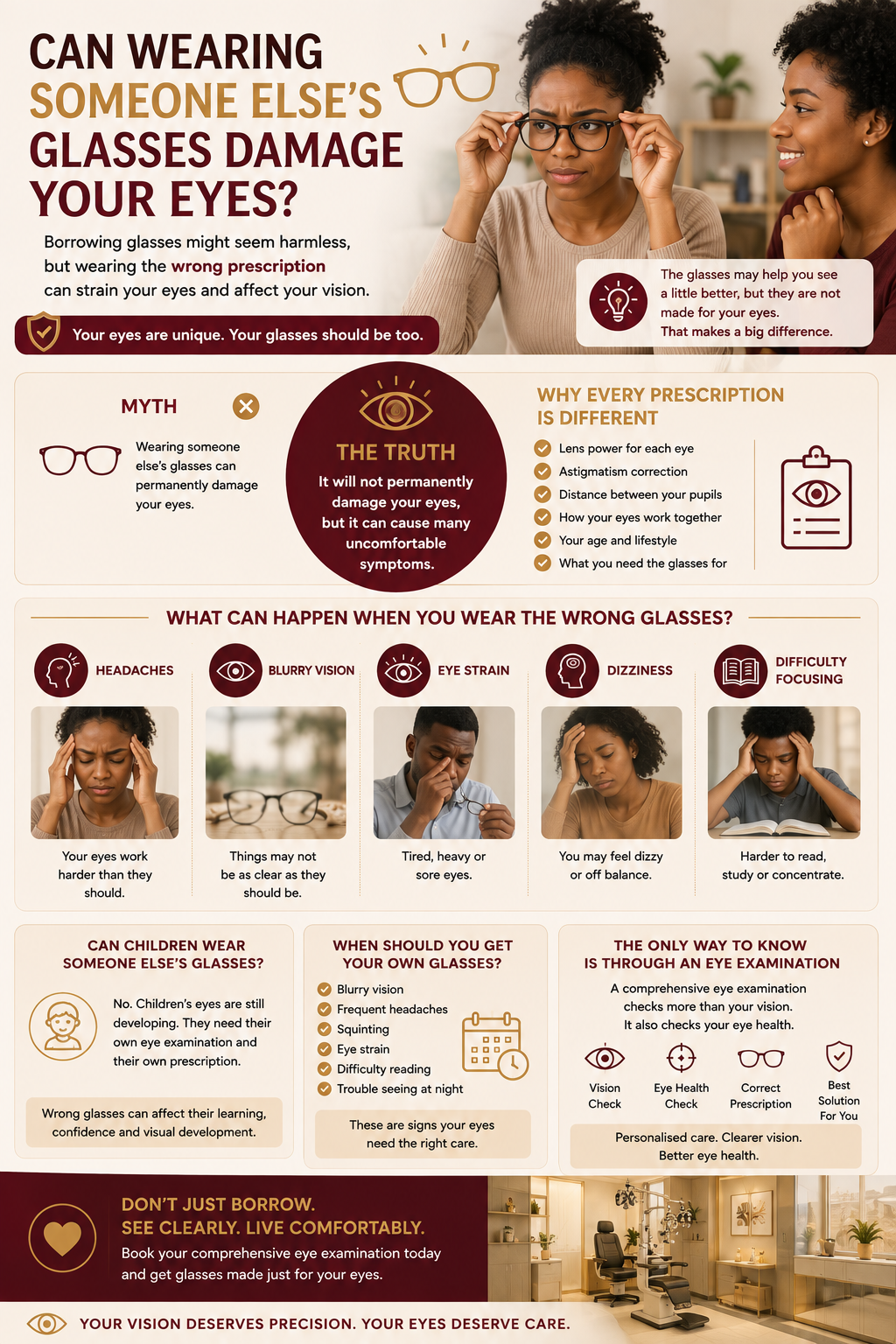
Can Wearing Someone Else's Glasses Damage Your Eyes?
Can Wearing Someone Else's Glasses Damage Your Eyes?
Maybe you forgot your glasses at home.
Your husband says:
“Just use mine.”
Or your friend hands you her glasses and suddenly you realise:
“Wait... I can actually see better with these.”
Now you are wondering:
“Does that mean we have the same prescription?”
Or more importantly:
“Can wearing someone else's glasses damage my eyes?”
The reassuring answer is:
Usually, no.
Briefly trying someone else's glasses is unlikely to permanently damage healthy adult eyes.
The glasses do not:
- Permanently change your prescription
- Make your eyes weak
- Make your eyes lazy
- Permanently reshape your eyes
But that does not mean somebody else's glasses are suitable for you.
An incorrect prescription may cause:
- Blurred vision
- Headaches
- Eye strain
- Dizziness
- Distorted vision
- Difficulty judging distances
- Uncomfortable reading
- Poor vision while driving
And the bigger problem is this:
Borrowed glasses may temporarily improve your vision while delaying you from finding out what your eyes actually need.
Quick Answer
Someone else's glasses usually will not permanently damage an adult's eyes.
However, you should not use borrowed prescription glasses as your regular glasses because:
- Their prescription may be different from yours
- Their two eyes may need different powers from your two eyes
- Their astigmatism correction may be wrong for you
- Their lenses may be centred differently
- They may be reading glasses when you need distance glasses
- They may make driving or walking unsafe
- They can hide the fact that your own vision has changed
For children, using somebody else's glasses instead of the child's prescribed correction is particularly inappropriate because children's vision is still developing.
Book Appointment
Why Is Every Glasses Prescription Different?
Your two eyes are not even guaranteed to have the same prescription.
So why would another person's eyes automatically match yours?
A spectacle prescription may include:
- Sphere
- Cylinder
- Axis
- Reading addition
- Prism in some cases
There are also measurements relating to how the lenses sit in front of your eyes.
One person may have:
Right eye: -1.00
Left eye: -1.25
while another person has:
Right eye: +1.00
Left eye: +2.00
Those are completely different visual needs.
What If Our Prescriptions Are Almost the Same?
Then their glasses may genuinely seem quite comfortable.
That can happen.
There is no rule saying two people can never have similar prescriptions.
But:
similar is not automatically identical.
And you cannot know just from saying:
“I can see through them.”
A proper refraction tells us what each of your eyes actually needs.
Why Can My Friend's Glasses Make Me See Better?
This is one of the most interesting parts.
Suppose you are short-sighted but have never had an eye examination.
Your friend is also short-sighted.
You put on your friend's glasses.
Suddenly:
the television becomes clearer.
Faces across the room look sharper.
Road signs improve.
You naturally think:
“These glasses are perfect for me.”
Maybe they are close.
But all you have discovered is:
some optical correction makes you see better.
You still do not know your exact prescription.
For example, perhaps you need:
-1.50
while your friend's glasses are:
-2.50.
You may still see more clearly than without glasses, but that does not mean -2.50 is the appropriate prescription for you.
Can Someone Else's Glasses Make My Vision Worse While I'm Wearing Them?
Yes.
If the prescription is very different from yours, everything may become:
- Blurry
- Distorted
- Magnified
- Minified
- Tilted
- Uncomfortable
Take the glasses off and your vision should generally return to how it was before.
The glasses have not normally damaged the eye.
They simply produced an unsuitable optical image while you were wearing them.
Can Wearing the Wrong Glasses Permanently Worsen My Eyesight?
For most healthy adults:
No.
Wearing an incorrect prescription does not normally permanently change the underlying refractive error.
It can make you feel uncomfortable while wearing it.
Possible symptoms include:
- Headaches
- Blur
- Eyestrain
- Dizziness
- Nausea in some people
- Difficulty concentrating visually
But when the glasses are removed, those optical effects usually disappear.
Will Wearing Someone Else's Strong Glasses Make My Eyes Become Dependent on Them?
No.
Glasses do not train adult eyes to become permanently dependent on a stronger prescription.
Suppose your friend wears:
-4.00
and you actually need:
-1.00.
Wearing their -4.00 glasses does not gradually convert your eyes into -4.00 eyes.
You may simply see poorly or feel uncomfortable through them.
Why Do Some People Feel Dizzy in Someone Else's Glasses?
Different prescriptions change the way images appear.
Strong differences can alter:
- Apparent size
- Position
- Depth perception
- Spatial orientation
Someone may put on borrowed glasses and say:
“The floor looks strange.”
or:
“I feel taller.”
or:
“Everything looks as if it is moving.”
This can be especially noticeable with:
- Strong prescriptions
- Significant astigmatism
- Large prescription differences
- Progressive lenses
- Prism lenses
If the glasses make you dizzy, do not keep walking around hoping your brain will eventually accept somebody else's prescription.
Take them off.
Can Borrowed Glasses Cause Headaches?
They can contribute to headaches or visual discomfort.
For example, the prescription may be:
- Too strong
- Too weak
- Wrong for one eye
- Wrong astigmatism correction
- Designed for the wrong working distance
But headaches have many causes.
So if headaches are frequent, do not assume:
“I just need stronger glasses.”
An eye examination can determine whether vision is actually contributing.
What About Astigmatism?
This is a major reason someone's glasses may not suit you.
Astigmatism prescriptions include:
cylinder
and:
axis.
The axis can be completely different between two people.
So even if the spherical power appears similar, the glasses may still feel wrong.
For example:
Your friend's prescription may include:
CYL -2.00 AXIS 180
while yours needs:
CYL -0.75 AXIS 90.
Those are not interchangeable.
If you have been told you have astigmatism, use the prescription measured for your own eyes rather than somebody else's.
Why Does One Lens Sometimes Feel Better Than the Other?
Because your two eyes may have different needs.
Someone else's right lens may accidentally be close to your prescription while their left lens is completely wrong.
If you regularly notice that one eye is significantly less clear than the other, read Why Is One Eye Blurrier Than the Other?.
Do not simply compensate by borrowing whichever pair seems strongest.
Can I Borrow Someone's Reading Glasses?
This is slightly different.
Ready-made reading glasses are already designed as general-purpose near correction.
People over 40 with simple presbyopia sometimes use the same reader strength.
For example:
You and your spouse might both find:
+1.50
comfortable for reading.
Briefly sharing them is unlikely to cause harm.
But prescription reading glasses may contain:
- Different powers between the two eyes
- Astigmatism correction
- Different near additions
So someone's custom reading glasses are not automatically appropriate for you.
Why Can My Mother's Reading Glasses Help Me?
Perhaps you also have an uncorrected near-vision problem.
Or perhaps the lenses provide magnification that temporarily makes small print easier.
But again:
“I see better” does not automatically mean “this is my prescription.”
If reading is becoming difficult, especially after age 40, have your own near vision assessed.
Can I Borrow Someone's Distance Glasses?
You can physically try them.
But using them regularly without knowing your prescription is not sensible.
Distance glasses may contain correction for:
- Myopia
- Hyperopia
- Astigmatism
- Prism
If they are wrong for you, distance vision may actually become worse.
Can I Drive Wearing Someone Else's Glasses?
This is where the answer becomes much firmer.
Do not drive in glasses that do not give you reliably clear, comfortable vision.
Even though the glasses may not permanently damage your eyes, they may impair:
- Distance clarity
- Depth perception
- Judgement of other vehicles
- Road-sign visibility
- Night vision
Someone else's glasses are not worth taking that risk.
If night driving itself is your problem, read Why Do Headlights Blind Me at Night?.
What About Progressive or Varifocal Glasses?
These are especially unsuitable for casual sharing.
Progressive lenses contain different powers in different parts of the lens for:
- Distance
- Intermediate vision
- Near vision
They are also fitted according to the individual wearer's:
- Prescription
- Pupil position
- Frame
- Fitting height
So your friend's varifocals may feel extremely strange even if you are approximately the same age.
Do not interpret difficulty seeing through somebody else's progressive lenses as proof that:
“Varifocals don't work for me.”
They were not made for you.
Can I Wear My Husband's or Wife's Glasses if We Have the Same Power?
If you genuinely have the same measured prescription, the optical powers may be similar.
But there can still be differences in:
- Pupillary distance
- Frame position
- Astigmatism
- Fitting measurements
- Lens design
So even couples should have individual prescriptions.
Your marriage may be shared.
Your spectacle prescription is not.
Can I Wear My Old Glasses Instead of Someone Else's?
An older pair of your own glasses may be a better temporary backup than somebody else's glasses, depending on how much your prescription has changed.
But if your old glasses no longer give useful vision, do not simply alternate between random pairs.
If you keep changing prescriptions or older glasses quickly stop working, read Why Do I Keep Changing My Glasses Prescription?.
Book Appointment
What If My Own Glasses Don't Work Anymore?
This is where borrowing often begins.
You say:
“My glasses aren't clear anymore, but my sister's are better.”
That is a clue.
It may mean your prescription changed.
But other possibilities include:
- Dry eye
- Cataract
- Diabetes-related visual changes
- Corneal problems
- Retina or optic-nerve problems
- Incorrect lens manufacture
- Lens damage
If your own glasses no longer provide clear vision, read Why Can't I See Clearly Even With My Glasses?.
Do not assume the solution is automatically:
“Find someone with stronger glasses.”
Can Someone Else's Glasses Hide an Eye Problem?
They cannot physically hide disease.
The problem is that borrowed glasses may delay you from seeking an examination.
Imagine:
Your vision gradually becomes blurry.
You borrow someone's glasses.
You see a little better.
So you conclude:
“I just need new glasses.”
But the original blur may be coming from something else.
That is why changing vision deserves an explanation.
What If My Vision Keeps Going Blurry and Clear?
That pattern may not simply mean you need another person's glasses.
Fluctuating vision can occur with:
- Dry eye
- Tear-film instability
- Blood-sugar changes
- Other eye conditions
Read Why Does My Vision Go Blurry Then Clear Again?.
If your vision changes from minute to minute or hour to hour, repeatedly changing spectacle power may not solve the real problem.
What If I Have Diabetes?
Be particularly careful about guessing your prescription when vision is changing.
Blood-glucose changes can sometimes temporarily change refraction.
Diabetes can also affect the retina.
If you have diabetes and notice changing vision, read Can Diabetes Affect My Eyes Even If I Can See Clearly?.
Do not simply borrow stronger glasses each time things look blurry.
Can Children Wear Someone Else's Glasses?
Children should have their own visual assessment and prescription.
Do not give a child:
- An older sibling's glasses
- A cousin's old glasses
- Your own glasses
- A random pair because they “seem to work”
Children's vision is still developing.
A child may have:
- Myopia
- Hyperopia
- Astigmatism
- Different prescriptions between the eyes
- Amblyopia
- Eye-alignment problems
And children often cannot accurately tell you:
“This prescription is slightly wrong.”
Will Borrowed Glasses Permanently Damage a Child's Eyes?
Briefly trying somebody else's glasses is unlikely to suddenly damage the eyes.
The bigger concern is using inappropriate glasses instead of correcting the child's actual visual problem.
Significant uncorrected refractive error during childhood can interfere with normal visual development and contribute to amblyopia in some children.
So if a child cannot see properly:
do not experiment with another child's glasses.
Have the child assessed.
If you are unsure whether your child needs glasses, read How Do I Know If My Child Needs Glasses?.
What If My Child Says Their Friend's Glasses Make Them See Better?
Take that information seriously.
It does not mean:
“Buy the same prescription.”
It means:
“This child may have an uncorrected vision problem.”
Arrange an eye examination.
The correct prescription could be completely different from the friend's.
Can Wearing Someone Else's Glasses Cause Lazy Eye?
In an adult:
No.
You do not develop amblyopia because you borrowed somebody else's glasses for an afternoon.
Amblyopia is a problem of visual development that begins in childhood.
In children, however, the important issue is making sure significant refractive errors are appropriately corrected while the visual system is still developing.
Can I Damage My Eyes by Trying Glasses in an Optical Shop?
No.
Trying a frame or briefly looking through demonstration lenses does not permanently damage your eyes.
Likewise, trying on your friend's glasses for a moment is generally not dangerous.
The concern is regularly using a prescription that was never intended for you.
Can Wearing Strong Glasses Make My Prescription Increase?
No.
A stronger pair does not physically force your adult eye to become that prescription.
If your prescription increases naturally over time, that change is occurring because of the eye's refractive development or another underlying factor, not because you briefly wore someone's stronger glasses.
Can Someone Else's Glasses Cause Eye Strain?
They can contribute to visual discomfort.
This is particularly true if you are trying to perform:
- Reading
- Computer work
- Driving
- Detailed tasks
through an unsuitable prescription.
If screen work is already making your eyes tired, read Why Do My Eyes Feel Tired After Using a Computer?.
The solution is not simply borrowing your colleague's computer glasses.
How Do I Know Whether I Actually Need Glasses?
Possible signs include:
- Blurry distance vision
- Difficulty reading
- Squinting
- Frequent visual discomfort
- Difficulty recognising distant details
- Trouble driving at night
- One eye seeing differently from the other
But symptoms alone cannot tell you the exact prescription.
A refraction measures it.
What Happens During an Eye Examination?
At Blossom Vision Eye Clinic in Games Village, Abuja, the goal is not simply to find:
“the strongest lens that makes you see.”
We determine the prescription that provides appropriate, comfortable vision.
Depending on your needs, the assessment may include:
- Visual acuity
- Refraction
- Comparison of the two eyes
- Eye-pressure measurement
- Slit-lamp examination
- Retina and optic-nerve assessment
- Eye alignment or binocular-vision assessment where appropriate
- Additional tests where clinically indicated
This helps answer:
Do you actually need glasses?
What power does each eye need?
Is astigmatism present?
Has your prescription changed?
Is something besides prescription affecting your vision?
Do I Need New Glasses Every Time My Prescription Changes Slightly?
Not automatically.
Very small prescription differences do not always mean a new pair is necessary.
The decision depends on:
- How much the prescription changed
- Your symptoms
- Current visual acuity
- What you use the glasses for
- Whether your current lenses remain comfortable
- Your eye health
A prescription should guide a sensible decision, not automatically create a sale.
How Much Does an Eye Examination Cost in Abuja?
If you want to know our current examination charges before coming in, see eye test costs in Abuja and what is included.
Frequently Asked Questions
Can wearing someone else's glasses damage my eyes?
Usually not permanently, particularly if you are an adult and only try them briefly. But an unsuitable prescription can cause blur, headaches, dizziness and visual discomfort.
Can someone else's glasses make my eyesight worse?
They may make your vision worse while you are wearing them, but they do not usually permanently worsen an adult's underlying prescription.
Why can I see better with my friend's glasses?
You may have a refractive error similar to part of their prescription. That is a useful clue that you may need glasses, but it does not tell you your exact prescription.
Is it okay to wear someone else's glasses for one day?
Briefly using them is unlikely to permanently damage healthy adult eyes, but avoid using them for activities such as driving if they do not provide reliably clear and comfortable vision.
Can borrowed glasses cause headaches?
Yes. An unsuitable prescription may contribute to headache, blur or visual discomfort.
Can wearing stronger glasses make my eyes weak?
No. Stronger glasses do not automatically weaken adult eyes or permanently increase your prescription.
Can someone else's glasses make me dizzy?
Yes. Strong prescription differences, astigmatism, prism or progressive lenses may produce spatial distortion or dizziness.
Can I drive with my friend's glasses?
Do not drive in glasses that were not prescribed for you unless you know they provide appropriate legal and comfortable driving vision. In practice, use your own correctly prescribed distance correction.
Can I use someone else's reading glasses?
Some simple ready-made reading powers may work for more than one person, but someone's customised prescription reading glasses may not suit your eyes.
Can husband and wife share glasses?
You may coincidentally have similar prescriptions, but each person should have an individual eye examination and prescription.
Can children share glasses?
Children should wear glasses appropriate to their own prescription. Significant uncorrected refractive error during childhood can interfere with visual development.
What if my child sees better through another child's glasses?
Arrange an eye examination. Do not simply copy the other child's prescription.
Why can't I see through my own glasses anymore?
Your prescription may have changed, but dry eye, cataract, corneal problems, retinal problems and other conditions can also affect vision. Read Why Can't I See Clearly Even With My Glasses?.
What if one eye needs stronger glasses?
That is common. The two eyes can have different prescriptions. Read Why Is One Eye Blurrier Than the Other?.
Where can I check my glasses prescription in Abuja?
Blossom Vision Eye Clinic provides comprehensive optometric eye examinations and refraction in the Games Village/Kaura District area of Abuja.
Your Friend's Glasses Can Give You a Clue. They Cannot Give You a Diagnosis.
If you put on someone's glasses and suddenly think:
“Wow, I can see!”
that information can be useful.
It may mean:
you probably need your own vision checked.
But do not stop there.
The other person's:
power
astigmatism
right-eye prescription
left-eye prescription
and:
lens measurements
were designed for their eyes.
Not yours.
At Blossom Vision Eye Clinic in Games Village, Abuja, we can determine exactly what each of your eyes needs and check whether anything besides prescription is affecting your vision.
If your friend's glasses help:
bring that information.
If your own glasses have stopped working:
bring those too.
But the goal should not simply be:
“Give me what my friend is wearing.”
The goal is:
“Find out what gives my own eyes clear, comfortable vision.”
Your friend's glasses may be close. Your own prescription should be correct.