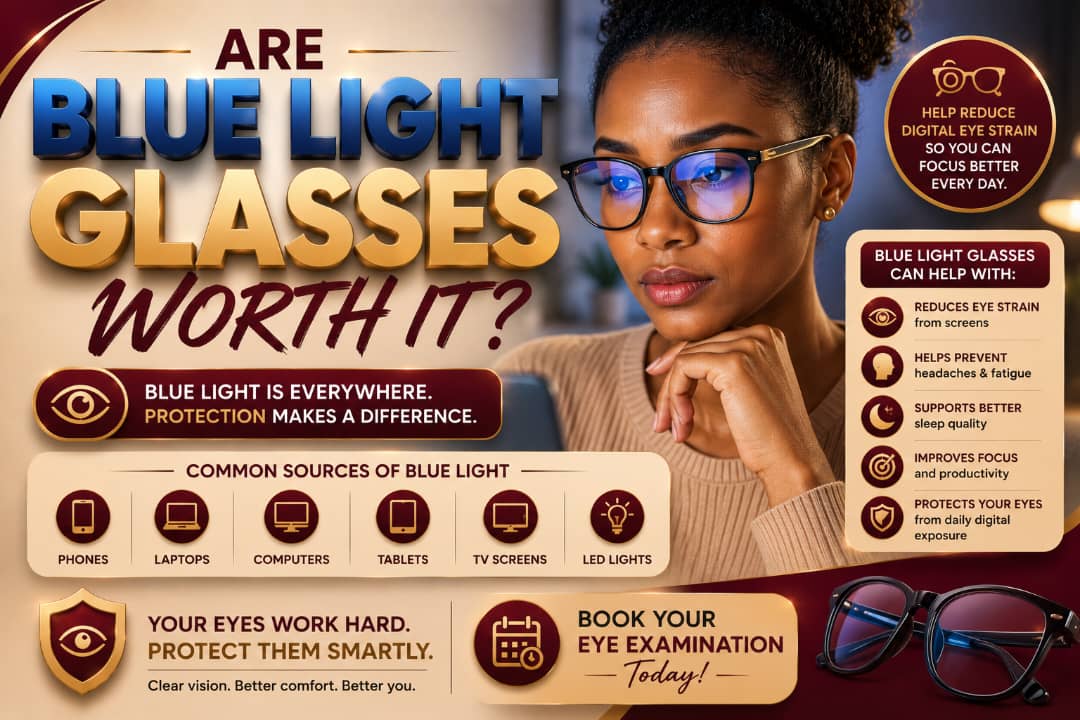
Do Blue Light Glasses Really Work?
Blue light glasses are popular, but they're not the miracle solution many advertisements claim. Current research suggests they may not significantly reduce digital eye strain for most people. However, reducing screen time before bed, taking regular breaks, and ensuring you have the correct prescription are far more effective ways to keep your eyes comfortable.
Do Blue Light Glasses Really Work?
You spend most of your day looking at screens.
Laptop at work.
Phone during lunch.
WhatsApp throughout the day.
Television in the evening.
Then your phone again in bed.
Your eyes start feeling tired and you think:
“Maybe I need blue light glasses.”
You search online and see claims such as:
“Protect your eyes from harmful screen light.”
“Stop headaches.”
“Prevent eye strain.”
“Sleep better.”
So you start wondering:
Do blue light glasses actually work?
The short answer is:
Not as well as the marketing sometimes suggests.
Current research does not show a meaningful short-term reduction in computer-related eye strain from blue-light filtering glasses compared with ordinary lenses.
There is also no good clinical evidence that normal screen use is damaging your retina because of the blue light coming from your phone or computer.
And the evidence that blue-light filtering glasses improve sleep remains uncertain.
That does not mean nobody should ever buy them.
It means you should know exactly what you are paying for and what the lenses can realistically do.
Quick Answer: Are Blue Light Glasses Worth It?
If you are buying blue-light glasses because you believe they will:
- Prevent screen-related eye damage
- Cure digital eye strain
- Stop headaches
- Protect your retina
- Guarantee better sleep
then the current evidence does not strongly support those promises.
If you personally prefer the appearance or visual experience of a particular lens, that is different.
But blue-light filtering should be presented as an optional lens feature, not as something everybody who uses a computer medically needs.
If your eyes hurt, feel tired or become blurry after screen use, the more important question is:
Why are your eyes uncomfortable?
Book Appointment
What Is Blue Light?
Visible light contains different colours.
Blue light is simply one part of the visible-light spectrum.
And here is something many advertisements do not emphasise:
Your phone is not your biggest source of blue light.
The sun produces far more blue light than ordinary digital screens.
Phones, tablets, televisions and computer monitors also emit blue light, but at much lower levels.
Blue light itself is therefore not automatically something harmful that needs to be removed from your life.
Does Blue Light From Phones Damage Your Eyes?
Current clinical evidence does not show that the amount of blue light produced by normal digital-device use causes retinal damage in people.
That is an important distinction.
Screens can definitely make your eyes uncomfortable.
But:
Eye discomfort is not the same thing as eye damage.
The 2023 Cochrane review found no clinical trial evidence showing that blue-light filtering spectacle lenses protect macular health.
So we should not tell a patient:
“You need blue-light glasses to protect your retina from your laptop.”
That claim goes beyond the evidence.
Then Why Do My Eyes Hurt After Using a Computer?
This is where the real problem usually begins.
You may spend several hours:
- Staring at one distance
- Reading small text
- Concentrating intensely
- Blinking less
- Sitting in air conditioning
- Working without breaks
That can contribute to digital eye strain.
You may experience:
- Tired eyes
- Dry eyes
- Burning
- Headaches
- Temporary blurry vision
- Difficulty focusing
- Neck discomfort
- Shoulder discomfort
Blue light does not need to be the cause for all of these symptoms to be real.
If this describes you, read Why Do My Eyes Feel Tired After Using a Computer?.
What Actually Causes Digital Eye Strain?
Several things can contribute.
Reduced Blinking
People often blink less frequently or incompletely while concentrating on screens.
That can make the tear film unstable.
The result may be:
- Burning
- Dryness
- Watering
- Fluctuating vision
Long Periods of Close Work
Your visual system is spending long periods focusing at one distance.
This can become tiring, particularly if you already have an uncorrected prescription or focusing problem.
An Incorrect Glasses Prescription
Sometimes the computer is not really the main problem.
Your glasses prescription may simply be:
- Outdated
- Inaccurate
- Unsuitable for your working distance
Poor Screen Setup
Screen distance, glare, text size, seating position and lighting can all affect comfort.
Dry Environment
Fans and air conditioners can increase tear evaporation.
This is especially relevant for people who spend their entire working day in an air-conditioned Abuja office.
Do Blue Light Glasses Reduce Digital Eye Strain?
Based on the best available evidence:
probably not significantly for most people.
A Cochrane review looked at 17 randomised controlled trials involving 619 participants.
Blue-light filtering lenses did not appear to perform better than non-blue-light filtering lenses for reducing short-term eye strain associated with computer use.
That is important because “reduces digital eye strain” is one of the biggest reasons these lenses are marketed.
Some individuals may still report that they personally like wearing them.
That experience is valid.
But personal preference is different from proving that the blue-light filter itself is treating digital eye strain.
What If I Feel Better Wearing Blue Light Glasses?
That can happen.
There are several possible explanations.
Your glasses may also contain:
- Your correct prescription
- A good-quality lens
- An anti-reflective coating
- Better optical measurements
You may also have changed your screen habits at the same time.
So someone might genuinely say:
“My eyes feel better since I got these glasses.”
We do not need to tell them they are imagining it.
But scientifically, we cannot automatically conclude:
“The blue-light filter caused the improvement.”
That is an important distinction.
What Is the Difference Between Blue Light Filtering and Anti-Reflective Coating?
These are not the same thing.
Blue-Light Filtering
This reduces transmission of some wavelengths in the blue portion of visible light.
Anti-Reflective Coating
This is designed to reduce reflections from the surfaces of your spectacle lenses.
A person may buy glasses described casually as:
“Blue-cut glasses”
when the lens actually contains several different features.
So when comparing lenses, ask exactly what you are buying rather than assuming every coating does the same thing.
Do I Need Blue Light Glasses If I Work on a Computer All Day?
Not automatically.
Someone who works on a computer for eight hours may benefit much more from:
- The correct prescription
- An appropriate working distance
- Proper screen positioning
- Regular breaks
- Managing dry eye
- Increasing text size
- Appropriate lighting
than from simply adding a blue-light filter.
If you are having symptoms, first determine why.
What Helps Digital Eye Strain More Than Blue Light Glasses?
Start with the basics.
Take Regular Breaks
A simple approach is the 20-20-20 rule.
Every 20 minutes, look at something around 20 feet away for approximately 20 seconds.
The main idea is simple:
Do not stare continuously at one close distance for hours.
Blink Properly
Make a conscious effort to blink fully when concentrating.
Increase Text Size
Do not force yourself to read tiny writing.
Position the Screen Comfortably
Your monitor should be at a comfortable viewing distance and height.
Reduce Distracting Reflections
Position screens and lighting so that reflections do not make viewing unnecessarily uncomfortable.
Avoid Direct Airflow
Do not have the air conditioner or fan blowing directly across your eyes for hours.
Check Your Prescription
If you have an uncorrected refractive error, better screen habits alone may not solve your symptoms.
Treat Dry Eye When Present
Dry eye requires proper assessment and management rather than automatically adding a coloured or filtered lens.
Can Blue Light Glasses Stop Headaches?
Not reliably.
If you develop headaches after computer work, possible contributors include:
- Digital eye strain
- An incorrect prescription
- Astigmatism
- Focusing problems
- Migraine
- Poor posture
- Stress
- Other medical causes
Putting a blue-light filter in front of your eyes does not address all of these possibilities.
If headaches are your main problem, the better question is:
“Are my eyes contributing to my headaches?”
rather than:
“Which blue-light glasses should I buy?”
Can Blue Light Glasses Fix Blurry Vision?
No.
A blue-light filter is not a substitute for a correct prescription.
If you are:
- Short-sighted
- Long-sighted
- Astigmatic
- Developing presbyopia
you need the appropriate optical correction.
Adding a blue-light filter to an incorrect prescription does not make the prescription correct.
If you are blurry even with your existing glasses, read Why Can't I See Clearly Even With My Glasses?.
Book Appointment
Can Blue Light Glasses Help Me Sleep Better?
This is one area where the marketing needs caution.
Light exposure is involved in regulating the body's sleep-wake cycle.
But that does not automatically mean blue-light filtering glasses reliably improve sleep.
The current evidence from randomised trials is inconclusive. Some studies showed improvement in sleep measures while others did not.
So I would not promise a patient:
“Wear these glasses at night and you will sleep better.”
A simpler approach is to reduce unnecessary bright-screen exposure close to bedtime if you notice that late-night screen use interferes with your sleep.
Is Night Mode Better Than Blue Light Glasses?
Your phone's night mode changes the appearance and colour temperature of the display.
It may feel more comfortable in the evening for some people.
But neither night mode nor blue-light glasses should be treated as a medical cure for:
- Insomnia
- Digital eye strain
- Dry eye
- Headaches
- Blurry vision
If sleep is the main problem, your overall evening screen habits and sleep routine matter much more than buying glasses alone.
Do Children Need Blue Light Glasses?
There is currently no good reason to say:
“Every child using a tablet needs blue-light glasses.”
That is not supported by strong evidence.
Parents should focus on the things that matter more:
- Appropriate screen habits
- Regular breaks
- Outdoor activity
- Adequate sleep
- Comfortable working distances
- Proper vision assessment when needed
If your child:
- Squints
- Cannot see the board
- Holds objects very close
- Complains of blurry vision
- Has a worsening prescription
then the priority is an eye examination.
Read How Do I Know If My Child Needs Glasses?.
What About Myopia in Children?
This is another important distinction.
Some parents buy blue-light glasses because they believe they will stop their child's short-sightedness from getting worse.
Blue-light filtering glasses are not established myopia-control treatment.
If your child's prescription keeps becoming more short-sighted, the issue is myopia progression, not simply blue light.
Read How Can I Stop My Child's Eyesight From Getting Worse?.
Can Blue Light Glasses Prevent Macular Degeneration?
There is currently insufficient clinical evidence to recommend blue-light filtering spectacle lenses to prevent macular degeneration.
The Cochrane review found no randomised-trial evidence from which conclusions about macular protection could be made.
The College of Optometrists similarly states that the best scientific evidence does not support recommending these lenses to preserve macular health in the general population.
So this is another claim Blossom Vision should not use when selling lenses.
Are Blue Light Glasses a Scam?
I would not describe them that way.
Blue-light filtering technology is real.
The issue is the claims made about it.
There is a big difference between saying:
“This lens filters some blue light.”
and saying:
“You need this lens to protect your eyes from your phone.”
The first describes what the product does.
The second makes a health claim that is not strongly supported by current evidence.
The problem is therefore not necessarily the lens.
It is overselling what the lens can achieve.
So Why Does Blossom Vision Sell Blue-Cut Lenses?
Because patients can choose different lens features based on their preferences, prescription, lifestyle and budget.
But responsible eye care means explaining those features accurately.
At Blossom Vision, a blue-light filtering option should be presented as:
an optional lens feature
rather than:
a compulsory treatment for everybody who uses a screen.
If you want it, we can discuss it.
If you do not need or want it, we should not frighten you into buying it.
Should I Pay Extra for Blue Light Glasses?
Ask yourself:
What am I paying extra for?
If the answer is:
“Because someone told me my phone is destroying my retina,”
that is not a good reason based on current evidence.
If the lens package includes other features you value, or you personally prefer that lens, then you can make an informed choice.
The important thing is that the decision should be based on accurate information rather than fear.
What Should I Ask Before Buying Blue Light Glasses?
Ask:
Do I actually need a prescription?
What exactly does this lens filter?
Does it include anti-reflective coating?
What benefit are you claiming it provides?
Is that benefit supported by evidence?
What alternatives could solve my symptoms?
A good optical provider should be comfortable answering those questions.
Should I Buy Ready-Made Blue Light Glasses Online?
If you do not require a prescription and simply want a non-prescription cosmetic lens, that is your choice.
But if you are buying them because you have:
- Headaches
- Blurry vision
- Eye strain
- Difficulty focusing
- Tired eyes
- Night-driving problems
then buying random glasses online may miss the actual problem.
You may need:
- A prescription
- Dry-eye treatment
- Different screen habits
- An eye-health examination
What If My Eyes Are Tired Every Day?
Do not automatically blame blue light.
Ask:
How long am I using screens?
Am I blinking properly?
Is my prescription current?
Are my eyes dry?
Is my computer positioned properly?
Am I sleeping enough?
Do I have another eye problem?
That investigation is more useful than assuming every symptom has one cause.
When Should I Have My Eyes Checked?
Arrange an examination if you experience:
- Persistent blurry vision
- Frequent headaches
- Daily eye strain
- Eye pain
- Difficulty focusing
- One eye seeing worse
- Significant night-driving difficulty
- Symptoms that continue despite screen breaks
- A prescription that seems to keep changing
If you want to know the cost, read How Much Does an Eye Test Cost in Abuja?.
What Happens at Blossom Vision?
At Blossom Vision Eye Clinic in Games Village, Abuja, we do not want to begin with:
“Which lens can we sell you?”
We begin with:
“Why are your eyes uncomfortable?”
Depending on your symptoms, we may assess:
- Your vision
- Your glasses prescription
- Your eye health
- Tear film
- Screen habits
- Working distance
- Focusing needs
- Other findings where clinically appropriate
Then we can discuss the options that actually make sense.
Sometimes that may include a particular lens feature.
Sometimes it may simply mean correcting your prescription.
Sometimes dry eye is the real problem.
Sometimes your eyes are healthy and you mainly need better screen habits.
Frequently Asked Questions
Do blue light glasses really work?
Current evidence suggests blue-light filtering lenses probably do not meaningfully reduce short-term digital eye strain compared with ordinary lenses.
Are blue light glasses worth it?
They may be worth it if you understand what you are buying and personally value the lens feature. They should not be sold as a proven cure for eye strain or guaranteed protection against screen-related eye damage.
Can blue light from my phone damage my eyes?
There is no strong clinical evidence that normal digital-device blue-light exposure causes retinal damage that requires protection with blue-light filtering spectacles.
Do blue light glasses prevent eye strain?
The best available systematic-review evidence suggests they may not provide meaningful short-term improvement in computer-related eye strain compared with non-blue-light filtering lenses.
Do blue light glasses help headaches?
They are not a proven general treatment for headaches. Screen-related headaches may involve digital eye strain, prescription problems, migraine, posture or other causes.
Do blue light glasses help you sleep?
The evidence is currently uncertain. Randomised trials have produced mixed results.
Do children need blue light glasses?
Not routinely. Healthy screen habits, outdoor activity, adequate sleep and appropriate eye examinations are more important.
Do blue light glasses stop childhood myopia?
No. Blue-light filtering lenses are not an established myopia-control treatment.
Are anti-reflective lenses the same as blue light glasses?
No. Anti-reflective coatings reduce reflections from spectacle-lens surfaces, while blue-light filtering is designed to reduce transmission of selected blue wavelengths.
Should I buy blue light glasses without an eye test?
If you are experiencing persistent headaches, blur or eye strain, it is better to determine the cause before assuming a particular lens feature will solve the problem.
Where can I get advice about computer glasses in Abuja?
Blossom Vision Eye Clinic can assess your prescription, visual needs and screen-related symptoms in the Games Village/Kaura District area of Abuja.
Your Eyes Deserve Better Than Fear-Based Marketing
The answer to:
“Do blue light glasses work?”
is not simply:
Yes.
And it is not simply:
No.
Blue-light filtering lenses genuinely filter some blue light.
But the strongest available evidence does not show that this automatically means they prevent digital eye strain, protect your retina or reliably improve sleep.
So the better question is:
“What is actually causing my eye discomfort, and what solution makes sense for me?”
At Blossom Vision Eye Clinic in Games Village, Abuja, we would rather explain the evidence and let you make an informed decision than sell you a lens feature through fear.
If your eyes feel tired, dry, blurry or uncomfortable after screen use, book an eye examination and find out what is actually causing it.