How Can I Stop My Child’s Eyesight From Getting Worse?
How Can I Stop My Child’s Eyesight From Getting Worse?
If your child's glasses prescription seems to become stronger every year, you may be wondering:
“Is there anything I can actually do to stop this from getting worse?”
The answer is important.
We cannot promise to completely stop or cure childhood short-sightedness.
But in many children, myopia progression can be slowed with appropriate myopia-management strategies.
That is different from simply giving your child stronger ordinary glasses every time their prescription changes.
Modern children's eye care asks two questions:
1. How do we help this child see clearly today?
and
2. How can we reduce how quickly the myopia progresses while the child's eyes are still growing?
At Blossom Vision Eye Clinic in Abuja, this is the approach we take with children whose short-sightedness is progressing.
Quick Answer
If your child's eyesight is becoming more short-sighted every year, the first step is a proper children's eye examination.
Depending on your child's age, prescription, rate of progression and other risk factors, myopia management may involve:
- Correctly prescribed glasses
- More outdoor time
- Better near-work and screen habits
- Regular monitoring
- Special myopia-management spectacle lenses
- Other evidence-based treatments when clinically appropriate
One spectacle-lens option now available through Blossom Vision Eye Clinic is ZEISS MyoCare, a lens specifically designed for childhood myopia management.
Through our partnership with ZEISS, Blossom Vision can assess suitable children and dispense ZEISS MyoCare myopia-management lenses in Abuja.
Book Appointment
Why Does My Child's Glasses Prescription Keep Getting Stronger?
This is one of the most common questions parents of short-sighted children ask.
Myopia, or short-sightedness, usually happens because the eye grows too long from front to back while the child is growing.
When this happens, light focuses in front of the retina instead of directly on it.
The child may see nearby objects clearly but struggle to see things farther away.
As the eye continues to grow, the prescription can become more short-sighted.
This is called myopia progression.
So if your child's prescription changes from year to year, it does not necessarily mean the glasses caused the problem.
The underlying eye growth is usually the issue.
Do Stronger Glasses Make My Child's Eyes Weaker?
No.
This is a very common myth.
Correctly prescribed glasses do not make a child's eyes lazy or weaker.
The prescription becomes stronger because the child's myopia has changed.
The glasses simply correct the blur created by that myopia.
In fact, deliberately giving a child glasses that are too weak is not an appropriate way to control myopia.
Children should have the correction they need to see clearly.
The separate question is:
Can we also slow the underlying progression?
That is where myopia management becomes important.
What Is Myopia?
Myopia is also called:
- Short-sightedness
- Near-sightedness
A child with myopia usually sees close objects more clearly than objects farther away.
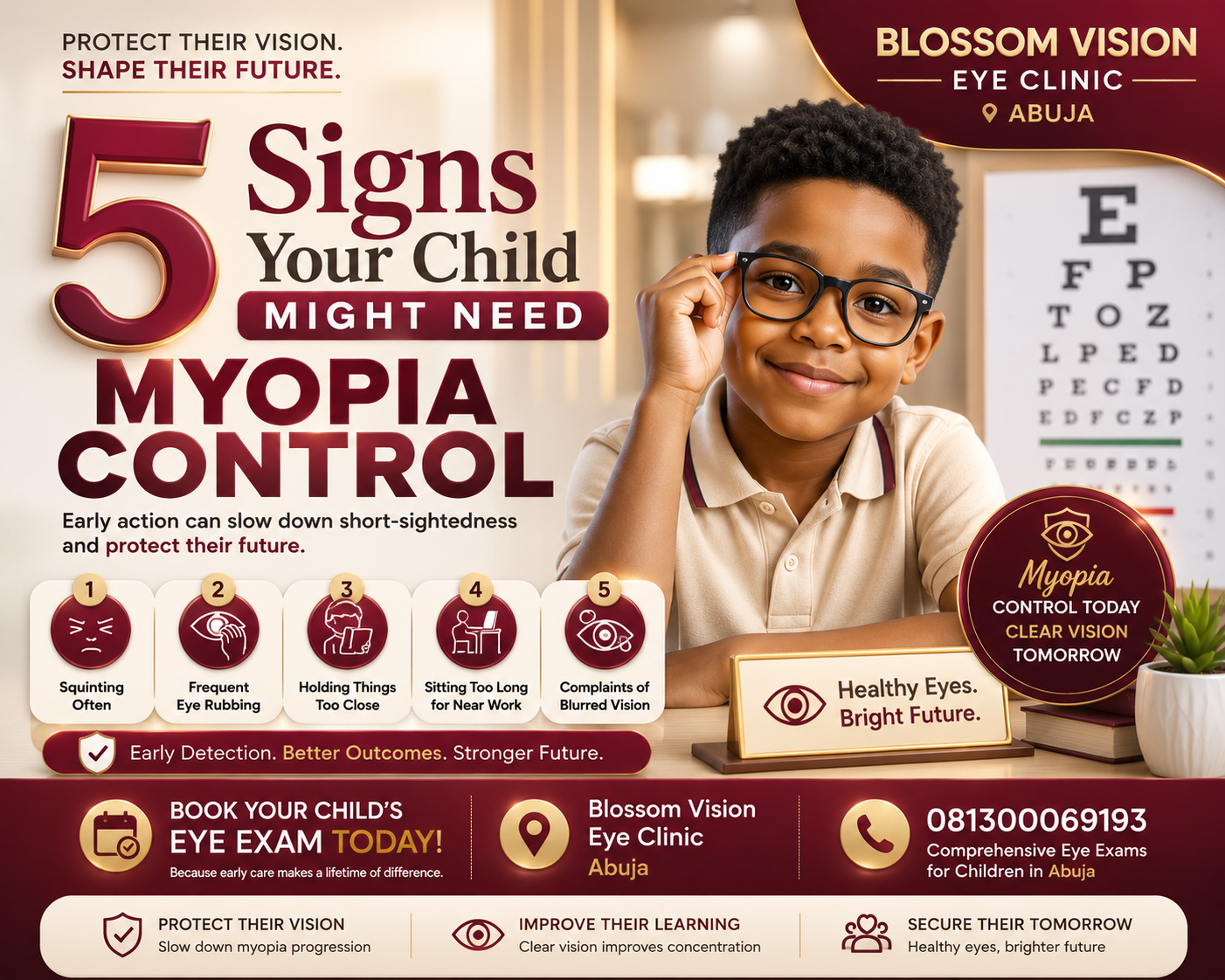
Possible signs include:
- Squinting at distant objects
- Difficulty seeing the classroom board
- Sitting close to the television
- Moving closer to distant objects
- Complaining that things far away look blurry
If you are still trying to work out whether your child may need glasses, read our guide on how to know if your child needs glasses.
If the first thing you noticed was your child constantly sitting near the television, read why your child may sit so close to the TV.
Can My Child's Short-Sightedness Get Worse?
Yes.
Myopia often progresses during childhood while the eyes are still growing.
The amount and speed of progression vary between children.
Some children's prescriptions change slowly.
Others progress considerably faster.
Factors that may influence risk include:
- Younger age when myopia begins
- Family history of myopia
- Previous rapid progression
- Large amounts of near work
- Limited outdoor time
- Other individual factors
This is why two children with the same prescription today may not necessarily have the same prescription several years from now.
Why Does Starting Myopia Young Matter?
A child who becomes short-sighted at a younger age has more years of eye growth ahead.
That can give the myopia more time to progress.
This does not mean every young child with myopia will develop very high myopia.
It does mean that earlier-onset myopia deserves proper attention and monitoring.
Instead of waiting until the prescription becomes very strong, we can assess the child earlier and discuss whether myopia management is appropriate.
Can Myopia Be Slowed Down?
Yes, myopia progression can often be slowed, although no treatment can guarantee that progression will stop completely.
Modern myopia management may involve different approaches depending on the child.
These include:
- Specially designed spectacle lenses
- Certain specialised contact lenses
- Orthokeratology in suitable cases
- Low-dose atropine under appropriate clinical care
- Healthy visual habits
- Outdoor time
- Regular monitoring
The correct option depends on the child's age, prescription, eye health, progression and family circumstances.
There is no single treatment that is automatically right for every child.
What Are Myopia-Control Glasses?
Ordinary single-vision glasses mainly do one job:
They correct the child's blurry distance vision.
Myopia-management spectacle lenses are designed to do something additional.
They provide clear central vision while using specially designed optical areas within the lens to influence the visual signals associated with excessive eye growth.
One example is ZEISS MyoCare.
ZEISS developed the MyoCare lens portfolio specifically for managing progressive myopia in children.
What Are ZEISS MyoCare Lenses?
ZEISS MyoCare lenses are special spectacle lenses designed for children with progressive myopia.
Unlike ordinary single-vision lenses, ZEISS MyoCare lenses combine:
A clear central viewing area
with
special optical structures surrounding that central area.
ZEISS calls this C.A.R.E. technology, which stands for Cylindrical Annular Refractive Elements.
In simple English, the lens contains tiny ring-shaped optical structures designed to help slow the excessive eye growth associated with myopia while still correcting the child's vision.
The lenses also use ZEISS ClearFocus design to provide clear and comfortable vision through different viewing directions.
ZEISS clinical studies have shown slower myopia progression in children wearing MyoCare lenses compared with children wearing ordinary single-vision spectacles.
Does ZEISS MyoCare Cure Myopia?
No.
This distinction is important.
ZEISS MyoCare is not a cure for myopia.
The child is still short-sighted and still needs vision correction.
The purpose of the lens is to:
correct the child's vision while helping slow further myopia progression.
We should therefore never tell parents:
“These glasses will stop your child's myopia.”
A better explanation is:
“These lenses are designed to reduce how quickly the myopia progresses.”
The amount of benefit can differ from one child to another.
Does My Child Need ZEISS MyoCare?
Not every child who wears glasses automatically needs a myopia-control lens.
We first need to know:
- Is the child actually myopic?
- How old is the child?
- When did the myopia begin?
- Has the prescription been increasing?
- How quickly is it progressing?
- Is there a family history of myopia?
- What are the child's visual habits?
- Is the child suitable for this particular approach?
That is why myopia management begins with an examination, not with ordering a lens.
Blossom Vision Eye Clinic × ZEISS MyoCare
Blossom Vision Eye Clinic works with ZEISS to make ZEISS MyoCare lenses available to appropriate children in Abuja.
This means parents do not simply buy a special pair of glasses off the shelf.
We first assess the child.
If ZEISS MyoCare is suitable, we can prescribe and dispense the appropriate MyoCare lens based on the child's findings.
This partnership allows Blossom Vision to combine:
Local children's eye care in Abuja
with
ZEISS myopia-management lens technology.
Parents who want to understand the technology in more detail can also read the official ZEISS information about ZEISS MyoCare lenses.
How Do ZEISS MyoCare Lenses Work?
Think about the lens in two parts.
The Middle Helps Your Child See Clearly
The central part of the lens corrects the child's short-sighted prescription.
That allows clear distance vision.
The Surrounding Area Helps Manage Myopia
Around the centre are special optical structures.
These create a particular pattern of light on the retina that is designed to reduce the signals associated with excessive lengthening of the eye.
This is different from an ordinary single-vision lens, which is designed primarily to correct blur.
The child therefore receives clear vision and myopia-management optics in the same spectacle lens.
Can My Child Wear ZEISS MyoCare Glasses Like Normal Glasses?
They are spectacle lenses, so for many families they can be an easier option to consider than treatments involving contact lenses or medication.
However, successful myopia management depends on appropriate:
- Prescription
- Lens selection
- Frame selection
- Lens positioning
- Fitting
- Wear time
- Follow-up
This is why myopia-management spectacles should be professionally fitted rather than treated like an ordinary fashion pair of glasses.
How Much Outdoor Time Does My Child Need?
Outdoor time matters.
Research consistently supports spending more time outdoors as a way of reducing the risk of children becoming myopic.
A practical target often used in myopia-management guidance is around two hours outdoors each day where possible.
ZEISS also recommends approximately two hours of outdoor time as part of healthy visual behaviour for children.
But there is an important distinction:
Outdoor time should be part of a healthy myopia-management plan.
It should not be presented as a guaranteed treatment capable of reversing established myopia.
Encourage children to:
- Play outside
- Walk outdoors
- Participate in outdoor sports
- Spend breaks outside
- Have a healthy balance between indoor near work and outdoor activities
Does Too Much Phone Use Cause Myopia?
Parents often ask:
“Did the phone cause my child's bad eyesight?”
The answer is more complicated than yes or no.
Myopia develops because of a combination of genetic and environmental factors.
Research has linked greater amounts of near work and less outdoor time with myopia risk.
So instead of treating the phone as the only enemy, look at your child's entire day.
Ask:
- How many hours are spent doing close work?
- How much outdoor time does the child get?
- Does the child take breaks?
- How close are screens being held?
- Is there myopia in the family?
Healthy habits matter more than blaming one device.
Should My Child Stop Using Screens Completely?
No.
That would be unrealistic for most children.
Screens are now used for:
- School
- Homework
- Communication
- Entertainment
- Learning
The aim is balance.
Encourage your child to:
- Take regular breaks
- Look into the distance during prolonged near work
- Avoid holding devices extremely close
- Spend regular time outdoors
- Avoid several uninterrupted hours of close work
Can Myopia Be Reversed Naturally?
No proven exercise, vitamin, food or home remedy can reliably reverse the structural changes responsible for childhood myopia.
Be cautious with claims online promising that children can:
- Exercise their myopia away
- Stop wearing glasses and become less short-sighted
- Cure myopia through supplements
- Reverse myopia simply by looking far away
Healthy visual habits are valuable.
But they do not replace appropriate correction and evidence-based myopia management.
Why Does Myopia Matter Beyond Wearing Glasses?
Parents sometimes ask:
“If my child can just wear glasses, why should I worry about the prescription getting stronger?”
Because higher levels of myopia are associated with greater lifetime risk of certain eye conditions.
These include:
- Retinal detachment
- Myopic macular degeneration
- Glaucoma
- Cataract
This does not mean a short-sighted child will develop these conditions.
It means that reducing excessive myopia progression may have long-term value beyond simply reducing the thickness of a future glasses prescription.
What Happens During a Myopia Assessment?
At Blossom Vision Eye Clinic, myopia management begins by understanding the child rather than simply copying their previous prescription.
Depending on the child's needs, assessment may include:
- Distance vision
- Near vision
- Refraction
- Eye alignment
- Eye health assessment
- Review of previous prescriptions
- Family history
- Age when myopia began
- Rate of progression
- Near-work habits
- Outdoor time
- Additional measurements where clinically appropriate
This helps us decide whether the child's myopia appears stable or progressive.
How Often Should a Child With Myopia Be Checked?
A child with progressing myopia usually requires closer monitoring than a child with stable vision.
The exact interval depends on the child and the management method being used.
ZEISS myopia-management guidance includes early follow-up after treatment begins, with further reviews based on the child's progression.
The important thing is not to simply give a child glasses and wait several years.
We need to know:
Is the treatment working?
and
Is the myopia still progressing?
What If My Child's Prescription Keeps Increasing Even With Treatment?
Myopia-control treatments reduce progression. They do not guarantee zero progression.
If your child's prescription continues changing, your optometrist may review:
- How consistently the treatment is being used
- Whether the lens is correctly fitted
- How quickly progression is occurring
- The child's age
- Other risk factors
- Whether another management approach should be considered
Myopia management is an ongoing process, not a one-time pair of glasses.
How Much Do Myopia-Control Glasses Cost in Abuja?
The price of specialised myopia-management lenses is different from the price of ordinary single-vision glasses.
The final cost depends on:
- The child's prescription
- The lens selected
- Frame requirements
- Additional lens specifications
Because these are specialised medical-optical lenses, the first step should be determining whether your child actually needs them.
For general eye-examination fees, you can see our guide to the cost of an eye test in Abuja.
Where Can I Get ZEISS MyoCare Lenses in Abuja?
Blossom Vision Eye Clinic provides children's myopia assessment in the Games Village/Kaura District area of Abuja and, through our partnership with ZEISS, can dispense ZEISS MyoCare lenses for suitable children.
The process is:
- Examine your child's eyes.
- Confirm whether myopia is present.
- Review whether the prescription is progressing.
- Assess whether myopia management is appropriate.
- Discuss suitable options with the parent.
- Prescribe and professionally fit ZEISS MyoCare where appropriate.
- Monitor the child's progression over time.
This is different from simply ordering stronger glasses each year.
Frequently Asked Questions
How can I stop my child's eyesight from getting worse?
You may not be able to completely stop myopia progression, but appropriate myopia-management treatments can slow progression in many children. The correct approach depends on the child's age, prescription and rate of progression.
Why does my child's glasses prescription keep increasing?
Childhood myopia can progress as the eye continues growing. A stronger prescription usually reflects a change in the myopia rather than glasses making the eyes weaker.
Can myopia be slowed in children?
Yes. Evidence-based myopia-management approaches can slow progression, although results vary between children.
Do stronger glasses make my child's eyes worse?
No. Properly prescribed glasses correct the child's blur. They do not make the eye weaker.
What are myopia-control glasses?
They are specially designed spectacle lenses that correct blurry vision while also using specific optical designs intended to slow myopia progression.
What are ZEISS MyoCare lenses?
ZEISS MyoCare lenses are spectacle lenses developed specifically for childhood myopia management. They combine clear vision correction with special C.A.R.E. optical structures designed to help slow excessive eye growth.
Does ZEISS MyoCare cure short-sightedness?
No. It corrects the child's myopia and is designed to slow progression. It does not permanently cure myopia.
Can my child use ZEISS MyoCare instead of normal glasses?
For suitable children, MyoCare lenses can provide the required spectacle prescription while adding myopia-management technology. An eye examination is needed to determine suitability.
Where can I get ZEISS MyoCare lenses in Abuja?
Blossom Vision Eye Clinic in Games Village/Kaura District provides childhood myopia assessment and, through its partnership with ZEISS, dispenses ZEISS MyoCare lenses for suitable children.
Does my child still need outdoor time if they use myopia-control glasses?
Yes. Healthy visual habits and outdoor time remain important parts of children's eye care.
How much outdoor time should my child have?
Around two hours outdoors per day where practical is commonly encouraged as part of healthy childhood visual habits.
Does too much screen time cause myopia?
Screen use is not the sole cause. Myopia is influenced by both genetic and environmental factors. Large amounts of near work combined with limited outdoor time are important considerations.
Don't Just Keep Making the Glasses Stronger
If your child's prescription changes every year, you do not have to simply say:
“I suppose we need stronger glasses again.”
Ask a better question:
“Is my child's myopia progressing, and can we slow it down?”
Modern myopia care is about more than giving a child clear vision today.
It is also about managing how their eyes develop over the years ahead.
At Blossom Vision Eye Clinic in Games Village, Abuja, we assess children with progressive short-sightedness and discuss appropriate myopia-management options.
Through our partnership with ZEISS, we also dispense ZEISS MyoCare lenses for suitable children who need spectacle-based myopia management.
If your child's glasses prescription keeps getting stronger, book a myopia assessment rather than simply ordering another stronger pair.