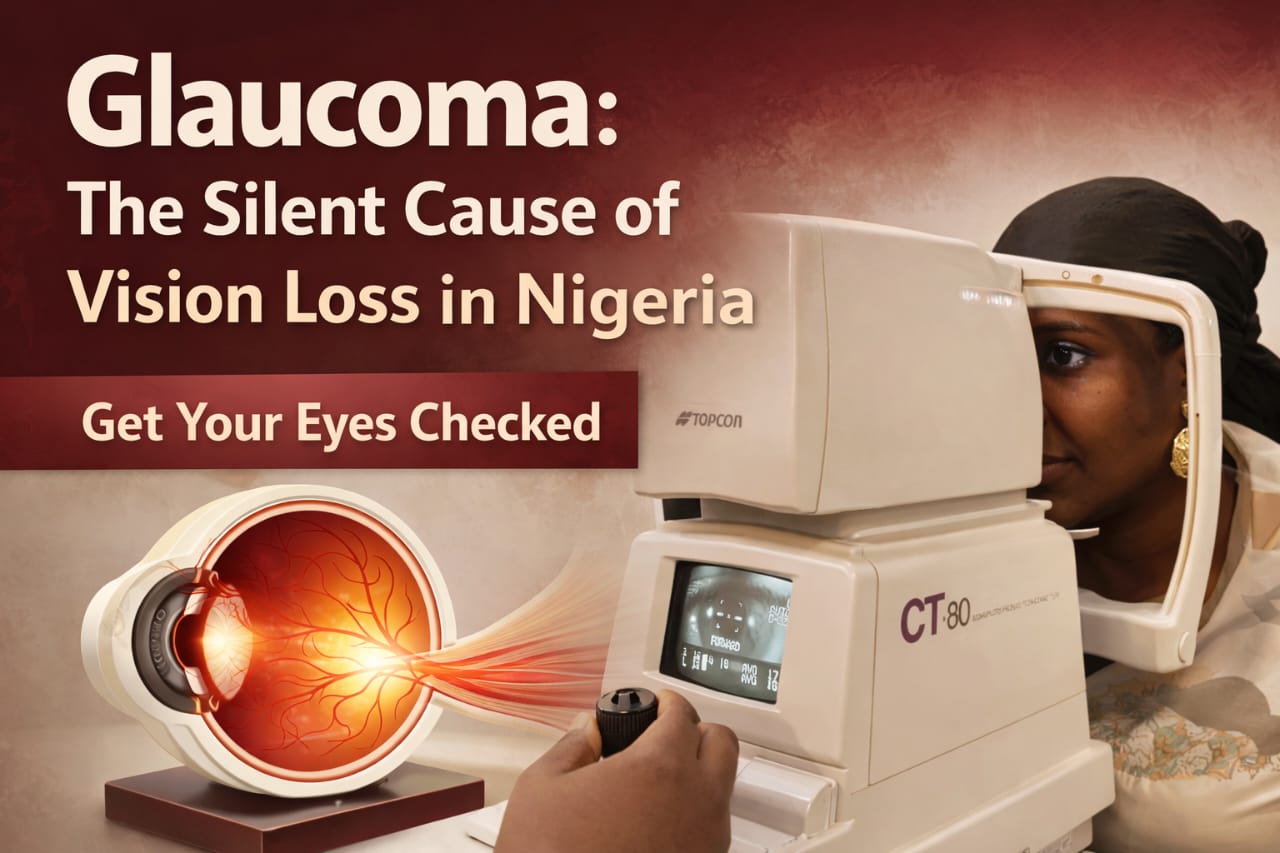
How Do I Know If I Have Glaucoma? | Glaucoma Test Abuja
How Do I Know If I Have Glaucoma?
The difficult thing about glaucoma is that you may not know you have it.
You may see clearly.
Your eyes may not hurt.
You may have no headaches.
You may continue driving, reading and working normally.
Yet glaucoma can gradually damage the optic nerve before you notice obvious changes in your vision.
That is why glaucoma is usually found through an eye examination and glaucoma testing, not by waiting for symptoms to appear.
Quick Answer
The only reliable way to know if you have glaucoma is to have your eyes properly examined.
Most people with the common form of glaucoma do not notice obvious symptoms in the early stages.
A proper glaucoma assessment looks at more than your eye pressure. Your optometrist may need to assess your optic nerve, eye pressure, peripheral vision and other parts of your eyes depending on your findings and risk.
If you have a family history of glaucoma, have previously been told your eye pressure is high or have other risk factors, do not wait until your vision becomes poor before getting checked.
Book Appointment
What Is Glaucoma?
Glaucoma is a group of eye diseases that damage the optic nerve.
The optic nerve is the pathway that carries visual information from your eye to your brain.
Once glaucoma damages parts of this nerve, the vision lost cannot usually be restored.
Treatment therefore focuses on protecting the vision you still have and reducing the risk of further damage.
This is why detecting glaucoma early matters.
How Common Is Glaucoma in Nigeria?
Glaucoma is an important eye-health problem in Nigeria.
A large national Nigerian eye-health survey found glaucoma in about 1 in every 20 adults aged 40 years and above.
One of the most concerning findings was that most people found to have glaucoma did not already know they had it.
This fits the nature of the disease:
Glaucoma can progress quietly.
You cannot safely decide that you do not have glaucoma simply because you can still see clearly.
How Do I Know If I Have Glaucoma?
For the common form of glaucoma, you often cannot tell by symptoms alone.
In the early stages:
- Your central vision may remain clear
- You may have no pain
- Your eyes may look normal
- You may not notice changes in everyday activities
Glaucoma often affects peripheral, or side, vision first.
Even this may be difficult to notice because both eyes work together and the brain can compensate for missing areas.
The safest way to know your glaucoma status is through an appropriate eye examination.
If you are unsure if you need an eye examination generally, read our guide on signs you may need an eye test.
What Are the First Signs of Glaucoma?
This question is slightly misleading because the most common type of glaucoma often has no noticeable early warning signs.
As open-angle glaucoma becomes more advanced, a person may gradually lose peripheral vision.
Eventually, this can produce increasingly restricted vision.
The problem is that by the time a person notices this themselves, significant optic nerve damage may already have occurred.
So the best “early sign” is often not a symptom.
It is an abnormal finding during an eye examination.
Can I Have Glaucoma Without Knowing?
Yes.
This is one of the main reasons glaucoma deserves attention.
You can have glaucoma while:
- Reading clearly
- Driving normally
- Using your phone without difficulty
- Experiencing no pain
- Having no obvious eye redness
Clear central vision does not rule out glaucoma.
This is why people with glaucoma risk factors should not wait for symptoms before having their eyes assessed.
Can My Eye Pressure Be High Without Me Knowing?
Yes.
High eye pressure usually does not create a feeling that you can recognise yourself.
You cannot reliably “feel” whether your eye pressure is normal or high.
It needs to be measured.
But there is another important point:
High eye pressure is a risk factor for glaucoma. It is not the same thing as glaucoma.
Some people have raised eye pressure without optic nerve damage.
Other people develop glaucoma even though their measured eye pressure is within what is traditionally considered a normal range.
That is why checking pressure alone is not enough.
Can I Have Glaucoma With Normal Eye Pressure?
Yes.
Glaucoma is ultimately about damage to the optic nerve, not simply one pressure reading.
Some people develop glaucoma without having consistently high measured eye pressure.
This is one reason a proper glaucoma assessment may also consider:
- The appearance of the optic nerve
- Your visual field
- Your family history
- Your cornea
- Your age
- Previous eye-pressure measurements
- Other examination findings
Do not assume a single “normal pressure” reading proves you cannot have glaucoma.
Is an Eye Pressure Test Enough to Detect Glaucoma?
No.
This is a very important misconception.
Eye pressure measurement, called tonometry, is useful.
But glaucoma assessment should not depend on eye pressure alone.
Depending on your examination and risk, assessment may include:
Eye Pressure Measurement
This measures the pressure inside your eye.
Raised pressure increases glaucoma risk, but pressure alone does not diagnose glaucoma.
Optic Nerve Examination
Your optometrist examines the optic nerve for changes that may suggest glaucoma.
This is extremely important because glaucoma damages this nerve.
Visual Field Testing
Glaucoma often affects peripheral vision.
A visual field test checks for areas of reduced sensitivity or missing vision that you may not notice yourself.
Fundus or Optic Nerve Photography
Images of the back of the eye can help document the appearance of the optic nerve and allow comparison over time.
Corneal Thickness Measurement
Corneal thickness can influence how an eye-pressure measurement is interpreted.
This may therefore be useful in some glaucoma assessments.
Gonioscopy
This is an examination of the drainage angle inside the eye and helps distinguish different forms of glaucoma.
OCT
OCT is a scan that can measure structures around the optic nerve and retinal nerve-fibre layer.
It may be recommended when additional information is required.
Not every person needs every test at every visit.
The correct tests depend on your risk factors and what the initial examination shows.
What Is a Visual Field Test for Glaucoma?
A visual field test checks how well you can see in different areas around the point you are looking at.
This matters because glaucoma may damage side vision before central vision becomes noticeably poor.
During the test, you look straight ahead while responding when you see small lights appearing in different areas.
The machine then creates a map of your visual field.
Repeated visual field tests can also help determine if glaucoma damage is stable or changing over time.
Book Appointment
Who Is Most at Risk of Glaucoma?
Anyone can develop glaucoma, but some people deserve particular attention.
You Have a Family History of Glaucoma
If a parent, sibling or other close relative has glaucoma, your risk is higher.
This is one of the most important questions to ask your family:
“Does anyone in our family have glaucoma?”
If the answer is yes, tell your optometrist.
You Are Getting Older
Glaucoma becomes more common with increasing age.
Nigeria also has a significant burden of glaucoma among adults from age 40 upward.
Age does not mean you will develop glaucoma, but it becomes increasingly important to pay attention to your eye health.
You Are of African Ancestry
People of African ancestry have a higher risk of open-angle glaucoma and may develop severe disease at younger ages compared with some other populations.
For Nigerians, this makes glaucoma awareness particularly important.
You Have Previously Had High Eye Pressure
Raised intraocular pressure is one of the strongest known glaucoma risk factors.
Anyone who has previously been told that their pressure is high should follow the review schedule recommended by their eye-care professional.
You Use Steroid Medication
Long-term steroid exposure can increase eye pressure in some people.
This may involve certain:
- Eye drops
- Tablets
- Injections
- Inhaled steroids
- Other steroid medicines
Do not stop prescribed steroid medication yourself.
Instead, tell your eye-care professional what medicines you use so your risk can be assessed properly.
You Have Certain Other Eye or Medical Risk Factors
Your optometrist will consider your wider eye and medical history when deciding how closely your eyes need monitoring.
If you live with diabetes, you should also have appropriate retinal monitoring. Read our guide on how diabetes can affect your eyes even when you can still see clearly.
Does Glaucoma Run in Families?
Yes, family history matters.
Having a close blood relative with glaucoma increases your own risk.
This does not mean you definitely have or will develop glaucoma.
It means you should tell your optometrist and take recommended eye examinations seriously.
It is also worth talking to relatives when a family member is diagnosed.
A simple family conversation may encourage someone else to have their eyes checked before they develop noticeable vision loss.
What Does Glaucoma Vision Look Like?
People sometimes imagine glaucoma as everything suddenly becoming black.
That is usually not how the common form develops.
Open-angle glaucoma often affects peripheral vision gradually.
A person may miss objects or people approaching from the side while still seeing straight ahead.
As damage becomes severe, the remaining field of vision can become increasingly restricted.
But online images showing “tunnel vision” are only illustrations.
They should not be used to diagnose yourself.
What Are the Symptoms of Angle-Closure Glaucoma?
There is an important exception to the usual silent nature of glaucoma.
An acute angle-closure attack can develop suddenly and is an eye emergency.
Symptoms may include:
- Severe eye pain
- Red eye
- Sudden blurred or hazy vision
- Halos around lights
- Severe headache
- Nausea
- Vomiting
If these symptoms develop suddenly, seek urgent medical or eye care.
Do not wait for a routine glaucoma-screening appointment.
Can Glaucoma Make You Blind?
Yes.
Untreated or poorly controlled glaucoma can cause irreversible vision loss and blindness.
But being diagnosed with glaucoma does not automatically mean you will become blind.
The purpose of early diagnosis, treatment and monitoring is to reduce the risk of further optic nerve damage and preserve useful vision.
This is why knowing about glaucoma before advanced damage occurs is so important.
Can Glaucoma Be Cured?
Glaucoma is generally managed rather than cured.
Existing optic nerve damage usually cannot be reversed.
Treatment aims to lower the risk of additional damage, most commonly by reducing eye pressure.
Depending on the type and severity of glaucoma, treatment may involve:
- Prescription eye drops
- Laser treatment
- Surgery
- Regular monitoring
Your treatment should be determined by the appropriate eye-care professional based on your diagnosis.
Do Glaucoma Eye Drops Restore Lost Vision?
No.
Glaucoma medicines are used primarily to lower eye pressure and reduce the risk of further optic nerve damage.
They do not normally restore vision that has already been permanently lost from glaucoma.
This is another reason early detection is valuable.
The goal is to protect vision before more is lost.
How Often Should I Get Checked for Glaucoma?
There is no single correct interval for everybody.
Someone with:
- A strong family history
- Previously high eye pressure
- Suspicious optic nerves
- Existing glaucoma
- Other significant risk factors
may need more frequent testing than someone with a completely normal examination and low risk.
Your optometrist or ophthalmologist should recommend your personal review interval based on your findings.
How Much Does a Glaucoma Test Cost in Abuja?
The cost depends on which glaucoma investigations you need.
A person may need only part of an assessment initially, while another patient may need several tests such as pressure measurement, visual field testing, optic nerve assessment or imaging.
You can see our current guide on glaucoma test costs in Abuja for more information.
For general examination fees, see our guide to the cost of an eye test in Abuja.
Where Can I Get a Glaucoma Test in Abuja?
At Blossom Vision Eye Clinic in Games Village, Abuja, we assess patients who have glaucoma risk factors, suspicious eye findings or established glaucoma requiring monitoring.
Depending on your clinical findings, assessment may involve:
- Eye pressure measurement
- Optic nerve assessment
- Visual field testing
- Fundus imaging
- Other investigations where clinically appropriate
If a test or treatment requiring specialist ophthalmology care is needed, an appropriate referral can be made.
Our clinic is located in the Games Village/Kaura District area of Abuja.
What Happens If My Glaucoma Test Is Abnormal?
An abnormal result does not automatically mean you are going blind.
Your next step depends on what is abnormal.
You may need:
- A repeat measurement
- Additional testing
- Closer monitoring
- OCT or other imaging
- Medical treatment
- Referral to an ophthalmologist or glaucoma specialist
Glaucoma diagnosis is often based on the pattern created by several pieces of information rather than one single test.
Frequently Asked Questions
How do I know if I have glaucoma?
Most people cannot tell from symptoms in the early stages. A proper eye examination assessing the optic nerve, eye pressure and other glaucoma-related findings is the reliable way to know.
What are the first signs of glaucoma?
The common open-angle form often causes no noticeable early symptoms. Peripheral vision may gradually be affected as the disease progresses.
Can I have glaucoma without knowing?
Yes. Many people with early glaucoma are unaware that they have it.
Can I have glaucoma with normal eye pressure?
Yes. Glaucoma can occur even when measured eye pressure is not unusually high.
Is high eye pressure the same as glaucoma?
No. High eye pressure increases glaucoma risk but does not automatically mean the optic nerve has been damaged.
Does glaucoma run in families?
Yes. A family history increases your risk, especially if a close blood relative has glaucoma.
Can glaucoma make you blind?
Glaucoma can cause irreversible blindness if enough optic nerve damage occurs. Early detection and appropriate treatment reduce the risk of further vision loss.
Can glaucoma be cured?
Glaucoma is generally controlled rather than cured. Treatment aims to prevent or slow additional optic nerve damage.
Is glaucoma testing painful?
Most common glaucoma tests are designed to be relatively quick and cause little or no pain.
Is checking eye pressure enough for glaucoma?
No. Eye pressure is only one part of glaucoma assessment.
Where can I get a glaucoma test in Abuja?
Blossom Vision Eye Clinic provides glaucoma assessment in the Games Village/Kaura District area of Abuja. The tests required depend on your individual findings.
Don't Wait for Glaucoma to Give You a Warning
This is the most important thing to remember:
Glaucoma may not warn you before it damages your sight.
You do not need blurry vision or eye pain before getting checked.
If you have a family history of glaucoma, have previously been told your eye pressure is high or simply do not know your glaucoma status, an appropriate eye examination can help determine your risk.
At Blossom Vision Eye Clinic in Games Village, Abuja, we can assess your eyes, explain your findings clearly and advise the appropriate next step.
Book your glaucoma assessment today.