What Happens During a Comprehensive Eye Exam in Abuja?
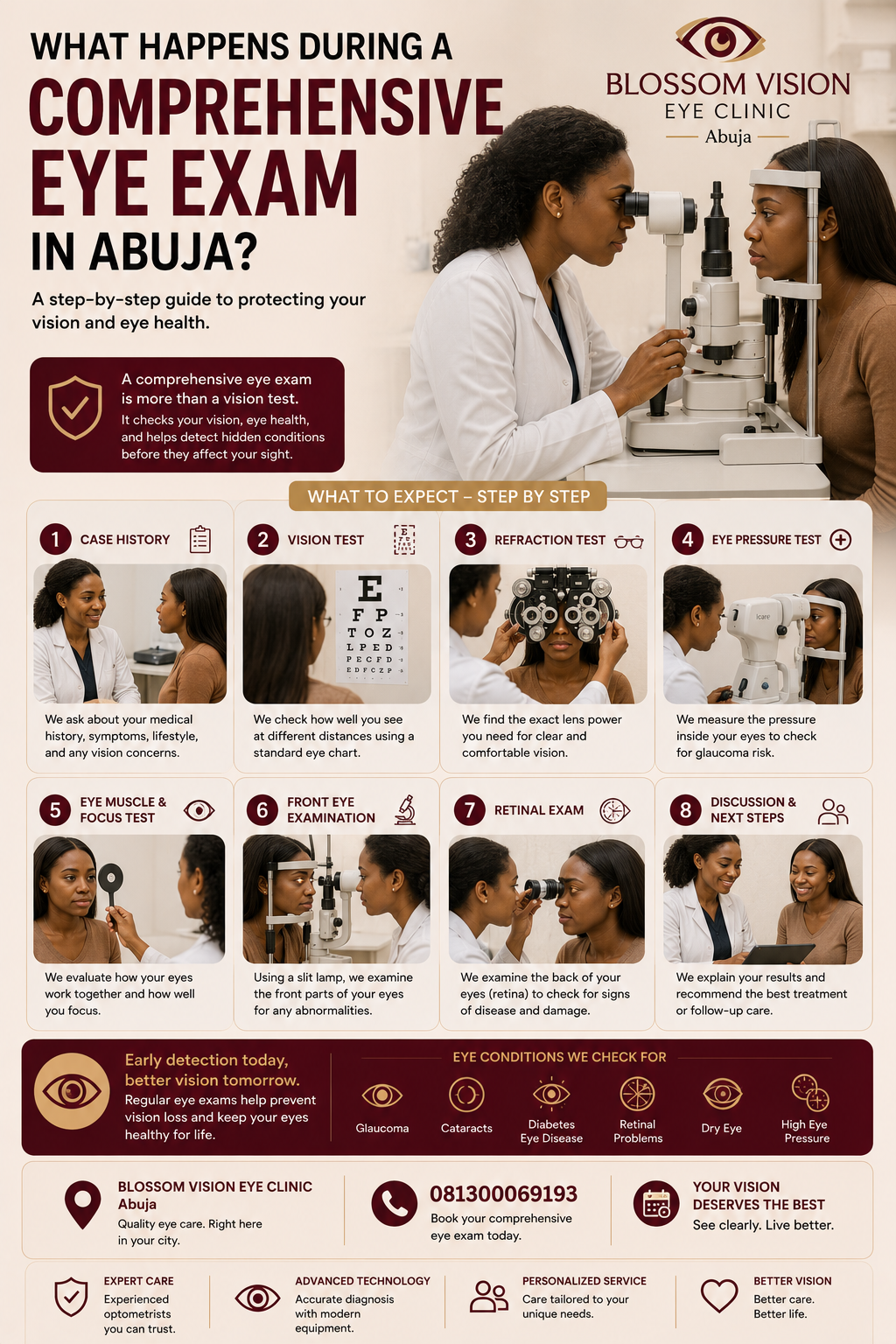
A comprehensive eye exam is much more than reading letters on a chart. It evaluates your vision, eye health, eye pressure, retina, and checks for hidden conditions such as glaucoma, cataracts, diabetes-related eye disease, and other vision-threatening problems.
What Happens During a Comprehensive Eye Exam?
You may have been told:
“You need an eye test.”
But what actually happens when you get there?
Will they just ask you to read some letters?
Will they put drops in your eyes?
Will they check for glaucoma?
How long will it take?
And most importantly:
What exactly are they checking?
A comprehensive eye examination is much more than finding out if you need glasses.
Depending on your age, symptoms and medical history, your optometrist may assess:
- How clearly each eye sees
- Your glasses prescription
- Near vision
- Eye pressure
- Eye movements and alignment
- The front of your eyes
- Your retina
- Your optic nerves
- Your tear film
- Other areas where clinically appropriate
The purpose is to answer two separate questions:
How well are you seeing?
and
How healthy are your eyes?
Quick Answer: What Happens During an Eye Exam?
A typical comprehensive eye examination may involve:
- Talking about your symptoms and health history
- Checking how clearly you see
- Measuring your glasses prescription
- Checking your eye movements and coordination
- Measuring eye pressure
- Examining the front of the eyes
- Examining the retina and optic nerve
- Performing additional tests if something needs closer investigation
- Explaining the findings and what happens next
Not every person requires exactly the same tests.
Your examination should be based on your eyes and your risks, rather than simply repeating the same checklist for everybody.
Book Appointment
Step 1: We Ask Why You Came
Before looking at your eyes, we need to understand the problem.
You may say:
“My vision is blurry.”
“I keep getting headaches.”
“My eyes are always itching.”
“I can't drive comfortably at night anymore.”
“My glasses aren't working.”
or:
“Nothing is wrong. I just want to check my eyes.”
All of those are valid reasons to have an eye examination.
Your optometrist may ask about:
- Blurry vision
- Headaches
- Eye pain
- Itching or watering
- Dryness
- Night-driving problems
- Flashes or floaters
- Double vision
- Current glasses
- Contact lenses
- Previous eye problems
This conversation tells us which parts of the examination deserve extra attention.
Step 2: We Ask About Your Medical History
Your general health matters because some medical conditions can affect the eyes.
You may be asked if you have:
- Diabetes
- High blood pressure
- Previous eye surgery
- Previous eye injuries
- A family history of glaucoma
- Other significant health conditions
We may also ask what medications you take.
For example, a person living with diabetes may require particular attention to the retina.
Someone with a strong family history of glaucoma may require closer assessment of the optic nerve and other glaucoma risk factors.
Step 3: We Check How Clearly Each Eye Sees
This is the part most people recognise.
You may be asked to read letters or symbols from a chart.
This is called visual acuity testing.
In simple English:
How small can you see clearly?
We normally check each eye separately because one eye can see very well while the other has a problem.
Depending on the patient, we may check:
- Distance vision
- Near vision
- Each eye individually
- Both eyes together
But passing the letter chart does not automatically mean your eyes are healthy.
Someone can have very good central vision and still have an eye condition that requires attention.
That is why the examination continues.
Step 4: Do I Need Glasses?
If your vision is not as clear as expected, we may measure your prescription.
This process is called refraction.
You may recognise the question:
“Which is clearer: one or two?”
We compare different lens powers until we determine which correction gives you the clearest and most comfortable vision.
Refraction can identify refractive errors such as:
- Myopia, or short-sightedness
- Hyperopia, or long-sightedness
- Astigmatism
- Presbyopia, which affects near focusing as we get older
Not everybody who has an eye examination needs glasses.
And not every person with blurry vision can have the problem completely corrected with stronger glasses.
If you already wear glasses but still cannot see clearly, read Why Is My Vision Still Blurry Even With Glasses?.
Step 5: We Compare Your Current Glasses
If you already wear glasses, bring them with you.
Your existing glasses provide useful information.
We may want to know:
- What prescription are you currently wearing?
- Is it different from today's findings?
- Is one pair clearer than another?
- Has your prescription changed significantly?
- Are the lenses damaged?
- Are you struggling with distance, reading or both?
If your prescription repeatedly changes, read Why Do I Keep Changing My Glasses Prescription?.
Step 6: We Check How Your Eyes Work Together
Your two eyes need to move and coordinate properly.
Depending on your symptoms, your optometrist may assess:
- Eye alignment
- Eye movements
- Near focusing
- How the eyes work together
Problems in these areas can contribute to symptoms such as:
- Double vision
- Eye strain
- Headaches
- Reading discomfort
- Difficulty maintaining focus
This can be particularly important for children and people with specific visual complaints.
But we should not assume every headache or school difficulty is caused by the eyes.
The examination helps determine if vision is actually contributing.
Step 7: We Check Your Eye Pressure
Eye pressure is also called intraocular pressure, or IOP.
It means the pressure of the fluid inside the eye.
Why do we care about it?
Because eye pressure is one important risk factor for glaucoma.
But this distinction is critical:
High eye pressure does not automatically mean you have glaucoma.
And:
Normal eye pressure does not guarantee that you do not have glaucoma.
Glaucoma assessment involves more than one number.
Your optic nerve, visual field, risk factors and other findings may also need to be considered.
If glaucoma is something you are particularly worried about, read How Do I Know If I Have Glaucoma?.
Step 8: We Examine the Front of Your Eyes
Your optometrist may use a specialised microscope called a slit lamp.
Do not let the name sound complicated.
It is simply a microscope designed for examining the eye in detail.
It allows us to look at structures such as:
- Eyelids
- Eyelashes
- Tear film
- Conjunctiva
- Cornea
- Iris
- Natural lens
This can help identify problems such as:
- Dry eye
- Allergic eye disease
- Eyelid inflammation
- Corneal problems
- Cataract
- Certain infections
- Eye injuries
If your main problem is persistent itching, read Why Are My Eyes Always Itchy?.
Step 9: We Examine the Back of Your Eyes
The back of the eye contains important structures including:
- Retina
- Optic nerve
- Macula
- Retinal blood vessels
The retina is the light-sensitive tissue that allows you to see.
The optic nerve carries visual information from your eye toward your brain.
Looking at these structures can help identify signs associated with conditions such as:
- Glaucoma
- Diabetic retinopathy
- Hypertensive retinal changes
- Retinal disease
- Macular disease
- Other abnormalities
Sometimes additional imaging or specialist assessment may be recommended depending on what is found.
Can an Eye Exam Detect Diabetes?
An eye examination can sometimes reveal retinal changes associated with diabetes.
That is not the same thing as saying an eye examination diagnoses diabetes.
If suspicious retinal findings or symptoms raise concern about diabetes, appropriate medical testing such as blood glucose assessment is still required.
People already living with diabetes also need appropriate retinal monitoring because diabetic retinal disease can develop before a person notices obvious visual symptoms.
Read Can Diabetes Affect My Eyes Even If I Can See Clearly?.
Can an Eye Exam Detect High Blood Pressure?
The retinal blood vessels can sometimes show changes associated with hypertension.
An optometrist may notice these during examination of the retina.
But an eye examination does not replace having your blood pressure properly measured.
If concerning retinal changes are seen, medical follow-up may be advised.
Step 10: Do I Need a Visual Field Test?
Not everybody needs a visual field test at every routine visit.
A visual field test measures how much you can see around you while looking straight ahead.
It may be useful when assessing conditions such as:
- Glaucoma
- Certain neurological problems
- Some retinal conditions
- Unexplained areas of missing vision
At Blossom Vision, visual-field testing may be performed when clinically appropriate.
Your optometrist should explain why the test is being recommended.
Step 11: Do I Need Retinal Photography?
Sometimes photographs of the back of the eye can provide a useful record.
They can help document structures such as:
- Retina
- Optic nerve
- Retinal blood vessels
This can be particularly useful for comparing changes over time.
But retinal photography does not replace every other part of an eye examination.
It is one tool among several.
Will My Eyes Be Dilated?
Not necessarily.
Dilating drops temporarily enlarge the pupil so the back of the eye can be examined more extensively.
Dilation may be recommended depending on:
- Your symptoms
- Age
- Medical history
- Retinal findings
- Diabetes
- Suspicion of retinal problems
- Other clinical reasons
If dilation is recommended, your optometrist should explain why.
Not every patient needs dilation at every examination.
Step 12: We Put All the Findings Together
This is perhaps the most important part.
An eye examination should not end with someone handing you numbers and saying:
“Go and make glasses.”
Your optometrist should explain what was found.
For example:
Your eyes are healthy, but you need a new prescription.
or:
Your prescription is fine, but dry eye is contributing to your symptoms.
or:
Your eye pressure requires further assessment.
or:
There is something at the back of the eye that needs specialist investigation.
You should understand:
- What was found
- Whether your eyes appear healthy
- If you need glasses
- If you need treatment
- If further testing is required
- If you need referral
- When you should return
What If Something Abnormal Is Found?
Finding something abnormal does not automatically mean something terrible is happening.
It means we have identified something that may need:
- Monitoring
- Treatment
- Additional testing
- Referral
For example, if we identify a condition requiring surgery or specialist ophthalmic management, we can refer you appropriately.
If you are confused about the different types of eye-care professionals, read Should I See an Optometrist or an Ophthalmologist?.
Is an Eye Examination Painful?
Most routine parts of a comprehensive eye examination are painless.
You may experience:
- Bright lights
- Brief contact or air during certain pressure measurements
- Temporary blur from some tests
- Temporary light sensitivity if dilating drops are used
But an ordinary comprehensive examination should not normally be painful.
Tell your optometrist immediately if something causes significant discomfort.
How Long Does a Comprehensive Eye Exam Take?
There is no exact time for every patient.
Someone coming for a straightforward prescription review may need a different amount of time from someone with:
- Glaucoma concerns
- Diabetes
- Children's vision problems
- A complicated prescription
- Retinal symptoms
- Several additional tests
So I would not judge the quality of an eye examination simply by whether it lasts 20, 40 or 60 minutes.
The better question is:
Was everything clinically necessary for my particular problem properly assessed?
Book Appointment
Do I Need an Eye Exam If I Can See Clearly?
Sometimes, yes.
Clear vision and healthy eyes are not exactly the same thing.
Some eye diseases can develop before a person notices obvious central vision loss.
Examples include early open-angle glaucoma and diabetic retinal disease.
So:
“I can still read the smallest line.”
does not necessarily answer:
“Are my eyes healthy?”
That is one reason the examination includes more than the vision chart.
How Often Should I Have My Eyes Checked?
There is no single correct interval for everybody.
How often you need an examination depends on factors such as:
- Age
- Symptoms
- Previous eye findings
- Glasses or contact-lens use
- Diabetes
- Family history of glaucoma
- Childhood myopia
- Other medical conditions
- Your optometrist's findings
Some people may need closer monitoring.
Others with healthy eyes and low risk may not require the same review frequency.
Your optometrist should recommend the next examination based on your individual situation.
Who Should Get Their Eyes Checked More Closely?
You may need closer monitoring if you:
- Have diabetes
- Have glaucoma or are considered at increased risk
- Have a strong family history of glaucoma
- Have progressing childhood myopia
- Wear contact lenses
- Have known eye disease
- Have had previous eye surgery
- Experience new or changing visual symptoms
But symptoms alone should not be the only reason to have your eyes assessed.
What Symptoms Mean I Should Book an Eye Exam?
Arrange an examination if you notice:
- Persistent blurry vision
- Headaches associated with visual tasks
- Difficulty reading
- Increasing glare
- Night-driving problems
- Frequent prescription changes
- One eye becoming blurrier
- Persistent itching or watering
- Double vision
- Difficulty seeing the classroom board
- Other unexplained visual changes
For a more complete checklist, read Signs You Need an Eye Test.
Which Eye Symptoms Are an Emergency?
A routine eye appointment is not appropriate for every problem.
Seek urgent eye or medical care if you develop:
- Sudden significant vision loss
- A curtain or shadow across your vision
- Sudden flashes with many new floaters
- Severe eye pain
- A very red painful eye
- Sudden double vision
- Significant eye injury
- Chemical exposure
- Vision problems associated with weakness, facial drooping or difficulty speaking
Do not wait for a routine comprehensive examination if the symptoms suggest an emergency.
How Much Is a Comprehensive Eye Exam in Abuja?
At Blossom Vision, the cost depends on the services and tests required.
You can see our current guide explaining eye test costs in Abuja and what is included.
This is useful because not every patient requires the same additional testing.
Where Can I Get a Comprehensive Eye Exam in Abuja?
At Blossom Vision Eye Clinic in Games Village, Abuja, we provide comprehensive optometric eye examinations.
Depending on your individual needs, your assessment may include:
- Visual acuity
- Refraction
- Eye-pressure measurement
- Slit-lamp examination
- Retina and optic-nerve assessment
- Eye alignment and focusing assessment
- Visual-field testing where indicated
- Retinal photography where appropriate
- Additional evaluation or referral when needed
The purpose is not simply to ask:
“Do you need glasses?”
It is to understand your vision and eye health together.
Frequently Asked Questions
What happens during a comprehensive eye exam?
Your optometrist usually reviews your symptoms and health history, checks your vision and prescription, examines the front and back of your eyes and performs additional tests when appropriate.
Is a comprehensive eye exam just a glasses test?
No. Refraction is only one part. Eye health, pressure, cornea, retina and optic nerve may also be assessed.
Is an eye examination painful?
Most routine eye tests are painless.
Will my eye pressure be checked?
Eye pressure is commonly assessed as part of comprehensive eye care, particularly when glaucoma risk is being considered.
Can an eye test detect glaucoma?
An eye examination can identify findings that suggest glaucoma, but glaucoma assessment involves more than eye pressure alone. The optic nerve, visual field and other risk factors may also need evaluation.
Can an eye test detect diabetes?
An eye examination may reveal retinal changes associated with diabetes, but diabetes itself requires appropriate medical testing for diagnosis.
Do I need an eye test if I can see clearly?
Sometimes. Certain eye conditions may develop before you notice obvious central vision problems.
Will I need glasses after my eye exam?
Not necessarily. Some people have healthy vision and do not require glasses.
Will my eyes always be dilated?
No. Dilation may be recommended depending on your symptoms, medical history and examination findings.
Do I need a visual field test every time?
No. Visual-field testing is performed when there is a clinical reason for it.
How often should I have an eye examination?
The appropriate interval depends on your age, risk factors, eye-health findings, symptoms and medical history.
Where can I get a comprehensive eye exam in Abuja?
Blossom Vision Eye Clinic provides comprehensive eye examinations in the Games Village/Kaura District area of Abuja.
An Eye Exam Is More Than “Can You Read This Line?”
You can read every letter on the chart and still have something about your eye health that deserves attention.
And you can have blurry vision without having a serious eye disease.
That is why a comprehensive examination looks at the whole picture.
At Blossom Vision Eye Clinic in Games Village, Abuja, the aim is to answer:
How well can you see?
Do you need glasses?
How healthy are your eyes?
Is anything putting your future vision at risk?
Do you need treatment, monitoring or referral?
Those are much more useful questions than simply asking how small a line you can read.
If you want to know the health of your eyes, book a comprehensive eye examination in Abuja.