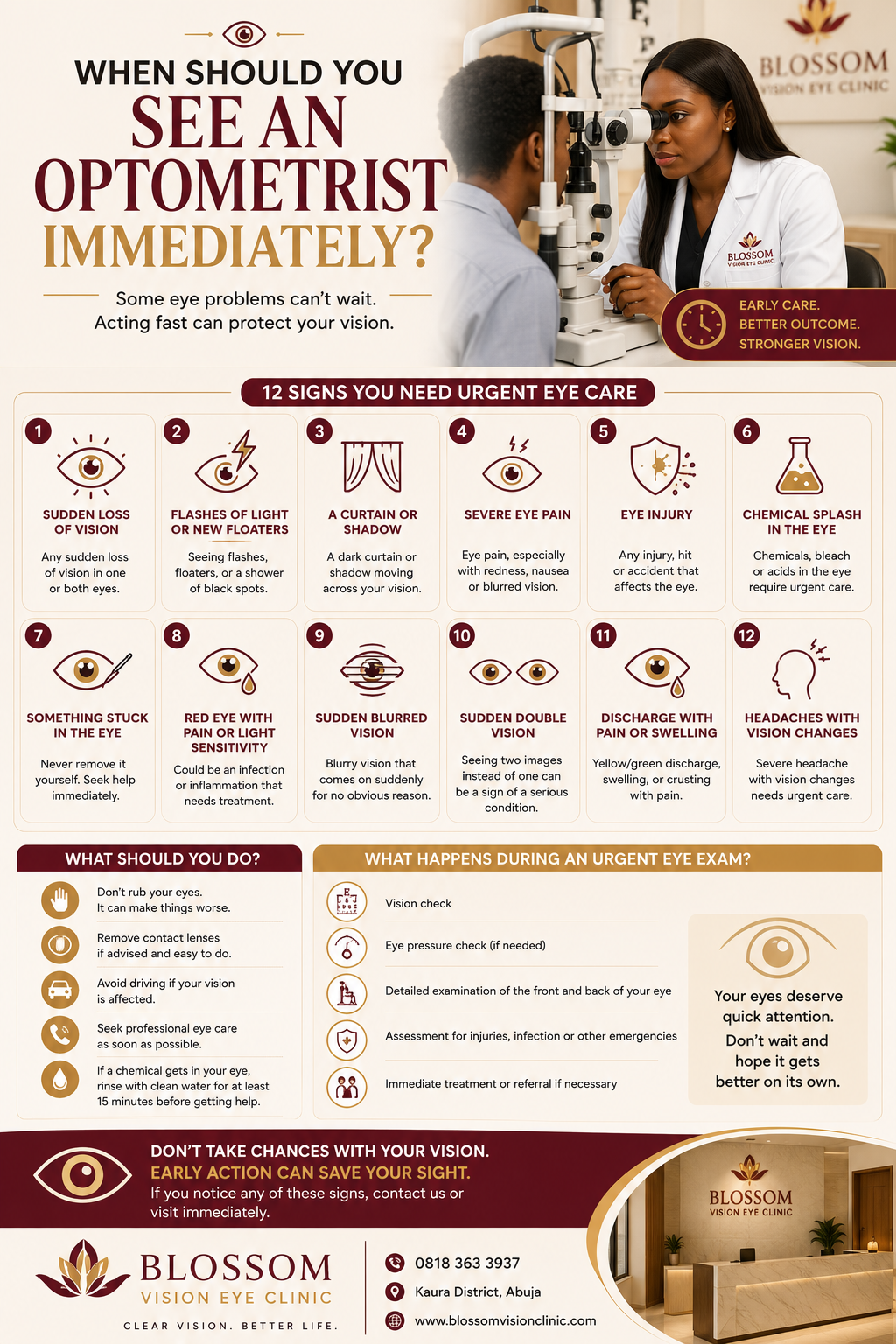
When Should You See an Optometrist Immediately?
When Should You See an Optometrist Immediately?
Not every eye problem is an emergency.
An itchy eye may be uncomfortable.
A slightly outdated glasses prescription may be frustrating.
Dry eyes may make a long workday miserable.
But some eye symptoms are very different.
They can mean:
“Do not wait until next week.”
And a few mean:
“Do not wait for a routine clinic appointment. Go for emergency medical care now.”
Knowing that difference matters.
Because with some eye conditions, treatment is much more effective when it happens quickly.
Quick Answer: Which Eye Symptoms Should Never Be Ignored?
Seek urgent eye or medical assessment if you suddenly develop:
- Significant loss of vision
- A curtain or shadow across your vision
- Many new floaters with flashes
- Severe eye pain
- A very red painful eye
- New strong light sensitivity with pain or redness
- Sudden double vision
- A chemical injury
- A penetrating eye injury
- Significant trauma
- A painful red contact-lens eye
- Sudden neurological symptoms with vision changes
- Significant visual changes during pregnancy
Some of these can be assessed urgently by an eye-care professional.
Others should go directly to an emergency department.
The safest question is not:
“Can I manage until Monday?”
It is:
“Could waiting make this worse?”
Book Appointment
What Is an Eye Emergency?
An eye emergency is a problem where delay could threaten:
- Vision
- The eye itself
- Or sometimes your wider health
Some eye symptoms can also be signs of:
- Stroke
- Severe hypertension
- Serious infection
- Neurological disease
- Pregnancy complications
So occasionally the eye symptom is only one part of a much bigger medical emergency.
1. Sudden Loss of Vision
This is one of the most important.
If you suddenly lose significant vision in:
one eye
or:
both eyes,
do not wait for a normal appointment.
The vision may become:
- Completely dark
- Very blurry
- Grey
- Partially missing
- Covered by a shadow
Possible causes include:
- Retinal detachment
- Retinal artery blockage
- Retinal vein blockage
- Optic-nerve disease
- Vitreous bleeding
- Stroke or neurological disease
If vision has suddenly disappeared or dramatically reduced, go for emergency medical or ophthalmic assessment immediately.
Your dedicated article explains this in detail:
What Does It Mean When You Suddenly Lose Vision in One Eye?
Do not delay emergency care just to finish reading an article.
What If My Vision Comes Back?
Still seek urgent assessment.
Temporary loss of vision in one eye may sometimes be caused by temporarily reduced blood flow.
A patient may describe:
“Everything went black for two minutes and then came back.”
That does not automatically mean:
“The problem has solved itself.”
Transient visual loss can sometimes be a warning of vascular disease.
2. A Curtain or Shadow Across Your Vision
This deserves its own section.
Patients sometimes say:
“It looks as though somebody pulled a curtain across my eye.”
or:
“There is a dark shadow coming from the side.”
That can be a warning sign of retinal detachment.
Especially if it happens together with:
- New floaters
- Flashes of light
- Missing side vision
do not wait.
Retinal detachment can threaten permanent vision.
3. Suddenly Seeing Many New Floaters
A few longstanding floaters are common.
But this is different:
Yesterday: normal
Today: suddenly dozens of black spots or cobwebs.
That deserves urgent assessment, particularly when there are also:
- Flashes
- A curtain
- A shadow
- Reduced vision
A sudden change may occur with posterior vitreous detachment, retinal tear, retinal detachment or bleeding.
Read Why Do I See Black Spots Floating in My Vision? for the full explanation.
But if you currently have:
many new floaters + flashes + curtain/shadow,
seek urgent eye care instead of waiting for a routine appointment.
4. Flashes of Light
Flashes may look like:
- Lightning
- Camera flashes
- Sparks
- Flickering at the edge of vision
There are several possible causes.
Migraine can cause visual phenomena.
But new flashes in one eye, especially together with many new floaters, need retinal assessment.
Do not automatically say:
“It must be migraine.”
particularly if the symptom is new.
5. Severe Eye Pain
A healthy eye should not suddenly become intensely painful.
Possible causes include:
- Corneal injury
- Corneal infection
- Acute angle-closure glaucoma
- Uveitis
- Chemical injury
- Significant inflammation
- Trauma
Pain becomes even more concerning when combined with:
- Reduced vision
- Redness
- Light sensitivity
- Headache
- Nausea
- Vomiting
That combination deserves urgent assessment.
6. A Very Red, Painful Eye
Many red eyes are not emergencies.
For example, mild allergy or dry-eye irritation can cause redness.
But:
red + painful + reduced vision
is different.
Also concerning:
red + pain + light sensitivity
or:
red + severe headache + halos + nausea.
Possible causes include:
- Corneal infection
- Uveitis
- Acute angle closure
- Significant corneal injury
Do not simply buy:
“redness relief drops.”
A red eye needs more urgent attention when pain or vision is involved.
7. A Painful Red Eye in a Contact-Lens Wearer
This combination deserves extra caution.
Contact-lens wear increases the risk of serious corneal infection.
If you wear lenses and develop:
- Redness
- Pain
- Strong light sensitivity
- Reduced or blurry vision
- Significant watering
- Discharge
remove the lenses and seek prompt eye assessment.
Do not:
- Keep wearing the lenses
- Sleep in them again
- Use leftover antibiotic drops
- Use steroid eye drops without assessment
If the main problem is ordinary contact-lens discomfort rather than an emergency, Read Why Do My Contact Lenses Feel Uncomfortable?
8. A White or Grey Spot on the Cornea
Look at the clear front part of your eye.
If you notice a new white or grey spot together with:
- Pain
- Redness
- Light sensitivity
- Reduced vision
particularly as a contact-lens wearer, seek urgent assessment.
A corneal infection or ulcer may be present.
These can threaten sight if not treated appropriately.
9. A Chemical Splash
This is an emergency where the first treatment starts before you reach the clinic.
If:
- Bleach
- Cleaning chemical
- Acid
- Alkali
- Battery chemical
- Industrial chemical
gets into your eye:
START RINSING IMMEDIATELY.
Use plenty of:
- Clean running water
- Or appropriate irrigation fluid if immediately available
Do not spend valuable time looking for special eye drops.
Do not wait until you arrive at the hospital before rinsing.
Continue flushing thoroughly while arranging urgent medical care.
Remove contact lenses if they come out easily during irrigation.
Should I Rinse for Exactly 15 Minutes?
Do not become too focused on a stopwatch.
The priority is:
start immediately and rinse generously.
Significant chemical injuries may require prolonged irrigation until the eye surface reaches an appropriate pH.
That is something the emergency team can assess.
The dangerous mistake is:
“Let me wait until I get professional water.”
Use clean running water immediately if that is what is available.
10. Something Penetrated the Eye
If an object appears to have entered or penetrated the eye:
do not pull it out.
Do not:
- Push it
- Wiggle it
- Press on the eyeball
- Try to remove it with tweezers
Protect the eye from additional pressure and seek emergency medical care.
This applies to objects such as:
- Metal
- Glass
- Sharp wood
- Other penetrating objects
11. Metal Flew Into Your Eye While Grinding or Hammering
This deserves particular attention.
If you were:
- Grinding metal
- Drilling
- Cutting metal
- Hammering metal against metal
and something hit your eye, seek urgent assessment.
A high-speed fragment can enter deeper into the eye even when the outside does not look dramatic.
Do not assume:
“It's only a tiny piece.”
12. A Significant Eye Injury
Seek urgent assessment after a significant:
- Punch
- Ball impact
- Fall
- Road accident
- Stick injury
- Sharp-object injury
- Explosion
especially if there is:
- Reduced vision
- Severe pain
- Blood inside or around the eye
- Double vision
- Irregular-looking pupil
- Significant swelling
A person can still see reasonably well initially and have an important internal injury.
13. Sudden Double Vision
If one object suddenly becomes two, particularly when the double vision is new, it should not simply be ignored.
Sudden double vision can sometimes involve:
- Eye-movement nerves
- Eye muscles
- Brain
- Blood vessels
- Neurological disease
It is especially concerning with:
- Weakness
- Numbness
- Facial drooping
- Difficulty speaking
- Severe imbalance
- Severe headache
In that situation, go to an emergency department because stroke or another neurological emergency must be considered.
What If the Double Vision Stops When I Cover One Eye?
Tell the clinician.
That information helps distinguish different types of double vision.
But a new sudden episode still deserves assessment.
14. Sudden Vision Change With Weakness or Difficulty Speaking
This is not primarily:
“Which eye clinic should I book?”
It may be a stroke.
If a sudden vision problem occurs with:
- Facial weakness
- Arm or leg weakness
- Numbness
- Difficulty speaking
- Confusion
- Sudden loss of balance
seek emergency medical care immediately.
Do not drive yourself.
15. Sudden Blurry Vision
This needs more careful wording than the original.
Not every episode of blur is an emergency.
For example, vision that fluctuates because of dry eye may come and go.
But sudden significant unexplained blur, especially in one eye, deserves urgent assessment.
Possible causes include:
- Retinal disease
- Vascular blockage
- Corneal disease
- Optic-nerve problems
- Acute glaucoma
- Neurological problems
If your vision instead repeatedly becomes blurry and clear again over time, read Why Does My Vision Go Blurry Then Clear Again?.
That is different from:
“I suddenly cannot see properly.”
16. One Eye Suddenly Becomes Much Blurrier Than the Other
Again, speed matters.
If one eye has always been somewhat blurrier, that may be a prescription or longstanding-eye issue.
Read Why Is One Eye Blurrier Than the Other?.
But if the difference appears:
suddenly
and:
significantly,
seek urgent assessment.
Do not simply order stronger glasses.
Book Appointment
17. Sudden Severe Light Sensitivity
Light sensitivity is called photophobia.
Not every person who squints outside has a medical emergency.
But new severe light sensitivity, particularly with:
- Eye pain
- Redness
- Reduced vision
- Contact-lens wear
- Headache
- Corneal injury
deserves prompt assessment.
A painful red photophobic eye should not automatically be labelled:
“ordinary conjunctivitis.”
18. Severe Eye Pain With Halos, Headache, Nausea or Vomiting
This combination is particularly concerning.
Possible acute angle-closure glaucoma symptoms include:
- Severe eye pain
- Red eye
- Hazy or blurry vision
- Rainbow halos
- Headache
- Nausea
- Vomiting
This is different from common open-angle glaucoma, which is usually silent in the early stages.
If this sudden painful pattern occurs:
seek emergency eye care.
19. Sudden Vision Changes During Pregnancy
Some pregnancy-related eye changes can be mild and temporary.
But the following need urgent medical attention:
- Sudden blurry vision
- Flashing lights
- Blind spots
- New double vision
- Significant vision loss
- Severe or persistent headache with visual changes
particularly if there is also:
- Facial or hand swelling
- Upper abdominal pain
- High blood pressure
- Difficulty breathing
These can be associated with pre-eclampsia or another pregnancy-related medical problem.
In this situation, the priority may be the maternity/emergency medical team, not a routine glasses appointment.
Your Can Pregnancy Affect Your Eyes? article should be linked here once its exact published URL is confirmed.
20. Sudden Vision Loss in Someone Over 50 With a New Headache
This is another emergency pattern worth adding.
A condition called giant cell arteritis can affect the blood supply to the optic nerve.
It is particularly important in older adults.
Warning symptoms may include:
- Sudden vision loss
- New headache
- Scalp tenderness
- Pain or tiredness in the jaw when chewing
- Feeling unwell
This requires urgent medical assessment because the other eye can also become threatened.
21. Severe Swollen Eyelids With Fever
A simple puffy eyelid in the morning is not usually an emergency.
But:
rapidly worsening eyelid swelling + fever
especially with:
- Pain moving the eye
- Reduced eye movement
- Reduced vision
- Eye appearing pushed forward
can suggest deeper orbital infection.
That requires urgent hospital assessment.
22. Sudden Severe Eye Symptoms in a Child
Children may not describe symptoms clearly.
Seek urgent assessment for things such as:
- Significant eye injury
- Chemical exposure
- Sudden vision reduction
- Severe eye pain
- Very red painful eye
- New severe light sensitivity
- Rapidly worsening eyelid swelling with fever
Do not assume:
“They'll tell me if it becomes serious.”
Children sometimes struggle to explain vision loss accurately.
What Eye Problems Usually Do NOT Need Emergency Care?
This distinction is useful.
Symptoms that are often suitable for a routine or non-emergency eye appointment, if mild and stable, include:
- Gradually blurry vision
- Difficulty reading small print
- Mild dry-eye symptoms
- Longstanding floaters that have not changed
- Mild eye strain after screen use
- Gradually changing glasses prescription
- Uncomplicated itchy eyes
- Stable contact-lens discomfort without pain/redness/vision loss
For example, if your main problem is simply that your current glasses are no longer clear, read Why Can't I See Clearly Even With My Glasses?.
The important word is:
stable.
If a symptom suddenly changes, urgency changes too.
Should I See an Optometrist or Go Straight to Hospital?
This is one of the most important sections in this article.
Go Straight to Emergency Medical Care for:
- Sudden major vision loss
- Vision changes with stroke symptoms
- Penetrating eye injury
- Severe chemical injury after beginning immediate irrigation
- Serious head or eye trauma
- Suspected orbital cellulitis
- Severe systemic allergic reaction
- Serious pregnancy-related symptoms
- Other obvious medical emergencies
Seek Urgent Eye-Care Assessment for:
- Sudden many floaters or flashes
- New curtain or shadow
- Painful red eye
- Contact-lens red eye with pain or photophobia
- Sudden significant unexplained blur
- Corneal foreign body
- Severe light sensitivity
- Suspected corneal abrasion or infection
Depending on local availability and severity, urgent ophthalmology or emergency-department assessment may be more appropriate than waiting for a normal clinic slot.
What Should You Do Before You Arrive?
Keep it simple.
Do Not Drive Yourself if Vision Is Significantly Affected
Arrange transport.
Do Not Rub an Injured Eye
Rubbing can worsen some surface injuries.
Do Not Remove a Penetrating Object
Leave it in place and avoid pressure.
Chemical Injury? Rinse Immediately
Do not wait to reach the clinic.
Contact-Lens Problem?
Remove the lens if it can be done easily.
Do not reinsert it.
Know When the Symptoms Started
With sudden vision loss or neurological symptoms, the approximate time of onset can be very important.
Should I Put Eye Drops in Before Coming?
Not randomly.
Do not delay assessment while trying:
- Redness-relief drops
- Leftover antibiotics
- Someone else's eye drops
- Steroid eye drops
Some treatments can actually make particular conditions worse.
Chemical exposure is different:
irrigation with plenty of clean water starts immediately.
What Happens During an Urgent Eye Assessment?
Assessment depends on what happened.
At Blossom Vision Eye Clinic in Games Village, Abuja, an urgent eye assessment may include, where appropriate:
- Visual acuity
- Pupil assessment
- Eye movements
- Eye-pressure measurement
- Slit-lamp examination
- Corneal examination
- Fluorescein assessment where indicated
- Retina and optic-nerve assessment
- Visual-field assessment where appropriate
- Additional testing or referral
But there is an important principle:
We should not delay necessary hospital or specialist care just to complete every possible test in the clinic.
If the presentation suggests:
- Retinal detachment
- Vascular occlusion
- Serious infection
- Neurological disease
- Penetrating injury
- Another condition requiring specialist or hospital management
the priority is rapid referral.
What If I'm Not Sure Whether It Is an Emergency?
If your symptom involves:
sudden
severe
painful
or:
significant vision change,
it is safer to seek professional advice promptly.
It is better to discover:
“This is not sight-threatening.”
than to wait through a genuinely time-sensitive emergency.
Frequently Asked Questions
Is sudden vision loss an emergency?
Yes. Sudden significant vision loss needs immediate medical or ophthalmic assessment.
What if the vision returns?
Still seek urgent assessment. Temporary vision loss can sometimes be a warning of vascular disease.
Are new floaters dangerous?
Longstanding stable floaters are often benign. A sudden shower of new floaters, especially with flashes or a curtain/shadow, needs urgent retinal assessment. Read Why Do I See Black Spots Floating in My Vision?.
Is every red eye an emergency?
No. But a red eye with pain, photophobia or reduced vision deserves prompt assessment.
Is sudden blurry vision an emergency?
Sudden significant unexplained blur can be urgent. Gradual or fluctuating blur may have less urgent causes, although it should still be assessed appropriately.
Should I go to an optometrist or hospital for sudden vision loss?
For major sudden vision loss, particularly with neurological symptoms, go directly to emergency medical or ophthalmic care rather than waiting for a routine optometry appointment.
What should I do if a chemical enters my eye?
Start rinsing immediately with plenty of clean running water or appropriate irrigation fluid and seek urgent medical care.
What if something is stuck in my eye?
A simple loose surface particle may rinse out. If the object is embedded, associated with high-speed metal or appears to penetrate the eye, do not remove it yourself. Seek urgent care.
Is severe eye pain normal?
No. Sudden severe eye pain, especially with redness or visual change, needs prompt assessment.
Are flashes and floaters always retinal detachment?
No. They can have other causes. But new flashes together with a sudden increase in floaters need prompt retinal assessment because a retinal tear or detachment must be excluded.
Is a painful red contact-lens eye urgent?
Yes. Contact-lens wear plus redness, pain, light sensitivity or reduced vision can indicate a serious corneal problem.
Are vision changes during pregnancy urgent?
Some mild pregnancy-related changes are temporary. Sudden blur, flashes, blind spots, double vision or severe headache with visual symptoms require urgent medical assessment.
Is double vision always an emergency?
Not every longstanding double-vision problem is an emergency. But new sudden double vision, especially with neurological symptoms, needs urgent assessment.
What if one eye has always been blurrier?
That is different from sudden visual loss. Read Why Is One Eye Blurrier Than the Other? for the non-emergency causes.
How much does a normal eye examination cost?
For stable, non-emergency symptoms, see our guide to eye test costs in Abuja and what is included.
But if you are experiencing a genuine eye emergency, do not delay urgent care because you are comparing examination prices.
Some Eye Problems Can Wait. These Ones Shouldn't.
This article should leave you with one simple idea:
The speed of the change matters.
Gradually needing stronger reading glasses?
Usually not an emergency.
Dry eyes after a day on the computer?
Usually not an emergency.
But:
sudden loss of vision
a curtain over your sight
many new floaters with flashes
severe eye pain
a painful red contact-lens eye
chemical injury
penetrating trauma
or:
vision changes with neurological symptoms
are different.
Do not sit at home asking:
“Should I wait until tomorrow?”
Seek urgent care.
At Blossom Vision Eye Clinic in Games Village, Abuja, we can assess appropriate urgent eye problems and arrange referral when specialist or hospital care is required.
But if your symptoms suggest a major medical or sight-threatening emergency, go directly to the nearest appropriate emergency service.
Your safety comes before booking an ordinary clinic appointment.