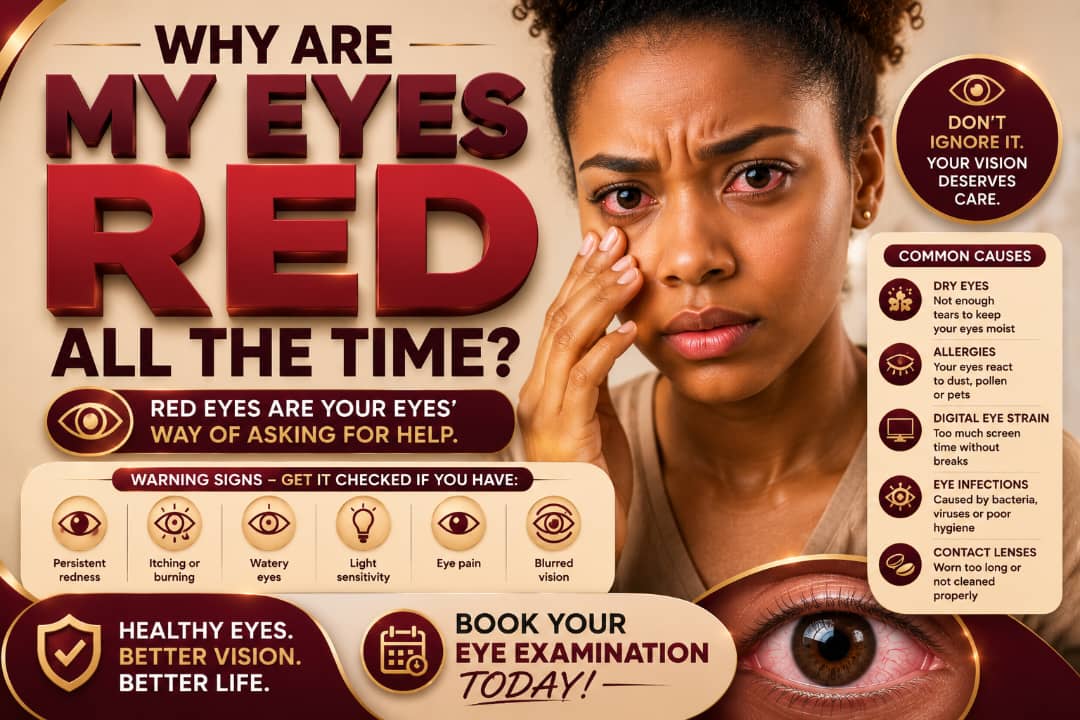
Why Are My Eyes Red All the Time?
Red eyes are one of the most common eye problems, but they don't all have the same cause. They may be due to allergies, dry eyes, lack of sleep, digital eye strain, infections, or more serious conditions like glaucoma. If your eyes are frequently red or the redness is accompanied by pain, blurred vision, or sensitivity to light, it's time to have them examined.
Why Are My Eyes Red All the Time?
Red eyes are extremely common, but they do not all mean the same thing.
Possible causes include:
- Dry eye
- Eye allergies
- Dust and Harmattan
- Eyelid inflammation
- Contact-lens problems
- Lack of sleep
- Environmental irritation
- Conjunctivitis
- A burst surface blood vessel
- Corneal problems
- Less commonly, more serious eye conditions
The important question is not simply:
“How do I make my eyes white again?”
It is:
“Why are they red?”
Quick Answer: Why Are My Eyes Always Red?
If your eyes are repeatedly red but not severely painful, common possibilities include:
- Dry or irritated eyes
- Allergies
- Dust
- Harmattan
- Eyelid inflammation
- Contact lenses
- Smoke or environmental irritants
If the red eye is accompanied by significant pain, reduced vision, strong sensitivity to light, injury or contact-lens-related pain, the situation deserves more urgent assessment.
A red eye is a symptom.
It is not a diagnosis.
Book Appointment
What Actually Makes the Eye Look Red?
The white part of your eye is called the sclera.
Over it sits a thin transparent tissue called the conjunctiva.
Tiny blood vessels run through this tissue.
Normally, you barely notice them.
When the eye becomes irritated or inflamed, those vessels can become larger and more visible.
That creates the familiar bloodshot appearance.
The question is:
What caused those blood vessels to become more noticeable?
1. Can Dry Eyes Make My Eyes Red?
Yes.
Dry eye does not simply mean:
“My eyes don't produce tears.”
You can have tears and still have an unstable tear film.
The tear film is the thin layer of moisture covering the front of the eye.
If it does not remain stable, the eye surface can become irritated.
Symptoms may include:
- Redness
- Burning
- Grittiness
- Watering
- Heavy eyes
- Fluctuating blurry vision
- Discomfort after screen use
One useful clue is vision that temporarily improves after blinking.
If your vision repeatedly becomes blurry and then clear, read Why Does My Vision Go Blurry Then Clear Again?.
Why Are My Eyes Watery If They Are Dry?
This sounds contradictory, but it can happen.
An irritated eye surface can trigger extra reflex tears.
Those tears may overflow even though the underlying eye surface remains uncomfortable.
So a person can genuinely complain:
“My eyes are red, dry and watering at the same time.”
If watering is a major symptom during reading or screen use, read Why Do My Eyes Water When I Read?.
2. Are Allergies Making My Eyes Red?
Very possibly, especially when itching is one of your strongest symptoms.
Eye allergies can cause:
- Redness
- Intense itching
- Watering
- Puffy eyelids
- Frequent eye rubbing
Possible triggers include:
- Dust
- Pollen
- Smoke
- Animal dander
- Other environmental allergens
A useful patient clue is:
Red + itchy + watery
That pattern often raises suspicion of allergy.
If itching is your biggest complaint, read Why Are My Eyes Always Itchy?.
3. Why Do My Eyes Get Red During Harmattan?
Harmattan can be difficult for people who already have sensitive eyes.
In Abuja, Harmattan commonly brings:
- Dust
- Dry air
- Wind
- Lower humidity
- More environmental irritation
This can worsen both:
dry-eye symptoms
and
eye allergies.
You may notice:
- Itching
- Redness
- Watering
- Burning
- Grittiness
- Increased eye rubbing
If your redness becomes noticeably worse during the dry season, read our guide on why your eyes itch and water during Harmattan.
4. Can Too Much Screen Time Make My Eyes Red?
Screen use can contribute indirectly.
When you concentrate on:
- Phones
- Laptops
- Tablets
- Documents on a computer
you may blink less frequently or less completely.
That can increase tear evaporation.
The eye surface may become dry and irritated, leading to symptoms such as:
- Burning
- Tired eyes
- Fluctuating blur
- Redness
- Watering
This is one reason someone may begin work with comfortable eyes and finish the day saying:
“My eyes look terrible every evening.”
If screens also make your eyes tired or heavy, read Why Do My Eyes Feel Tired After Using a Computer?.
5. Can Lack of Sleep Make My Eyes Red?
Poor sleep can make your eyes look and feel worse.
After several nights of inadequate sleep, you may experience:
- Tired eyes
- Dryness
- Heaviness
- Increased irritation
- More noticeable redness
But chronic red eyes should not automatically be dismissed with:
“I just need more sleep.”
If the redness continues even after your sleeping pattern improves, something else may be contributing.
6. Could My Eyelids Be Causing the Redness?
Yes.
Sometimes the problem is not primarily the eyeball.
It may start around the eyelids.
Blepharitis means inflammation around the eyelid margins.
You may notice:
- Red eyelids
- Itching
- Burning
- Crust around the eyelashes
- Flaky skin
- Grittiness
- Dry-eye symptoms
Eyelid inflammation and dry eye can also occur together.
So simply buying another bottle of “red eye drops” may not solve the problem.
7. Can Contact Lenses Cause Red Eyes?
Yes.
And this deserves more caution.
Contact lenses sit directly on the cornea.
Redness may occur because of:
- Wearing lenses too long
- Sleeping in lenses when this is not appropriate
- Poor hygiene
- Lens deposits
- Dryness
- A poorly fitting lens
- An eye-surface reaction
- Corneal infection
If your eye becomes red while wearing contact lenses:
remove the lenses.
Do not simply put another lens back into the irritated eye.
When Is a Red Eye in a Contact-Lens Wearer More Serious?
Seek prompt eye assessment if a contact-lens-related red eye also has:
- Pain
- Sensitivity to light
- Reduced vision
- Significant discharge
- Increasing redness
- A feeling that something is stuck in the eye
A corneal infection in a contact-lens wearer can become serious and should not be treated casually.
8. Is My Red Eye an Infection?
Possibly.
But:
Red eye does not automatically mean infection.
Conjunctivitis simply means inflammation of the conjunctiva, and there are different causes.
Infectious conjunctivitis may be:
- Viral
- Bacterial
Symptoms can vary.
You may experience:
- Redness
- Watering
- Irritation
- Discharge
- Crusting
- Eyelids sticking together
Some forms spread easily between people.
Good hand hygiene is important.
Avoid sharing:
- Towels
- Face cloths
- Eye makeup
- Eye drops
But do not assume every itchy or watery red eye needs antibiotics.
Allergy and dry eye can look similar.
What Is “Apollo”?
In Nigeria, many people call almost every red eye:
“Apollo.”
But medically, that is not specific enough.
A red eye might be:
- Viral conjunctivitis
- Bacterial conjunctivitis
- Allergy
- Dry eye
- Corneal disease
- Eyelid inflammation
- Another condition
So:
“My eye is red, therefore I have Apollo”
is not a reliable diagnosis.
9. Why Is There a Bright Red Patch in My Eye?
If you suddenly notice a sharply defined bright-red patch on the white of the eye, it may be a subconjunctival haemorrhage.
That means a small blood vessel under the conjunctiva has broken.
It can look dramatic.
You may think:
“There is blood inside my eye!”
But many uncomplicated subconjunctival haemorrhages are painless and do not affect vision.
They may happen after:
- Coughing
- Sneezing
- Straining
- Vomiting
- Heavy lifting
Sometimes there is no obvious trigger.
How Long Does a Burst Blood Vessel Take to Clear?
It usually fades gradually as the blood is reabsorbed.
The colour may change as it heals, similar to a bruise.
If the problem repeatedly returns, however, it is sensible to review possible contributing factors such as:
- Blood pressure
- Blood-thinning medications
- Bleeding problems
- Trauma
particularly when clinically appropriate.
Does High Blood Pressure Cause Red Eyes?
Ordinary everyday bloodshot eyes are not a reliable sign of high blood pressure.
High blood pressure can affect the retinal blood vessels at the back of the eye.
It may also be relevant in someone with recurrent subconjunctival haemorrhages.
But simply looking at someone's red eye cannot tell you their blood pressure.
The proper way to know is to measure it.
10. Can Glaucoma Cause a Red Eye?
Most glaucoma does not present as an ordinary red eye.
The common open-angle form usually develops quietly.
This is important because we should not frighten every person with a bloodshot eye by saying:
“It may be glaucoma.”
However, one particular condition called acute angle-closure glaucoma can cause a very different picture.
Possible symptoms include:
- Severe eye pain
- A red eye
- Sudden blurry or hazy vision
- Halos around lights
- Headache
- Nausea
- Vomiting
That combination is an emergency.
If your concern is glaucoma generally, read How Do I Know If I Have Glaucoma?.
11. Can an Eye Injury Cause Redness?
Yes.
Redness after an injury deserves more caution.
Examples include:
- Being hit in the eye
- Something entering the eye
- Metal or dust exposure
- Scratching the eye
- Chemical splash
Do not assume trauma-related redness is just irritation.
Book Appointment
What Should I Do If a Chemical Enters My Eye?
Start rinsing the eye immediately with plenty of clean running water or suitable irrigation fluid.
Do not wait for the redness to settle first.
After irrigation, seek urgent medical or eye assessment.
Chemical eye injuries can be serious.
Why Is Only One Eye Red?
One-sided redness may occur with many conditions, including:
- Irritation
- Foreign body
- Infection
- Corneal problems
- Contact-lens complications
- Subconjunctival haemorrhage
- Other eye inflammation
If only one eye remains persistently red, especially with pain or vision changes, have it examined.
Why Are Both Eyes Red?
When both eyes are red, possibilities may include:
- Allergy
- Dry eye
- Environmental exposure
- Viral infection
- Screen-related dryness
- Eyelid problems
Again, the pattern helps but does not prove the diagnosis.
Why Are My Eyes Red Every Morning?
Morning redness may be associated with:
- Dryness overnight
- Eyelid inflammation
- Allergy
- Sleeping under direct fan or air-conditioner airflow
- Poor sleep
- Certain environmental exposures
Look for additional clues.
Do your eyes also:
- Itch?
- Feel gritty?
- Have crusting?
- Become clearer later in the day?
- Water?
- Feel painful?
Those details help narrow down the cause.
Why Do My Eyes Become Red Every Evening?
If your eyes are fine in the morning and progressively redden during the day, think about your daily exposures.
For example:
- Hours on a computer
- Air conditioning
- Dust
- Long contact-lens wear
- Reduced blinking
- Eye rubbing
- Dry environments
That pattern may point toward accumulated surface irritation rather than an infection.
Why Are My Eyes Red but Don't Hurt?
Painless redness can happen with:
- Dry eye
- Allergy
- Mild environmental irritation
- Subconjunctival haemorrhage
- Certain forms of conjunctivitis
The absence of pain is reassuring in some situations, but persistent redness still deserves assessment if it does not settle or keeps returning.
Why Are My Eyes Red and Painful?
Pain changes the level of concern.
A painful red eye can occur with conditions involving:
- Cornea
- Significant inflammation
- Trauma
- Acute glaucoma
- Contact-lens complications
- Other serious eye problems
A red painful eye, especially with reduced vision or significant light sensitivity, should be assessed promptly.
What If Light Hurts My Red Eye?
Significant sensitivity to light is called photophobia.
A red eye with pronounced photophobia can suggest something more significant than ordinary allergy or mild dry eye.
Seek professional assessment, particularly if it is associated with:
- Pain
- Reduced vision
- Contact-lens use
- Trauma
Should I Use Eye Drops to Make My Eyes White?
Be careful.
There are drops marketed mainly to reduce redness by temporarily constricting surface blood vessels.
That may make the eye look whiter without treating the reason it became red.
Frequent use of some redness-relief drops can also contribute to rebound redness.
So the better question is not:
“Which drop will make my eyes white?”
It is:
“Why are my eyes becoming red?”
Can I Use Antibiotic Drops for Red Eyes?
Not simply because the eye is red.
Antibiotics treat particular bacterial infections.
They do not treat:
- Allergy
- Dry eye
- Harmattan irritation
- Most viral conjunctivitis
- Ordinary digital eye strain
Using antibiotics unnecessarily does not solve the underlying cause.
What About Steroid Eye Drops?
Do not routinely self-medicate with steroid eye drops.
Steroids can be extremely useful for certain properly diagnosed conditions.
But inappropriate use can cause serious problems, including:
- Increased eye pressure
- Cataract
- Worsening of certain infections
Steroid eye drops should be used under appropriate professional supervision.
What Can I Do at Home for Mild Red Eyes?
If the redness is mild and there are no warning symptoms, simple measures may help while you identify the trigger.
You can:
- Avoid rubbing your eyes
- Take regular screen breaks
- Blink naturally during close work
- Reduce direct fan or air-conditioner airflow
- Protect your eyes in dusty environments
- Keep contact lenses properly cleaned
- Avoid smoke and known irritants
- Get enough sleep
But persistent redness should not become something you simply learn to live with.
When Should I See an Optometrist for Red Eyes?
Arrange an eye examination if:
- Your eyes stay red repeatedly
- The redness keeps returning
- You constantly need eye drops
- Your eyes are also itchy or watery
- You have chronic burning or grittiness
- Your contact lenses frequently make your eyes red
- Your vision becomes blurry
- One eye remains much redder than the other
- You are simply unsure what is causing the problem
When Is a Red Eye an Emergency?
Seek urgent eye or medical assessment if redness is associated with:
- Significant eye pain
- Sudden reduction in vision
- Severe sensitivity to light
- A very painful contact-lens eye
- Chemical exposure
- Significant eye injury
- Severe headache with eye pain
- Halos with nausea or vomiting
- A foreign body that will not come out
Those symptoms should not wait for a routine appointment.
What Happens During an Eye Examination for Red Eyes?
At Blossom Vision Eye Clinic in Games Village, Abuja, we do not want to treat every red eye with the same bottle of drops.
Depending on your symptoms, the examination may assess:
- Visual acuity
- Eyelids and eyelashes
- Conjunctiva
- Cornea
- Tear film
- Signs of allergy
- Contact-lens related problems
- Eye pressure where appropriate
- Front of the eye using the slit lamp
- Other eye structures where clinically appropriate
We also want to know:
- When did the redness start?
- Is it one eye or both?
- Does it itch?
- Does it hurt?
- Is there discharge?
- Do you wear contact lenses?
- Does Harmattan make it worse?
- Are you using any eye drops already?
- Has your vision changed?
Those questions help separate one kind of red eye from another.
How Much Does It Cost to Get Red Eyes Checked?
The examination required depends on your symptoms and findings.
You can see our current guide explaining eye test costs in Abuja.
If you want to know what the overall eye examination involves, link this section to your “What Happens During a Comprehensive Eye Exam in Abuja?” article once its exact URL is confirmed.
Frequently Asked Questions
Why are my eyes red all the time?
Common possibilities include dry eye, allergy, eyelid inflammation, dust exposure, Harmattan, contact lenses and environmental irritation.
Why are my eyes red even though they don't hurt?
Painless redness may occur with dry eye, allergy, environmental irritation or a subconjunctival haemorrhage. Persistent redness should still be assessed.
Can dry eyes make my eyes red?
Yes. An unstable tear film can irritate the eye surface and make surface blood vessels more visible.
Can allergies make my eyes red?
Yes. Allergy commonly produces red, itchy and watery eyes.
Why are my eyes red during Harmattan?
Dust, low humidity and wind can worsen dry-eye and allergy symptoms.
Can computer use make my eyes red?
Prolonged screen use may reduce blinking and worsen eye-surface dryness, which can contribute to irritation and redness.
Are red eyes always an infection?
No. Allergy, dry eye and environmental irritation are also common causes of red eyes.
Do I need antibiotics for a red eye?
Not automatically. Antibiotics are appropriate for particular bacterial infections, not every red eye.
Why is only one eye red?
One-sided redness has many possible causes, including irritation, infection, corneal problems and foreign bodies. Persistent unilateral redness should be assessed.
Can lack of sleep make my eyes red?
Poor sleep can worsen eye discomfort and make redness more noticeable, but persistent redness may have another cause.
Should I worry about a bright red patch on my eye?
It may be a subconjunctival haemorrhage, which is often harmless, painless and self-limiting. Recurrent episodes or associated symptoms deserve evaluation.
Can glaucoma make my eye red?
Common open-angle glaucoma usually does not. Acute angle-closure glaucoma can cause a severe painful red eye with blurred vision, halos, headache, nausea or vomiting and requires urgent treatment.
When should I worry about a red eye?
Significant pain, reduced vision, severe light sensitivity, injury, chemical exposure or a painful contact-lens-related red eye require prompt assessment.
Where can I get red eyes checked in Abuja?
Blossom Vision Eye Clinic provides comprehensive eye assessment in the Games Village/Kaura District area of Abuja.
Don't Just Try to Make Your Eyes White
A red eye is your eye telling you:
Something is irritating or affecting me.
Sometimes the cause is simple.
Dryness.
Dust.
Allergy.
Poor sleep.
Sometimes the problem needs treatment.
And occasionally the combination of redness, pain and visual change means you should not wait.
At Blossom Vision Eye Clinic in Games Village, Abuja, we can examine the eye surface and eye health to determine what is actually causing the redness.
If your eyes are always red, stop guessing and find out why.