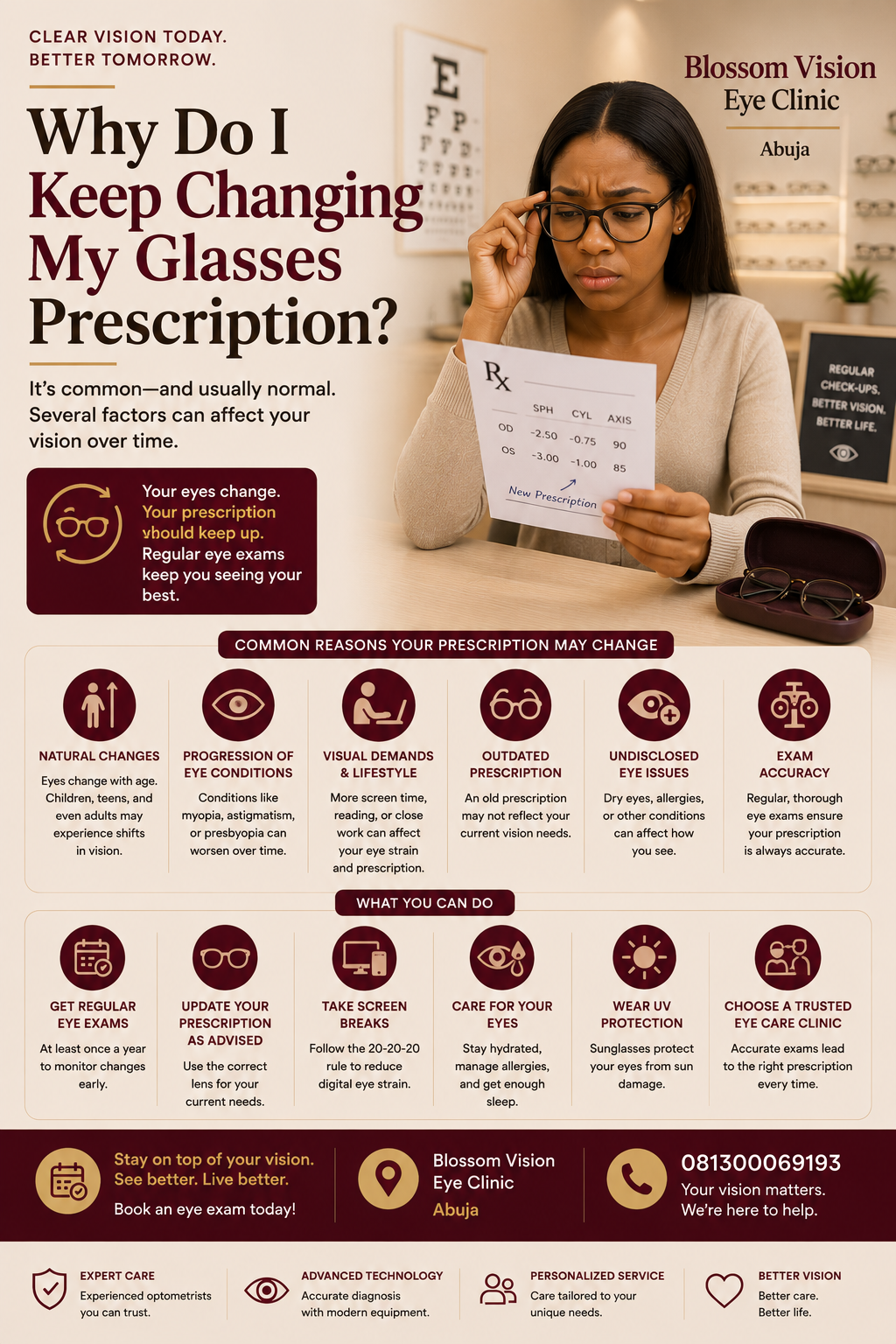
Why Do I Keep Changing My Glasses Prescription?
A changing glasses prescription can be completely normal, especially during childhood and early adulthood. However, frequent prescription changes may also be caused by diabetes, cataracts, dry eyes, keratoconus, eye strain, or other underlying eye conditions. If your vision seems to be changing more often than expected, a comprehensive eye examination can help identify the cause.
Why Do I Keep Changing My Glasses Prescription?
You made new glasses last year.
A few months later, things started looking blurry again.
You went back for another eye test.
The prescription changed.
Now you are wondering:
“Why does my glasses prescription keep changing?”
or:
“Are my eyes getting weaker?”
A changing prescription does not automatically mean your eyes are becoming damaged or weaker.
Sometimes prescription changes are expected.
Children's eyes are still growing. Adults experience natural changes with age. Short-sightedness may progress. Reading prescriptions change as we get older.
But frequent, rapid or unpredictable changes can sometimes happen because of something else, including:
- Blood sugar fluctuations
- Dry eye
- Cataract
- Keratoconus
- Changes in the cornea
- Pregnancy or hormonal changes
- Certain medications
- An inaccurate previous prescription
- Problems with the glasses rather than the eyes
The important question is not simply:
“Do I need stronger glasses again?”
It is:
“Why has my vision changed?”
Quick Answer
Your glasses prescription may change because:
- Your eyes are still growing
- Childhood myopia is progressing
- You are developing presbyopia with age
- Your blood sugar is fluctuating
- Your tear film is unstable
- Cataracts are changing how light focuses inside the eye
- Your cornea is changing shape
- Your previous prescription or glasses measurements were not ideal
Small gradual changes can be normal.
A prescription that changes rapidly, repeatedly or unpredictably deserves a more detailed eye examination.
Book Appointment
Is It Normal for My Glasses Prescription to Change?
Sometimes.
A prescription is not necessarily something you receive once and keep for life.
Your eyes can change.
But how much, how quickly and why the prescription changes matter.
For example:
A child whose short-sightedness becomes gradually stronger over several years is very different from an adult whose prescription suddenly changes significantly within a few months.
Likewise, someone whose vision fluctuates from morning to evening may not actually need a new permanent prescription every time the vision seems different.
That pattern may point to another problem.
Why Does My Glasses Prescription Keep Getting Stronger?
There are several possibilities.
1. Your Child's Eyes May Still Be Growing
Prescription changes are particularly common during childhood.
A child may begin with mild short-sightedness and become progressively more short-sighted as the eye grows.
Parents often notice:
“Every year we come back, the glasses are stronger.”
That may represent progressive myopia.
Myopia means distant objects are blurry while near objects remain clearer.
If your child's prescription keeps becoming more short-sighted, do not simply assume stronger ordinary glasses are the only option.
Read our guide on how to slow worsening short-sightedness in children.
If you are not yet sure if your child even needs glasses, see How Do I Know If My Child Needs Glasses?.
Does Wearing Glasses Make My Eyes Weaker?
No.
This is one of the most persistent myths about glasses.
Correctly prescribed glasses do not make your eyes lazy or dependent on them.
What usually happens is simpler:
As your prescription changes, you become more aware of how blurry the world looks without correction.
The glasses are revealing the difference, not causing the problem.
If your prescription increases, the question should be why your eyes changed, not whether wearing glasses caused the change.
Can Diabetes Make My Glasses Prescription Change?
Yes.
Blood sugar changes can temporarily affect the way the natural lens inside your eye focuses light.
That means someone with significant blood sugar fluctuations may experience:
- Blurry vision
- Vision that changes from day to day
- A prescription that seems different at different visits
- Glasses that suddenly feel too strong or too weak
This is one reason it can be unhelpful to repeatedly make new glasses while blood sugar is significantly unstable.
The problem may not be the glasses.
The focusing power of the eye itself may be temporarily changing.
If you have diabetes, read our guide on how diabetes can affect your eyes even when you can still see clearly.
Why Is My Vision Blurry Some Days but Clear on Other Days?
That does not automatically mean your prescription is changing every day.
Possible causes include:
- Dry eye
- Blood sugar fluctuations
- Contact lens problems
- Fatigue
- Tear-film instability
- Focusing problems
One useful clue is whether your vision improves after blinking.
If it does, the tear film may be contributing.
Read our guide on why vision sometimes goes blurry and then clear again.
Can Dry Eyes Change My Glasses Prescription?
Dry eye can make vision and prescription measurements less consistent.
The tear film is the first optical surface light passes through.
If it becomes unstable, you may experience:
- Fluctuating blur
- Difficulty focusing
- Vision improving after blinking
- Different responses during refraction
- Glasses seeming clearer at some times than others
This can create the impression that your prescription keeps changing.
Sometimes the better approach is to stabilise the eye surface before repeatedly changing the glasses.
Why Do My New Glasses Feel Wrong?
A new pair feeling wrong does not necessarily mean your eyes changed.
Possible reasons include:
- Incorrect prescription
- Incorrect pupillary distance
- Lens centration problems
- Incorrect progressive-lens measurements
- Frame position
- Lens design
- Significant prescription change requiring adaptation
- Dry eye
- The prescription being measured while vision was unstable
If your new glasses remain uncomfortable, they should be checked rather than automatically assuming you simply “need time.”
Can Cataracts Change My Glasses Prescription?
Yes.
A cataract is a change in the natural lens inside the eye.
As that lens changes, its focusing power may also change.
Some people experience what is sometimes called a myopic shift, meaning their prescription becomes more short-sighted.
You may notice:
- Increasing blur
- Changing prescriptions
- More glare
- Halos
- Difficulty driving at night
- Reduced contrast
- Colours looking less bright
A new prescription may temporarily improve vision in early cataract.
But if the cataract continues progressing, repeatedly changing glasses will not remove the clouding inside the natural lens.
If your biggest problem is night glare, read Why Do Headlights Blind Me at Night?.
Can Keratoconus Make My Prescription Keep Changing?
Yes.
This is an important cause of repeatedly changing or increasing astigmatism, particularly in younger people.
Keratoconus happens when the cornea gradually becomes thinner and changes shape.
A person may notice:
- Increasing astigmatism
- Frequent prescription changes
- Distorted vision
- Ghost images
- Starbursts
- Difficulty seeing clearly even with glasses
- One eye being much worse than the other
A common complaint is:
“Every time I make new glasses, they still don't feel quite right.”
If the prescription or astigmatism is changing unusually quickly, the cornea may need further assessment.
Why Does My Astigmatism Keep Changing?
Small measurement differences can happen.
But increasing or irregular astigmatism deserves attention.
Possible explanations include:
- Natural corneal changes
- Dry eye affecting measurements
- Contact-lens wear
- Keratoconus
- Other corneal irregularities
A routine refraction alone may not explain the reason.
Your optometrist may need to examine the cornea more closely and arrange additional testing if something looks unusual.
Can Eye Strain Change My Prescription?
Eye strain can make your vision feel worse, but it does not usually cause a permanent prescription change by itself.
Long periods of:
- Computer work
- Phone use
- Reading
- Close work
can lead to:
- Temporary blur
- Headaches
- Heavy eyes
- Difficulty switching focus
- Tired eyes
That can make someone think:
“My glasses have stopped working.”
But after resting, blinking or looking farther away, the vision may improve.
If screen use is the main trigger, read Why Do My Eyes Feel Tired After Using a Computer?.
Why Does My Reading Prescription Keep Changing After 40?
Around the 40s, most people begin developing presbyopia.
Presbyopia is the normal age-related reduction in the eye's ability to focus at close distances.
You may notice:
- Holding your phone farther away
- Needing brighter light
- Small print becoming difficult
- Removing your distance glasses to read
- Reading glasses no longer feeling strong enough
The near prescription may gradually change as presbyopia progresses.
That is different from an eye disease causing rapid unpredictable changes.
An examination can distinguish the two.
Can Pregnancy Change My Glasses Prescription?
Hormonal and fluid changes during pregnancy can sometimes temporarily affect the cornea and vision.
Some women notice:
- Blurry vision
- Contact lenses feeling different
- Mild prescription changes
Not every vision change during pregnancy is simply hormonal, however.
Sudden visual symptoms, especially when associated with severe headache, high blood pressure or other concerning symptoms, need proper medical assessment.
Can Medication Affect My Vision or Prescription?
Some medicines can influence:
- Focusing
- Tear production
- Pupil size
- Blood sugar
- The natural lens
- Eye pressure
If your vision changed soon after starting or changing medication, tell your optometrist exactly what you are taking.
Do not stop prescribed medication simply because you suspect it may affect your eyes.
The prescribing doctor and eye-care professional can determine the appropriate next step.
What If My Prescription Changed Because the First Eye Test Was Wrong?
That can happen.
No clinical measurement is perfect.
Refraction can be affected by:
- Rushing the examination
- Poor responses during testing
- Dry eye
- Fatigue
- Accommodation, which is the eye's focusing effort
- Unstable blood sugar
- Previous contact-lens wear
There is also a difference between:
the prescription being correct
and
the finished glasses being made correctly.
Problems with lens measurements, centration or fitting can make the glasses feel wrong even when the written prescription itself is accurate.
Book Appointment
Can My Glasses Be Wrong Even If the Prescription Is Correct?
Yes.
Making glasses requires more than the prescription written on paper.
Depending on the lens, important measurements may include:
- Pupillary distance
- Optical centre placement
- Fitting height
- Frame position
- Lens design
If those measurements are inappropriate, vision can feel uncomfortable even with the correct prescription.
This is particularly important with:
- High prescriptions
- Progressive lenses
- Prism
- Specialised lenses
Why Can't I See Clearly Even With New Glasses?
There are several possibilities.
Your prescription may be inaccurate.
But the problem may also be:
- Dry eye
- Cataract
- Corneal irregularity
- Retinal disease
- Optic nerve disease
- Poor lens positioning
- Another eye-health condition
This is why the question should sometimes change from:
“What stronger glasses do I need?”
to:
“Why isn't glasses correction giving me clear vision?”
If this is your main problem, read Why Can't I See Clearly Even With My Glasses?.
Should I Keep Making New Glasses Every Time My Vision Changes?
Not automatically.
If your prescription has genuinely changed and your eyes are otherwise healthy, new glasses may be exactly what you need.
But if the change is:
- Very rapid
- Large
- Different from day to day
- Difficult to measure consistently
- Associated with other symptoms
then simply making another pair may not solve the real problem.
The eye examination should investigate the reason first.
How Often Should I Check My Glasses Prescription?
There is no single rule for everybody.
The appropriate interval depends on:
- Age
- Symptoms
- Medical history
- Eye-health findings
- Existing prescription
- Previous rate of change
- Diabetes
- Childhood myopia
- Other risk factors
A child with rapidly progressing myopia may need closer monitoring than an adult whose prescription has been stable for several years.
Your optometrist should recommend a review interval based on your findings.
When Should Frequent Prescription Changes Worry Me?
Arrange an eye examination if:
- Your prescription changes several times within a short period
- Your vision fluctuates significantly
- One eye changes much more than the other
- Astigmatism is increasing rapidly
- You cannot get clear vision despite several pairs of glasses
- Night glare is becoming worse
- You see ghost images
- Your blood sugar is unstable
- Your vision suddenly changes
- You develop other eye symptoms
The pattern is more important than one small prescription change.
When Is a Vision Change Urgent?
A gradual change in glasses prescription is usually not an emergency.
But seek urgent eye or medical care for:
- Sudden major vision loss
- A curtain or shadow over your vision
- Sudden new flashes with many floaters
- Severe eye pain
- Sudden double vision
- Sudden vision changes with weakness, facial drooping or difficulty speaking
- Significant eye injury
Do not assume a sudden major visual change simply means you need stronger glasses.
What Happens During an Eye Examination for a Changing Prescription?
At Blossom Vision Eye Clinic in Games Village, Abuja, we do not want to answer only:
“What prescription do you need today?”
We also want to understand:
“Why has it changed?”
Depending on your history and symptoms, the examination may include:
- Visual acuity
- Refraction
- Comparison with previous prescriptions
- Eye pressure
- Tear-film assessment
- Corneal examination
- Slit-lamp examination
- Retinal examination
- Optic nerve assessment
- Other tests where clinically appropriate
We may also ask about:
- Diabetes
- Medication
- Previous glasses
- Contact-lens use
- Family eye history
- How quickly the changes occurred
The aim is to determine whether the change is expected or whether something else needs investigation.
How Much Does an Eye Test Cost in Abuja?
The total depends on the examination and any additional testing required.
You can see our current guide to the cost of an eye test in Abuja.
If you are not sure which type of eye doctor you need, read Should I See an Optometrist or an Ophthalmologist?.
Frequently Asked Questions
Why does my glasses prescription keep changing?
Possible causes include normal growth, progressing myopia, ageing, blood sugar fluctuations, cataract, dry eye affecting measurements, corneal changes such as keratoconus and problems with the previous prescription or glasses.
Is it normal for my glasses prescription to change every year?
It can be, particularly in children with progressing myopia and adults experiencing age-related changes. The amount and pattern of change matter more than simply whether a change occurred.
Does a stronger prescription mean my eyes are getting weaker?
No. Glasses correct the focusing problem that already exists. They do not make your eyes weaker.
Can diabetes change my prescription?
Yes. Significant blood sugar fluctuations can temporarily change how the natural lens focuses, causing blurry or changing vision.
Can dry eye make my prescription look different?
Yes. An unstable tear film can make vision and refraction measurements inconsistent.
Can cataracts change my glasses prescription?
Yes. Cataract changes can alter the focusing power of the natural lens and sometimes cause repeated prescription changes.
Can keratoconus cause frequent prescription changes?
Yes. Keratoconus can cause increasing or irregular astigmatism and may make ordinary glasses progressively less effective.
Can eye strain make my prescription stronger?
Eye strain can cause temporary blur and focusing discomfort, but it does not usually create a permanent refractive change by itself.
Why does my vision change from day to day?
Dry eye, blood sugar fluctuations, fatigue and focusing problems are among the possible causes. Day-to-day changes are not necessarily true permanent prescription changes.
Why do my new glasses still feel wrong?
Possible explanations include adaptation, an incorrect prescription, lens positioning, frame fit, dry eye or an underlying eye condition.
Should I keep buying stronger glasses?
Only if an examination confirms that the prescription has genuinely changed and the new prescription is appropriate. Repeated or unexplained changes should be investigated.
Where can I get my prescription checked in Abuja?
Blossom Vision Eye Clinic provides comprehensive eye examinations and prescription assessment in the Games Village/Kaura District area of Abuja.
Don't Just Ask for Stronger Glasses
If you find yourself saying:
“Every time I make new glasses, I need another prescription.”
do not automatically assume your eyes are simply getting weaker.
Sometimes the change is completely expected.
Sometimes the vision only appears to be changing because of dry eye or fluctuating blood sugar.
And occasionally repeated prescription changes give us an important clue about cataract, keratoconus or another eye condition.
At Blossom Vision Eye Clinic in Games Village, Abuja, we can assess both your prescription and your eye health to understand what is actually changing.
If your glasses prescription keeps changing, book a comprehensive eye examination and find out why before simply making another pair.