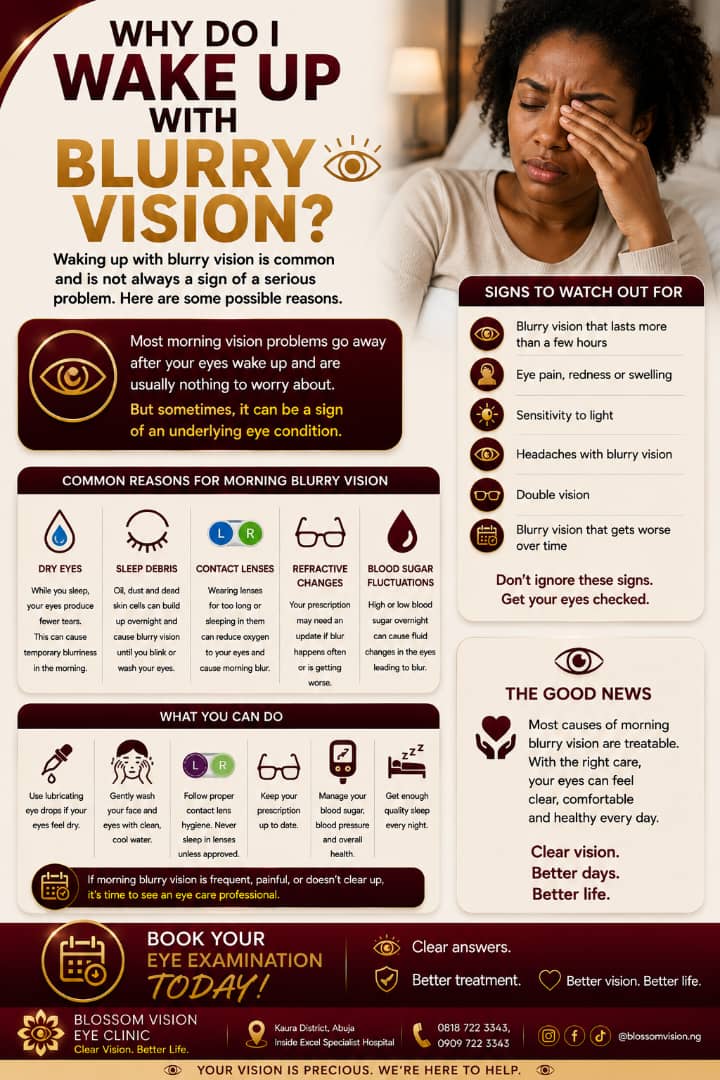
Why Do I Wake Up With Blurry Vision?
Why Do I Wake Up With Blurry Vision?
Waking up with blurry vision is often related to dry eyes, the way your eyelids close during sleep, contact lens wear, temporary changes on the surface of the eye or changes in blood sugar.
For some people, the blurriness disappears after a few blinks. For others, it lasts longer or happens every morning.
Occasional brief blurring may not be serious, but repeated or worsening morning blurry vision deserves an eye examination to find the cause.
Quick Answer
Have you ever opened your eyes in the morning and thought:
“Why is everything blurry?”
Maybe your bedroom looks out of focus.
Perhaps you pick up your phone and struggle to read the screen.
Then you blink several times and, after a few seconds or minutes, everything becomes clearer.
There are several possible reasons this can happen.
One of the most common is an unstable tear film or dry eye. But contact lens problems, corneal changes, blood sugar fluctuations, cataract, prescription changes and other eye conditions can also affect morning vision.
The important question is not simply whether your sight clears.
It is why the blurring keeps happening.
Book Appointment
Is Blurry Vision When You Wake Up Normal?
A few seconds of mild blur after waking can happen.
During sleep, your eyes behave differently from when you are awake. Your eyelids remain closed, blinking stops and the tear film over the front of your eyes changes.
After waking, blinking redistributes your tears and the eye surface returns to its normal daytime state.
However, arrange an eye examination if the blur:
- Happens almost every morning
- Lasts several minutes or longer
- Is becoming worse
- Mainly affects one eye
- Comes with pain, redness or light sensitivity
- Interferes with reading, driving or work
Morning blurry vision is a symptom, not a diagnosis.
What Causes Blurry Vision in the Morning?
1. Dry Eye Disease
Dry eye is one of the most common causes of vision that looks blurry immediately after waking.
Your tears are important not only for comfort but also for clear vision.
They create a smooth surface over the front of the eye.
If that tear layer becomes unstable overnight, you may wake up with:
- Blurry vision
- Burning
- Watering
- Grittiness
- Redness
- Tired or uncomfortable eyes
Blinking may temporarily improve the vision because fresh tears spread across the eye.
If your vision repeatedly becomes clearer after blinking, read our guide on why vision may go blurry and then clear again.
2. Sleeping With Your Eyes Slightly Open
Some people do not completely close their eyelids while sleeping.
This is sometimes called nocturnal lagophthalmos, which simply means part of the eye remains exposed during sleep.
That exposed area can become dry overnight.
You may wake up with:
- Blurry vision
- Burning
- Redness
- Grittiness
- Eye discomfort
- Sensitivity to light
Many people do not know they sleep this way until someone notices it or an eye examination suggests it.
3. Sleeping in Contact Lenses
Sleeping in contact lenses that were not specifically prescribed for overnight wear can increase the risk of eye problems.
The front of the eye receives less oxygen while the eyelids are closed, and a contact lens can reduce that oxygen further.
You may wake up with:
- Blurred vision
- Redness
- Dryness
- Pain
- Light sensitivity
Sleeping in lenses can also increase the risk of corneal infection.
If you wake up with significant pain, redness and light sensitivity after sleeping in contact lenses, seek prompt eye care.
4. Temporary Corneal Swelling
The cornea is the clear front surface of the eye.
During sleep, mild changes can occur in the amount of fluid within the cornea.
For most people, this causes no noticeable problem.
In some people, however, temporary corneal swelling may make vision hazy on waking and improve as the morning progresses.
Persistent morning haze should be examined rather than assumed to be normal.
5. Blood Sugar Changes
Changes in blood sugar can temporarily affect focusing inside the eye.
People living with diabetes may notice that their vision becomes clearer or blurrier as blood sugar levels change.
If you have diabetes and your vision repeatedly fluctuates, both your eye health and blood sugar management deserve proper review.
Repeated blurring should not automatically be treated by simply changing your glasses prescription.
6. Your Glasses Prescription May Have Changed
Your prescription can change gradually.
Sometimes you notice the difference more clearly after waking, during reading or after prolonged visual work.
Signs may include:
- Needing to squint
- Headaches
- Eye strain
- Difficulty reading
- Distance vision that is no longer as sharp
- One eye appearing clearer than the other
If one eye is noticeably worse, read our guide on why one eye may be blurrier than the other.
7. Cataract
A cataract is a gradual clouding of the natural lens inside the eye.
It usually develops slowly rather than suddenly.
Possible symptoms include:
- Gradually blurry vision
- Increasing glare
- Halos around lights
- Difficulty seeing at night
- Colours appearing less bright
- Vision that no longer improves enough with your current glasses
Morning haziness alone does not prove that you have cataract, but an eye examination can determine if the lens is contributing to your symptoms.
8. Glaucoma and High Eye Pressure
Most common forms of glaucoma develop gradually and do not usually cause obvious morning blurriness in the early stages.
However, very high eye pressure in certain types of glaucoma can cause blurred vision together with symptoms such as severe eye pain, redness, headache, nausea or halos around lights.
That requires urgent assessment.
Glaucoma is often detected through examination rather than symptoms, which is why regular testing matters.
You can read our guide on glaucoma screening and glaucoma test costs in Abuja.
Book Appointment
Why Does My Vision Clear After I Blink?
This is an important clue.
Blinking spreads a fresh layer of tears across the surface of your eye.
If the tear film is uneven or dry, your vision may become blurry.
After you blink, the tear layer temporarily becomes smoother and your vision may improve.
This pattern often suggests that the eye surface or tear film may be contributing.
It does not prove the diagnosis, but it is useful information to tell your optometrist.
Why Is Only One Eye Blurry When I Wake Up?
Morning blurring does not always affect both eyes equally.
One eye may have:
- More dryness
- A different glasses prescription
- A contact lens problem
- Corneal changes
- Cataract
- Another eye condition
If one eye is consistently blurrier than the other, do not simply assume the stronger eye will compensate indefinitely.
Our guide on why one eye may be blurrier than the other explains this in more detail.
Can Morning Blurry Vision Be Caused by Dry Eye?
Yes.
Dry eye is a common cause of temporary blurred vision, especially when the blur improves after blinking.
You may also notice:
- Burning
- Grittiness
- Watering
- Tired eyes
- Screen discomfort
- Redness
If your eyes also feel unusually tired or heavy, read our guide on why your eyes may feel heavy all the time.
Should I Be Worried About Blurry Vision in the Morning?
Most cases of brief morning blur are not emergencies.
However, repeated symptoms deserve investigation.
Arrange an eye examination if:
- It happens every morning
- The blur lasts longer than it used to
- Your vision is gradually worsening
- One eye is significantly worse than the other
- Your glasses no longer seem effective
- You have diabetes
- You regularly sleep in contact lenses
- You experience repeated eye pain or redness
If you would like to know what happens during an examination and the current fees, read our guide to eye test prices and what is included in an eye examination in Abuja.
When Is Morning Blurry Vision an Emergency?
Seek urgent medical attention if blurred vision is accompanied by:
- Sudden significant vision loss
- Severe eye pain
- A very red painful eye
- New flashes of light
- A sudden increase in floaters
- A curtain or shadow over your vision
- New double vision
- Significant light sensitivity
- Weakness, facial drooping or difficulty speaking
- Blurred vision after a significant eye injury
These symptoms should not wait for a routine appointment.
What Can I Do at Home?
If your symptoms are mild and temporary, simple habits may help.
Try:
- Getting enough good-quality sleep
- Avoiding sleeping in contact lenses unless specifically prescribed for overnight wear
- Blinking fully after waking
- Staying hydrated
- Taking regular breaks from prolonged screen use
- Following the dry-eye treatment already recommended by your eye-care professional
Avoid repeatedly trying different eye drops without knowing the cause.
If the problem keeps returning, an examination is more useful than guessing.
What Happens During an Eye Examination?
At Blossom Vision Eye Clinic, we do not simply test whether you can read letters on a chart.
We try to understand why your morning vision is blurry.
Depending on your symptoms and examination findings, your assessment may include:
- Vision testing
- Glasses prescription assessment
- Dry eye evaluation
- Examination of the cornea and front of the eye
- Eye pressure measurement
- Examination of the retina
- Assessment of the optic nerve
- Overall eye health evaluation
Additional tests may be recommended if your findings suggest they are necessary.
Book Appointment
How We Help at Blossom Vision Eye Clinic, Abuja
Morning blurry vision may seem like a small inconvenience, but repeated changes in vision deserve a proper explanation.
At Blossom Vision Eye Clinic in Games Village, Abuja, our optometrists take time to understand when your symptoms happen, how long they last and what makes them better or worse.
We then examine your eyes carefully and explain our findings in simple language.
The solution may involve managing dry eye, updating your prescription, changing contact lens habits or arranging further investigation depending on what we find.
Key Takeaways
- A few seconds of mild blur after waking can happen.
- Morning blur that repeatedly returns deserves attention.
- Dry eye is a common cause.
- Sleeping with the eyes partly open can dry the eye surface overnight.
- Contact lens wear can contribute to morning blur and, in some situations, increase the risk of infection.
- Blood sugar changes can cause fluctuating vision.
- One eye being consistently blurrier than the other should be investigated.
- Sudden vision loss, severe pain, flashes, new floaters or a curtain-like shadow require urgent assessment.
Frequently Asked Questions
Why is my vision blurry when I first wake up?
Possible causes include dry eye, tear-film changes, sleeping with the eyes partly open, contact lens wear, blood sugar changes, prescription changes and other eye conditions.
Is blurry vision in the morning normal?
A few seconds of mild blur may occur. Morning blur that happens repeatedly, lasts longer or becomes worse should be examined.
Can dry eyes cause blurry vision when I wake up?
Yes. An unstable tear film can cause temporary blurred vision, particularly if the vision improves after blinking.
Why does my vision become clear after a few minutes?
Blinking spreads tears across the eye, and temporary changes in the cornea and focusing system may settle after you wake up.
Why is only one eye blurry in the morning?
One eye may be drier, have a different prescription or have another condition affecting it more than the other eye. Persistent one-sided blur should be assessed.
Can diabetes cause blurry vision in the morning?
Changes in blood sugar can cause temporary changes in vision. Repeated fluctuations in someone living with diabetes deserve proper eye and medical review.
Should I worry if the blur clears after blinking?
Clearing after blinking can suggest a tear-film or dry-eye problem, but if it keeps happening, an eye examination can help confirm the cause.
When should I book an eye examination?
Book an examination if morning blur happens repeatedly, is getting worse, lasts several minutes or more, affects one eye significantly or interferes with everyday activities.
Wake Up to Clearer Vision
Your mornings should not begin with repeated blurry vision and uncertainty.
If this keeps happening, finding the cause is better than simply waiting for your sight to clear each morning.
At Blossom Vision Eye Clinic in Games Village, Abuja, we can examine your eyes, explain what may be causing the problem and recommend the appropriate next step.
Book your comprehensive eye examination today.