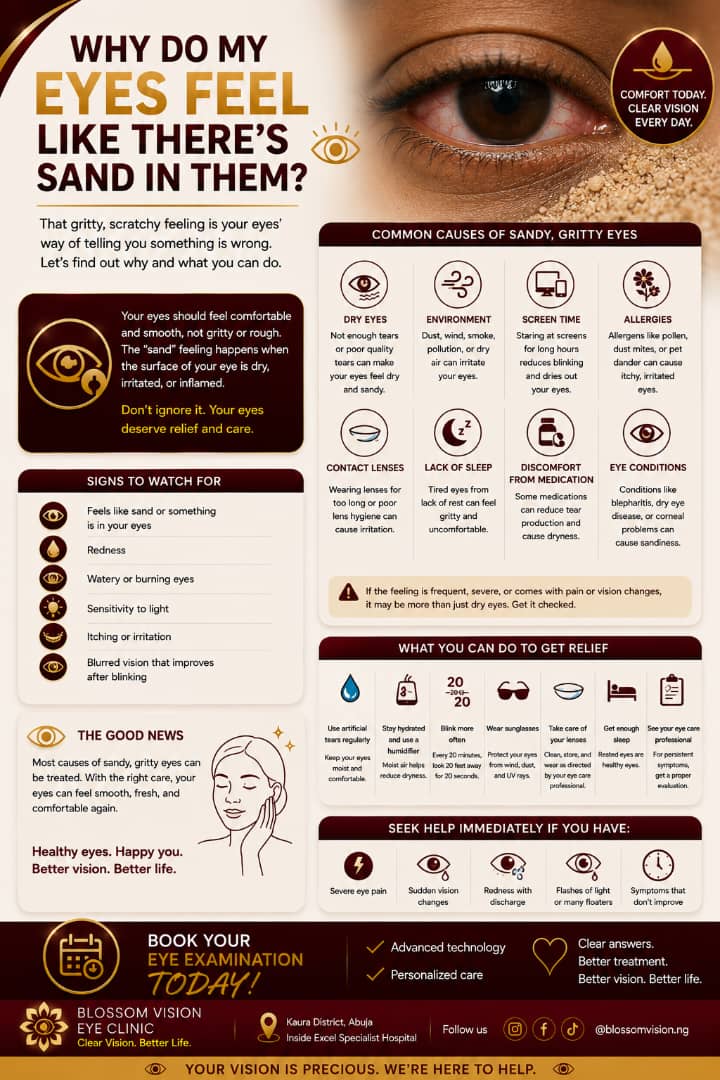
Why Do My Eyes Feel Like There's Sand in Them?
Why Do My Eyes Feel Like There's Sand in Them?
This is one of the most common ways patients describe what eye-care professionals call a foreign-body sensation.
That name simply means:
“It feels like something is inside my eye.”
But here is the surprising part:
There may be nothing physically inside the eye at all.
Dry eye, eyelid inflammation and problems affecting the cornea can all create the same gritty or sandy sensation.
Sometimes, however, there really is something inside the eye.
The job is to determine which situation you are dealing with.
Quick Answer: Why Do My Eyes Feel Sandy or Gritty?
Possible causes include:
- Dry eye
- Blepharitis
- Blocked eyelid oil glands
- Dust or another foreign body
- An eyelash rubbing the eye
- A corneal scratch
- Contact-lens irritation
- Allergy
- Eye-surface inflammation
- Certain infections
Dry eye in particular can cause a scratchy feeling that patients describe as though something is stuck in their eye.
But if the sensation is accompanied by:
significant pain
a very red eye
light sensitivity
or:
reduced vision
we need to think beyond ordinary dryness.
Book Appointment
What Is “Foreign-Body Sensation”?
It sounds like something must be inside the eye.
Not necessarily.
The front surface of your eye is extremely sensitive.
Your eyelids move across that surface every time you blink.
If the surface becomes dry, scratched or inflamed, your nerves may interpret that irritation as:
“Something is rubbing against me.”
So the patient says:
“Doctor, there's sand inside my eye.”
even though examination may reveal no sand at all.
1. Can Dry Eyes Feel Like Sand?
Yes.
This is a classic dry-eye complaint.
The National Eye Institute lists a scratchy feeling, including the sensation that something is in the eye, among the symptoms of dry eye.
Your tears normally form a smooth protective layer over the front surface of your eyes.
If your eyes:
- Do not produce enough tears
- Lose tears too quickly
- Have an unstable tear film
the surface may become irritated.
You may experience:
- Sandiness
- Grittiness
- Burning
- Stinging
- Watering
- Redness
- Fluctuating blurry vision
The strange part is that dry eyes can also water excessively.
An irritated eye surface may trigger reflex tearing.
So:
watery eyes do not automatically mean your eyes cannot be dry.
Why Does Blinking Sometimes Make My Vision Clearer?
Your tear film is part of the eye's optical surface.
Blinking temporarily spreads fresh tears across the cornea.
Someone with an unstable tear film may notice:
blurry → blink → clearer → blurry again.
If your vision repeatedly becomes blurry and then clear again, read Why Does My Vision Go Blurry Then Clear Again?.
2. What Is Blepharitis?
Sometimes the problem is not primarily the eyeball.
It starts at the eyelids.
Blepharitis means inflammation around the eyelid margins.
It may cause:
- Grittiness
- Burning
- Itching
- Red eyelids
- Crusting around the eyelashes
- Dry-eye symptoms
- Watering
You may notice it particularly when you wake up.
A patient may say:
“Every morning my eyes feel dirty.”
or:
“It feels as if I slept with sand in my eyes.”
In some cases the eyelids and tear film need attention together.
3. What Do the Oil Glands in My Eyelids Have to Do With Gritty Eyes?
Your eyelids contain tiny glands called meibomian glands.
They produce an oily layer that helps slow the evaporation of your tears.
If these glands do not work properly, the tear film may become unstable.
The eye can then feel:
- Dry
- Scratchy
- Burning
- Gritty
- Tired
This is why simply adding random drops may not completely solve every dry-eye problem.
Sometimes the eyelids themselves are contributing.
4. Could There Actually Be Sand or Dust in My Eye?
Yes.
Sometimes the simplest explanation is the correct one.
Possible foreign bodies include:
- Dust
- Sand
- An eyelash
- Tiny pieces of debris
- Plant material
- Metal particles
Foreign bodies and corneal abrasions commonly produce:
- Foreign-body sensation
- Tearing
- Redness
- Pain when blinking
and sometimes reduced vision if the central cornea is affected.
If the sensation started suddenly after something entered your eye, tell your optometrist exactly what happened.
Why Does a Tiny Particle Hurt So Much?
Because the cornea is extremely sensitive.
The cornea is the clear front window of the eye.
Something tiny enough that you cannot see it in a mirror may still produce significant discomfort.
You may feel it every time your eyelid moves across the surface.
5. Can an Eyelash Get Stuck Under My Eyelid?
Yes.
An eyelash or small particle can sometimes sit underneath the upper eyelid.
Every time you blink, it may move across the cornea.
The patient often says:
“It feels worse when I blink.”
A proper eye examination may include looking underneath the eyelid when a hidden foreign body is suspected. Slit-lamp examination and eyelid eversion are standard ways clinicians assess corneal abrasions and foreign bodies.
Do not keep aggressively rubbing the eye trying to move it.
6. Can My Own Eyelashes Scratch My Eye?
Yes.
Sometimes the problem is not a loose eyelash.
An eyelash may actually be growing or turning toward the eye.
This is called trichiasis.
The lash repeatedly rubs against the eye surface and may produce:
- Foreign-body sensation
- Watering
- Redness
- Irritation
- Corneal injury
The patient may repeatedly think:
“Something is trapped in my eye.”
but the problem keeps returning because the eyelash itself is rubbing the cornea.
7. Could My Cornea Be Scratched?
Yes.
A scratch on the cornea is called a corneal abrasion.
Possible causes include:
- Fingernails
- Makeup brushes
- Tree branches
- Dust
- Contact lenses
- Foreign bodies
- Eye rubbing after something enters the eye
A corneal abrasion may cause:
- Strong foreign-body sensation
- Pain
- Watering
- Redness
- Light sensitivity
Corneal abrasions and foreign bodies are common causes of this type of symptom.
How Can Such a Small Scratch Hurt So Much?
Because the cornea contains many sensory nerve endings.
A tiny surface injury can therefore be disproportionately uncomfortable.
The size of the scratch does not necessarily predict how painful it feels.
Why Does a Corneal Scratch Hurt More When I Blink?
Every blink moves the eyelid over the injured surface.
That may make the scratch more noticeable.
Surface pain associated with blinking and photophobia can suggest corneal involvement such as a foreign body or abrasion.
8. Why Does My Eye Feel Gritty When I Wake Up?
This is worth asking because timing provides useful clues.
Morning grittiness may occur with:
- Dry eye
- Blepharitis
- Eyelid inflammation
- Dry bedroom air
- Air conditioning
- Fan exposure
But there is another condition worth knowing about.
Some people experience recurrent corneal erosion.
This means the outer layer of the cornea does not remain firmly attached in one area and can repeatedly become disturbed, sometimes when the eyelid first opens after sleep.
The patient may describe:
“I woke up, opened my eye and suddenly it felt scratched.”
especially if there has been a previous corneal injury.
Repeated episodes of sharp pain on waking deserve assessment.
9. Can Contact Lenses Make My Eyes Feel Sandy?
Yes.
A contact-lens wearer may experience grittiness because of:
- Dry eye
- Lens deposits
- A damaged lens
- Poor fit
- Wearing the lens too long
- Debris beneath the lens
- Eye-surface inflammation
- Infection
If a contact lens becomes significantly uncomfortable:
remove it.
Do not keep wearing it simply because:
“I need to see.”
Use glasses instead if available.
If your contacts feel uncomfortable you can also read Why Do My Contact Lenses Feel Uncomfortable?
When Is Grittiness Dangerous in a Contact-Lens Wearer?
This combination matters:
Contact lens + red eye + pain + light sensitivity + reduced vision
That requires prompt professional assessment.
Contact-lens users are at risk of corneal inflammation and infection, and the National Eye Institute advises removing lenses if there is pain, redness, light sensitivity, sudden blurry vision, unusual watering or discharge.
Do not simply buy antibiotic or redness-relief drops.
10. Can Allergies Make My Eyes Feel Gritty?
Yes.
Eye allergy more classically causes itching, but an irritated eye surface can also feel gritty.
Other allergy symptoms may include:
- Watering
- Redness
- Puffy eyelids
- Sneezing
- Runny nose
If the main symptom is intense itching rather than pain, allergy becomes particularly relevant.
If itching is your main symptom, read Why Are My Eyes Itchy All the Time in Abuja?
11. Can Harmattan Make My Eyes Feel Sandy?
Absolutely.
This is especially relevant in Abuja.
During Harmattan, your eyes may be exposed to:
- Dust
- Dry air
- Wind
- Airborne particles
These conditions can aggravate:
- Dry eye
- Allergy
- Surface irritation
And sometimes there may literally be dust in the eye.
So during Harmattan, someone may experience:
grittiness + watering + itching + burning
with more than one factor contributing.
If your symptoms become worse during Abuja's dry and dusty season, read Why Do My Eyes Itch and Water During Harmattan?
12. Can Air Conditioning Cause Gritty Eyes?
It can contribute.
Air conditioning may lower humidity and increase evaporation from the eye surface.
The effect may be greater if the vent blows directly toward your face.
Someone working eight hours in an air-conditioned office may notice:
morning: comfortable
afternoon: dry
evening: gritty and burning.
Changing where you sit and avoiding direct airflow may help.
But persistent symptoms deserve proper assessment.
13. Can Screen Time Make My Eyes Feel Like Sand?
Yes, indirectly.
When concentrating on a phone or computer, people may blink less completely.
That can make the tear film less stable.
You may develop:
- Dryness
- Burning
- Grittiness
- Watering
- Fluctuating blur
- Heavy eyes
The screen itself has not poured sand into the eye.
The problem may be how prolonged concentration is affecting blinking and the eye surface.
If prolonged computer use leaves your eyes dry, gritty or tired, read Why Do My Eyes Feel Tired After Using a Computer?
14. Can Makeup Cause a Gritty Feeling?
Yes.
Possible irritants include:
- Mascara
- Eyeliner
- Eye shadow
- False-lash adhesive
- Makeup remover
- Facial products
Tiny cosmetic particles can enter the eye.
Products may also irritate the eye surface or eyelid margin.
If the symptoms started after using a particular product, stop and ask:
“What changed?”
That timing can provide a useful clue.
15. Could an Infection Feel Like Sand in My Eye?
Yes, some corneal or conjunctival infections can cause foreign-body sensation.
But do not assume:
“gritty eye = infection.”
Dry eye and eyelid problems are also possible.
Signs that make infection or significant inflammation more concerning include:
- Increasing redness
- Significant pain
- Light sensitivity
- Reduced vision
- Discharge
- Contact-lens wear
Corneal infections can cause foreign-body sensation, tearing, redness and photophobia and may threaten sight if not treated appropriately.
Should I Use Antibiotic Eye Drops?
Not simply because the eye feels sandy.
Antibiotics do not treat:
- Ordinary dry eye
- Allergy
- Meibomian gland problems
- Every type of eye infection
The correct treatment depends on the cause.
Do not use leftover antibiotics from somebody else's eye problem.
What About Steroid Eye Drops?
Do not self-medicate a gritty, red or painful eye with steroid drops.
Steroid eye drops can worsen certain infections and can cause other complications when used without appropriate supervision.
If a steroid is genuinely needed, an eye-care professional should decide.
Book Appointment
16. Why Do Both Eyes Feel Sandy?
When both eyes are affected, especially gradually, possibilities include:
- Dry eye
- Blepharitis
- Environmental irritation
- Allergy
- Screen-related dryness
But that is not a rule.
The full symptom pattern still matters.
Why Does Only One Eye Feel Like Sand Is Inside?
A persistent problem in only one eye makes local causes particularly important.
Possible explanations include:
- Foreign body
- Eyelash rubbing the eye
- Corneal abrasion
- Contact-lens problem
- Local inflammation
- Infection
- Dry eye that is worse on one side
If the sensation is strong, one-sided and does not settle, have the eye examined.
17. Why Are My Eyes Sandy and Watery at the Same Time?
Because watering can be a response to irritation.
Dry eye is one example.
The surface becomes irritated.
Your nervous system responds with extra reflex tears.
So:
sandy + watery
can occur together.
If constant watering is your main symptom, read Why Are My Eyes Watering All the Time?
18. Why Are My Eyes Sandy and Blurry?
An unstable tear film can temporarily blur vision.
But a corneal abrasion, infection, contact-lens complication and other corneal problems can also reduce vision.
This is the important distinction:
mild fluctuation that clears after blinking
is different from:
persistent or worsening reduced vision.
A meaningful change in vision deserves assessment. The National Eye Institute advises urgent attention for corneal symptoms involving intense pain, vision change, very red watery eyes, a retained object or serious trauma.
19. Should I Rub My Eye?
No.
I know it is tempting.
The instinct is:
“Something is inside. Let me rub it out.”
But vigorous rubbing may:
- Increase irritation
- Move a particle across the cornea
- Worsen a scratch
- Introduce contamination from your hands
If the discomfort comes from dryness, rubbing does not fix the tear-film problem either.
What Should I Do if Dust Gets Into My Eye?
If loose dust or a small superficial particle enters the eye:
- Do not rub
- Blink several times
- Rinse gently with plenty of clean water or sterile saline
- Remove contact lenses if you are wearing them
- Seek assessment if the sensation persists
But this advice changes if the injury involves:
- High-speed metal
- Drilling
- Grinding
- Hammering metal
- An explosion
- A sharp penetrating object
Those situations can drive material into the eye rather than simply leaving it on the surface.
High-speed machinery, hammering and metal-on-metal injuries are recognised warning mechanisms for possible intraocular foreign bodies.
20. What If Metal Flew Into My Eye?
This requires more caution.
If you were:
- Grinding metal
- Cutting metal
- Drilling
- Hammering metal-on-metal
and something entered your eye:
seek urgent eye care.
Do not assume that because the particle is tiny, the injury is minor.
A high-speed fragment can penetrate the eye.
Do not attempt to dig an embedded object out yourself.
What If Something Is Sticking Out of My Eye?
Do not pull it out.
Do not press on the eye.
Do not patch it tightly.
Protect the eye from further pressure and seek emergency medical care.
21. What Should I Do if a Chemical Enters My Eye?
This is different again.
Start rinsing immediately.
Do not spend ten minutes searching for the perfect eye clinic first.
Use plenty of clean running water or suitable irrigation fluid.
Continue flushing the eye while arranging urgent medical assessment.
With chemical injuries, immediate irrigation comes before almost everything else.
22. Why Does My Eye Still Feel Sandy After I Removed the Dust?
Because the particle may have left behind a corneal abrasion.
Imagine dragging a tiny grain of sand across a clear surface.
The sand may be gone.
The scratch remains.
So the patient says:
“I removed whatever was inside, but it still feels like something is there.”
That can happen because the injured cornea continues producing foreign-body sensation.
23. Can I Just Use Lubricating Eye Drops?
Lubricating drops may help if dry eye is responsible.
But they should not be used to delay assessment when there is:
- Significant pain
- A very red eye
- Light sensitivity
- Reduced vision
- Contact-lens-associated symptoms
- Injury
- Suspected foreign body
The correct treatment depends on why the eye feels gritty.
When Should I Book an Eye Examination?
Arrange assessment if:
- The sandy feeling keeps returning
- It affects you almost every day
- Dry-eye treatment is not helping
- One eye is persistently worse
- Your eyelids are crusty or inflamed
- You repeatedly wake with gritty eyes
- You wear contact lenses and comfort has changed
- You are unsure whether something is actually stuck inside the eye
Do not spend weeks saying:
“Maybe it will eventually disappear.”
When Is a Sandy or Gritty Eye Urgent?
Seek prompt or urgent assessment for:
- Significant eye pain
- Reduced or suddenly blurry vision
- Strong light sensitivity
- A very red eye
- Contact-lens-related pain or redness
- A visible white or grey spot on the cornea
- A foreign body that will not wash out
- High-speed metal or drilling injury
- Significant trauma
- Something penetrating the eye
For a chemical splash, start immediate irrigation and seek urgent medical care.
What Happens During an Eye Examination?
At Blossom Vision Eye Clinic in Games Village, Abuja, we first need to determine:
Is something actually inside the eye?
or:
Does the eye only feel as though something is inside?
Depending on your symptoms, assessment may include:
- Visual acuity
- Eyelid examination
- Eyelash assessment
- Tear-film assessment
- Corneal examination
- Slit-lamp examination
- Looking under the eyelids where appropriate
- Dry-eye assessment
- Contact-lens assessment where relevant
- Additional evaluation or referral when necessary
A special dye called fluorescein may sometimes be used to help reveal abnormalities of the corneal surface such as an abrasion. Slit-lamp examination with fluorescein is a standard part of evaluating suspected corneal abrasions and foreign bodies.
How We Help at Blossom Vision Eye Clinic, Abuja
When somebody says:
“Doctor, my eye feels like sand is inside it,”
our answer should not automatically be:
“Take dry-eye drops.”
First, we need to work out whether the problem is coming from:
the tear film
the eyelids
a contact lens
the cornea
or:
an actual foreign body.
At Blossom Vision Eye Clinic in Games Village, Abuja, we can examine the front surface of your eyes, eyelids and tear film and determine what may be causing the gritty sensation.
If specialist or emergency treatment is needed, we can direct appropriate referral.
Frequently Asked Questions
Why do my eyes feel like there's sand in them?
Possible causes include dry eye, eyelid inflammation, a foreign body, corneal abrasion, allergy or contact-lens irritation.
Can dry eyes really feel like sand?
Yes. A scratchy or foreign-body sensation is a recognised symptom of dry eye.
Why does my eye feel gritty but there's nothing inside?
The eye surface may be dry, inflamed or scratched. Your nerves can create a foreign-body sensation even when no physical particle remains.
Why does blinking make the sandy feeling worse?
Your eyelid moves across the eye surface with each blink. If the cornea is scratched or irritated, blinking may make you more aware of the problem.
Why do my eyes feel sandy when I wake up?
Dry eye, blepharitis and eyelid problems may contribute. Repeated sharp pain on first opening the eye after sleep also deserves assessment for corneal surface problems.
Can contact lenses make my eyes feel gritty?
Yes. Dryness, poor fit, debris, a damaged lens, excessive wearing time and eye-surface inflammation can all contribute.
Should I remove my contact lenses if my eye feels sandy?
If a lens becomes significantly uncomfortable, remove it. Seek prompt assessment if there is redness, pain, light sensitivity or reduced vision.
Can allergies make my eyes feel gritty?
Yes, although prominent itching is especially suggestive of allergy.
Can Harmattan make my eyes feel sandy?
Yes. Dust, wind and dry air can aggravate dryness, allergy and eye-surface irritation.
Should I rinse my eye with water?
For a simple loose particle such as dust, gentle rinsing with clean water or sterile saline may help. Persistent symptoms need assessment.
What should I do if a chemical enters my eye?
Start flushing the eye immediately with plenty of clean running water or appropriate irrigation fluid and seek urgent medical assessment.
What if metal flew into my eye?
Seek urgent eye care, especially after grinding, drilling or hammering metal. High-speed fragments can penetrate the eye.
Can a scratch feel like something is still inside my eye?
Yes. A corneal abrasion can continue producing strong foreign-body sensation even after the original particle has gone.
When should I worry?
Significant pain, reduced vision, photophobia, severe redness, contact-lens-associated symptoms or an injury should be assessed promptly.
“Sand in My Eye” Is a Symptom, Not a Diagnosis
Your eye may feel exactly as though there is a grain of sand inside it.
But the real cause could be:
dry eye
blepharitis
an eyelash
a corneal scratch
a contact-lens problem
or:
an actual foreign body.
That is why repeatedly rubbing the eye or trying random drops can miss the real problem.
At Blossom Vision Eye Clinic in Games Village, Abuja, we can examine the eye surface and help determine what is causing the sensation.
If the gritty feeling keeps returning, arrange an eye assessment. If you have significant pain, redness, light sensitivity, reduced vision or a contact-lens-related painful red eye, seek prompt care instead of waiting.