Why Does My Eyelid Keep Jumping?
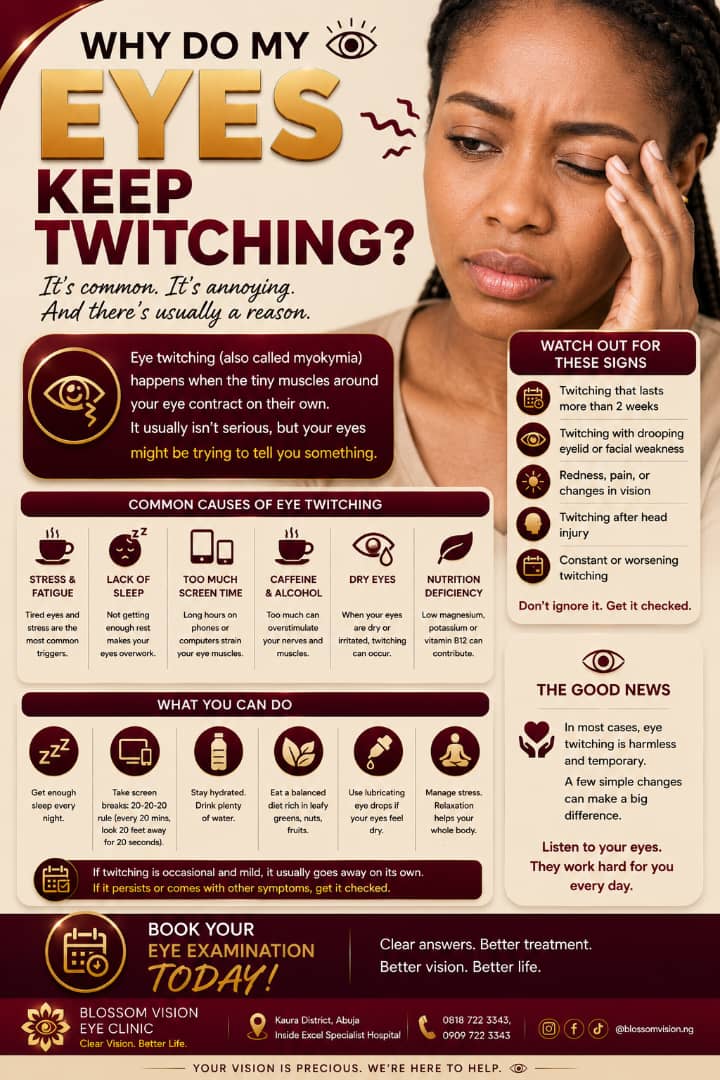
Eye twitching is usually harmless and often caused by stress, tiredness, too much caffeine, dry eyes or prolonged screen use. Most twitching goes away on its own. However, if it lasts for weeks, affects other parts of your face or is associated with other symptoms, you should have it checked by an eye care professional.
Why Does My Eyelid Keep Jumping?
The reassuring news is that most ordinary eyelid twitching is harmless and settles by itself.
Common triggers include:
- Stress
- Lack of sleep
- Too much caffeine
- Dry-eye irritation
But persistent twitching, forceful eye closure or twitching that spreads into the cheek or mouth deserves closer attention.
Quick Answer: Why Does My Eyyelid Keep Jumping?
A small eyelid twitch is often caused by temporary irritation or increased activity in the eyelid muscle.
You may notice it more when you are:
- Tired
- Stressed
- Drinking a lot of coffee or energy drinks
- Sleeping poorly
- Experiencing dry or irritated eyes
The common harmless form is often called eyelid myokymia.
In simple English:
one of the tiny eyelid muscles keeps contracting by itself.
Most episodes go away without serious treatment.
But if the twitch continues for several weeks, forcefully closes your eye or spreads to other parts of your face, have it assessed.
Book Appointment
Is My Eye Actually Twitching?
Usually, it is your eyelid, not your eyeball.
Patients commonly say:
“My eye is jumping.”
But what is actually moving is often a small part of the upper or lower eyelid.
You may feel it strongly even though somebody looking at you can barely see anything.
The twitch may:
- Last seconds
- Come and go for minutes
- Return several times during the day
- Disappear for days and then return
What Is Eyelid Myokymia?
Eyelid myokymia is the term commonly used for a fine, repetitive twitch of an eyelid muscle.
You do not need to remember the name.
The important thing is that this ordinary type is usually:
- Mild
- Temporary
- Limited to the eyelid
- Not associated with loss of vision
It is different from conditions that cause forceful eyelid closure or movement of an entire side of the face.
1. Can Stress Make My Eyelid Jump?
Yes.
Stress is a recognised trigger for eyelid twitching.
You may notice the twitching during periods of:
- Work pressure
- Exams
- Financial worry
- Travel
- Poor sleep
- Emotional stress
Sometimes the twitch becomes another thing to worry about.
Then you keep checking it.
You become more anxious.
And you notice every movement.
If it is a simple isolated eyelid twitch without other concerning symptoms, reducing stress and improving rest may help.
2. Can Lack of Sleep Cause Eye Twitching?
Yes.
Lack of sleep is another recognised trigger.
You may notice the eyelid jumping after:
- Several late nights
- Long workdays
- Travel
- Shift work
- Poor-quality sleep
If the twitching began during a period when you have barely been sleeping, start by correcting that before assuming something serious is wrong.
3. Can Too Much Coffee Make My Eye Twitch?
Yes.
Too much caffeine can contribute to eyelid twitching.
Caffeine may come from:
- Coffee
- Energy drinks
- Tea
- Cola
- Some supplements
You do not necessarily need to stop caffeine completely.
But if you recently increased your intake and the twitching started around the same time, reducing it may be worth trying.
What About Energy Drinks?
They matter because some contain substantial amounts of caffeine.
A person may say:
“I only drink one coffee a day.”
but also drink two energy drinks while working.
The total caffeine intake may be much higher than they realise.
If eyelid twitching is bothering you, look at all your caffeine sources.
4. Can Dry Eyes Make My Eyelid Twitch?
Yes.
Dry eye is another recognised trigger for eyelid twitching.
If the eye surface is irritated, you may also notice:
- Burning
- Grittiness
- Watering
- Redness
- Fluctuating blurry vision
- Heavy or tired eyes
In that situation, treating the eye-surface problem may help reduce the irritation associated with twitching.
If your eyes also feel sandy, gritty or burning, link this section to your dedicated dry-eye article once its exact URL is confirmed.
5. Can Using My Phone Make My Eye Twitch?
Possibly indirectly.
I would not say:
“Phones directly cause eyelid twitching.”
Instead, long periods of phone use may come with:
- Reduced or incomplete blinking
- Dry-eye symptoms
- Visual fatigue
- Late nights
- Less sleep
Those factors may make twitching more noticeable or more likely in someone who is already susceptible.
If phone use repeatedly leaves your eyes painful or uncomfortable, your separate “Why Do My Eyes Hurt After Using My Phone?” article should link here once its URL is confirmed.
6. Can Computer Work Cause Eyelid Twitching?
Again, not necessarily directly.
Someone working on a computer for eight or ten hours may also be experiencing:
- Dry eye
- Poor sleep
- High caffeine intake
- Stress
- Prolonged concentration
So instead of blaming the computer alone, look at the whole pattern.
If your main problem is tired, dry or blurry eyes after computer use, read Why Do My Eyes Feel Tired After Using a Computer?.
7. Can Eye Strain Cause Eyelid Twitching?
People often use “eye strain” to describe several symptoms.
These may include:
- Tired eyes
- Headaches
- Dryness
- Temporary blur
- Difficulty focusing
If these occur alongside eyelid twitching, prolonged visual activity may be contributing to the overall discomfort.
But avoid thinking:
“My eye muscles are becoming damaged from working too hard.”
Ordinary eyelid twitching usually does not mean the eye itself is being damaged.
8. Does Eye Twitching Mean I Need Glasses?
Not necessarily.
A twitching eyelid is not a reliable sign that you need glasses.
However, if you are also experiencing:
- Blurry vision
- Squinting
- Headaches
- Difficulty reading
- Eye strain
then your prescription may be worth checking.
The two problems can occur at the same time without one necessarily causing the other.
9. Can Dry Eye and Screen Use Cause Twitching Together?
Yes, several contributors can overlap.
Imagine someone who:
works on a laptop all day,
uses their phone late at night,
sits under air conditioning,
drinks several cups of coffee,
and sleeps five hours.
There may not be one single cause.
The eyelid twitch could be occurring in the middle of:
stress + caffeine + poor sleep + dry-eye irritation.
That is often more realistic than searching for one dramatic disease.
10. Is Eye Twitching a Sign of High Eye Pressure?
Ordinary eyelid twitching is not a typical sign of raised eye pressure or glaucoma.
The common form of glaucoma often has no noticeable symptoms in its early stages.
So I would not use twitching to tell somebody:
“Maybe you have glaucoma.”
If glaucoma risk is a concern, it should be assessed properly rather than guessed from an eyelid twitch.
11. Does Eye Twitching Mean I Am Going Blind?
Usually, no.
A simple eyelid twitch does not normally cause vision loss.
If your vision is genuinely changing at the same time, that is a separate reason to have your eyes examined.
Do not assume the twitch itself caused the blur.
12. Can Vitamin Deficiency Cause Eyelid Twitching?
This is one of the biggest internet rabbit holes.
Someone searches:
“Why is my eye jumping?”
and immediately sees:
“You are deficient in magnesium.”
That conclusion is too simple.
Certain nutritional or metabolic problems can affect muscles and nerves, but ordinary eyelid twitching is much more commonly associated with everyday triggers such as stress, fatigue, caffeine and dry-eye irritation.
Do not start taking large amounts of supplements simply because your eyelid twitched.
If there is a genuine reason to suspect a deficiency, appropriate medical assessment can determine that.
Should I Take Magnesium for Eye Twitching?
Do not automatically take magnesium solely because of an eyelid twitch.
There is no reason to assume:
twitching = magnesium deficiency.
Supplements should be used for an appropriate reason rather than because a social-media video diagnosed you.
Start by looking at the common triggers:
- Sleep
- Stress
- Caffeine
- Dry-eye symptoms
If the twitch persists, get assessed.
13. Can Dehydration Cause Eye Twitching?
I would not present dehydration as one of the main established causes of ordinary eyelid twitching.
Normal hydration is important for general health.
But:
“Drink more water and your twitch will disappear”
is not a reliable treatment plan.
Look first at the better-established triggers.
Book Appointment
Why Does My Lower Eyelid Keep Jumping?
Ordinary eyelid twitching commonly affects a small area of an upper or lower eyelid.
A lower-lid twitch can therefore still be a simple benign twitch.
The important questions are:
- How long has it been happening?
- Is it getting stronger?
- Does the eye close?
- Does anything else on the face twitch?
- Are there other symptoms?
The exact lid matters less than the overall pattern.
Why Does My Left Eye Keep Twitching?
A simple twitch may happen in either eye.
Having it on the left side does not automatically mean something different from having it on the right.
There is also no good medical reason to interpret:
left eye twitching
as a prediction that something good or bad is about to happen.
Clinically, we look at the symptoms and pattern.
Why Does My Right Eye Keep Twitching?
The same applies to the right eye.
The side by itself usually does not reveal the cause.
What matters more is whether the movement stays in the eyelid or begins involving the rest of the face.
Can Eye Twitching Come and Go for Days?
Yes.
A benign eyelid twitch may be intermittent.
It can appear:
- For a few minutes
- Several times in one day
- On and off over several days
The National Eye Institute notes that ordinary eyelid twitching often goes away on its own.
If it continues for more than a few weeks, however, an eye examination is sensible.
When Does an Ordinary Eye Twitch Become Something Else?
This distinction matters.
A tiny twitch in one eyelid is different from:
both eyes squeezing shut uncontrollably
or
one entire side of the face twitching.
Those patterns deserve closer assessment.
What Is Blepharospasm?
Blepharospasm is a condition involving involuntary eyelid movements or blinking.
Benign essential blepharospasm is uncommon compared with ordinary eyelid twitching.
It can begin with occasional twitching but may progress to more frequent spasms that can force the eyes closed and interfere with activities such as reading or driving.
So:
small eyelid flutter
is not automatically
blepharospasm.
But if your eyes are repeatedly squeezing shut without your control, have it assessed.
What Is Hemifacial Spasm?
Hemifacial means one side of the face.
Hemifacial spasm causes involuntary contractions on one side of the face.
It often begins around the eyelid and may later involve the:
- Cheek
- Mouth
- Other muscles on that side
It is different from a simple isolated eyelid twitch and may be related to irritation or compression of the facial nerve.
If the movement is spreading beyond the eyelid, medical assessment is appropriate.
What If My Eyelid Twitch Makes My Eye Close Completely?
That is not the typical little flutter most people mean when they say:
“My eye is jumping.”
The National Eye Institute advises evaluation when eyelid twitching causes the eye to close completely.
This can suggest a stronger spasm and deserves closer examination.
What If My Cheek or Mouth Starts Twitching Too?
That changes the situation.
If twitching spreads from the eyelid into other muscles on the same side of the face, conditions such as hemifacial spasm need to be considered.
Do not keep treating it as:
“just stress”
without assessment.
What If Both Eyes Keep Squeezing Shut?
Repeated involuntary closure of both eyelids may suggest a condition such as blepharospasm rather than ordinary eyelid myokymia.
Benign essential blepharospasm can become chronic and interfere with reading or driving.
Specialist treatment may be required.
Can Blepharospasm Be Treated?
Yes.
For people with genuine benign essential blepharospasm, specialist treatment can include botulinum toxin injections, commonly known by the brand name Botox.
The injections reduce unwanted muscle contractions, although treatment may need to be repeated.
This is not treatment for every person whose eyelid jumps after three cups of coffee and a bad night's sleep.
Ordinary eyelid twitching usually does not need that level of treatment.
When Should I Get My Eyelid Twitch Checked?
Arrange an examination if:
- The twitch continues for more than a few weeks
- It is happening very frequently
- Your eye closes completely during the twitch
- Other areas of your face begin twitching
- The eyelid becomes swollen or inflamed
- You have persistent dry-eye symptoms
- Your vision has changed
- You are unsure whether the movement is actually coming from the eyelid
The National Eye Institute specifically recommends eye assessment when twitching persists for more than a few weeks, closes the eye completely or spreads to other parts of the face.
When Should I Seek Urgent Medical Care?
Seek prompt medical assessment if the twitching occurs with new neurological symptoms such as:
- Facial weakness
- Arm or leg weakness
- Difficulty speaking
- Sudden severe imbalance
- Sudden double vision
- New severe headache with neurological symptoms
Those symptoms are not typical of a simple benign eyelid twitch.
They require assessment for problems beyond the eyelid itself.
What Can I Try at Home?
For a simple isolated twitch without concerning symptoms, start with the common triggers.
Sleep Properly
Several late nights can be enough to trigger or worsen twitching.
Reduce Excess Caffeine
Especially if you drink several coffees or energy drinks each day.
Manage Stress Where Possible
Notice whether the twitch appears during particularly stressful periods.
Give Your Eyes Screen Breaks
Especially if you spend most of the day on phones or computers.
Address Dry-Eye Symptoms
If your eyes also burn, feel gritty or water excessively, dry eye may be contributing.
The goal is not to perform twenty different home remedies.
It is to correct the obvious triggers and see whether the twitch settles.
Should I Rub My Eye to Stop the Twitch?
Avoid aggressive rubbing.
Rubbing does not fix the underlying muscle activity and may irritate the eye or eyelid.
If the eye feels itchy or dry, identify and treat that problem rather than repeatedly rubbing.
If itching is a major problem, read Why Are My Eyes Always Itchy?.
What Happens During an Examination for Eyelid Twitching?
At Blossom Vision Eye Clinic in Games Village, Abuja, we first need to understand what type of movement is actually happening.
We may ask:
- Which eyelid is twitching?
- How long has it been happening?
- Does it happen every day?
- Does the eye close completely?
- Does your cheek or mouth move?
- Have you been sleeping properly?
- How much caffeine do you drink?
- Are your eyes dry or irritated?
- Are you taking any medicines?
- Has your vision changed?
Depending on your symptoms, your examination may assess:
- Vision
- Eyelids
- Eye surface
- Tear film
- Dry-eye signs
- Prescription where relevant
- Overall eye health
If the pattern suggests a neurological movement disorder rather than ordinary eyelid twitching, referral for appropriate medical or specialist assessment may be needed.
How Much Does It Cost to Have My Eyes Checked?
If your twitching persists or you also have other visual symptoms, you can see our guide to eye test costs in Abuja.
Frequently Asked Questions
Why does my eyelid keep jumping?
Common triggers include stress, lack of sleep, too much caffeine and dry-eye irritation. Most simple eyelid twitches settle on their own.
Why does my lower eyelid keep twitching?
Ordinary eyelid myokymia can affect the upper or lower eyelid. The pattern and duration matter more than which lid is affected.
Can stress make my eye twitch?
Yes. Stress is a recognised trigger for eyelid twitching.
Can lack of sleep cause eye twitching?
Yes. Poor sleep or fatigue is another common trigger.
Can coffee make my eye twitch?
Too much caffeine can contribute to eyelid twitching.
Can dry eyes cause eyelid twitching?
Yes. Dry-eye irritation is one recognised trigger.
Does screen time cause eye twitching?
Screen use is better thought of as an indirect contributor through dry-eye symptoms, prolonged visual activity, fatigue and sometimes reduced sleep.
Does eye twitching mean I need glasses?
Not necessarily. A twitch alone is not a reliable sign that you need a spectacle prescription.
Is eye twitching a sign of glaucoma?
Ordinary eyelid twitching is not a typical symptom of glaucoma.
Does eye twitching mean I'm going blind?
Usually not. A simple eyelid twitch does not normally cause loss of vision.
Is eye twitching caused by vitamin deficiency?
Not usually. Do not assume an isolated twitch means you need magnesium or another supplement without evidence of a deficiency.
How long is too long for an eyelid twitch?
If it persists for more than a few weeks, the National Eye Institute recommends having it assessed.
When should I worry about eye twitching?
Have it checked if it persists, forcefully closes your eye or spreads to other parts of your face.
Where can I get persistent eyelid twitching checked in Abuja?
Blossom Vision Eye Clinic provides comprehensive eye assessment in the Games Village/Kaura District area of Abuja.
Your Jumping Eyelid Usually Isn't a Warning That You're Going Blind
Most of the time, an eyelid that keeps jumping is annoying rather than dangerous.
The first things to ask are surprisingly simple:
Am I sleeping enough?
Am I stressed?
How much caffeine am I taking?
Are my eyes dry or irritated?
But if the twitch does not settle, forces the eye closed or begins spreading into the cheek or mouth, the story changes.
At Blossom Vision Eye Clinic in Games Village, Abuja, we can examine your eyes and eyelids, look for eye-surface problems and determine whether further assessment is needed.
If your eyelid has been twitching for several weeks or the movement is spreading beyond the eyelid, have it checked rather than continuing to guess.