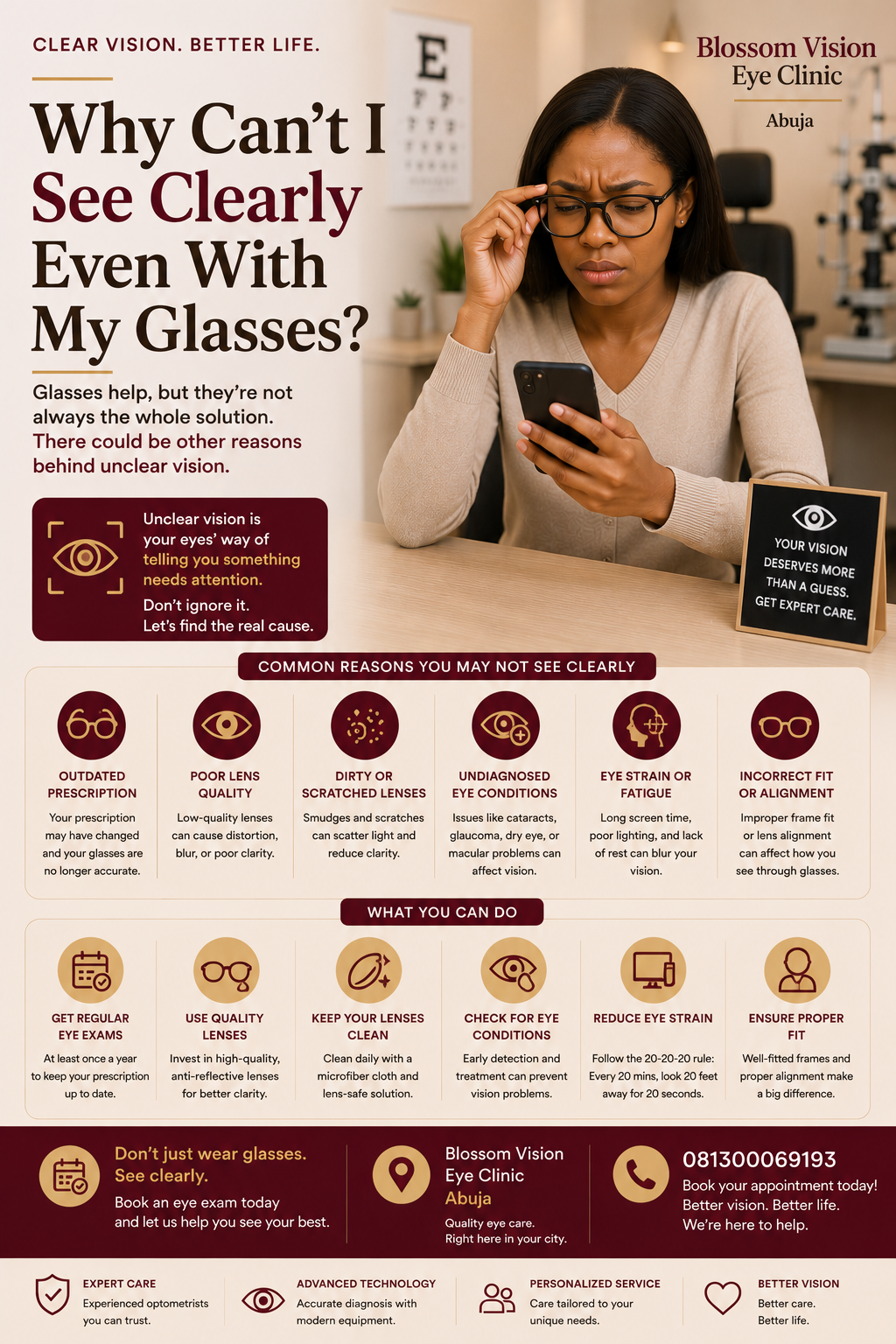
Why Is My Vision Still Blurry Even With Glasses?
Why Is My Vision Still Blurry Even With Glasses?
You put on your glasses.
But the road signs are still blurry.
Small print still looks unclear.
You keep cleaning the lenses because everything seems slightly foggy.
Or perhaps your new glasses simply do not give you the sharp vision you expected.
So you start wondering:
“Why is my vision still blurry even with my glasses on?”
The answer is not always:
“You need stronger glasses.”
Sometimes your prescription has changed.
Sometimes the glasses themselves need checking.
And sometimes the blur is coming from the eye rather than the prescription.
Common possibilities include:
- An outdated prescription
- An incorrect prescription
- Dry eye
- Cataract
- Keratoconus
- Diabetes-related vision changes
- Retinal or macular problems
- Poor lens measurements or fitting
- Scratched or damaged lenses
- Problems adapting to a new lens design
A comprehensive eye examination helps determine why the glasses are not giving you clear vision.
Quick Answer
If you cannot see clearly even with glasses, ask three questions:
1. Is my prescription still correct?
2. Were my glasses made and fitted correctly?
3. Is there something affecting my eye that glasses cannot correct?
Those three questions explain most situations.
Simply making stronger glasses without finding the cause can sometimes leave you with another pair that still does not work.
Book Appointment
Why Is My Vision Blurry Even With My Glasses On?
Glasses correct what is called a refractive error.
That means they help focus light properly when you have:
- Short-sightedness
- Long-sightedness
- Astigmatism
- Presbyopia
But glasses cannot correct every possible cause of poor vision.
Think of your eye like a camera.
The glasses help focus the image.
But you still need:
- A smooth eye surface
- A clear cornea
- A clear natural lens
- A healthy retina
- A functioning optic nerve
If one of those parts is affected, simply increasing your glasses prescription may not solve the problem.
1. Has My Glasses Prescription Changed?
This is one of the simplest explanations.
Your prescription can change with time.
You may notice:
- Road signs becoming blurry
- Difficulty reading
- More squinting
- Headaches
- Night-driving problems
- Your old glasses no longer feeling sharp
Prescription changes can happen during childhood, adulthood and later life for different reasons.
If your prescription seems to change repeatedly, read our guide on why your glasses prescription may keep changing.
How Do I Know If My Glasses Prescription Is Wrong?
Possible clues include:
- Things remain blurry with the glasses
- One eye sees much better than the other
- You have persistent headaches
- Straight lines appear distorted
- You feel uncomfortable whenever you wear the glasses
- Your old glasses actually feel clearer
- You cannot adapt after a reasonable period
- Distance or near vision is not performing as expected
But symptoms alone cannot tell us whether the written prescription is wrong.
The prescription needs to be checked.
2. Can New Glasses Be Blurry at First?
Sometimes.
A new pair may feel different when:
- The prescription changed significantly
- Astigmatism correction changed
- You are using progressive lenses for the first time
- The frame sits differently
- The lens design changed
A short adjustment period can occur.
But this does not mean every problem should be dismissed with:
“Just wear it until you get used to it.”
If the vision is very poor, causes significant dizziness or headaches, one eye seems wrong, or the problem persists, the glasses should be checked.
3. Could My Glasses Have Been Made Incorrectly?
Yes.
A good written prescription can still produce uncomfortable glasses if something goes wrong during manufacturing or fitting.
Important factors include:
- Lens power
- Astigmatism axis
- Pupillary distance
- Optical-centre placement
- Fitting height
- Frame position
- Lens design
These become particularly important with:
- Strong prescriptions
- Progressive lenses
- Prism
- Specialised lenses
If the glasses never felt right from the day you collected them, checking the finished spectacles is sensible.
What Is Pupillary Distance and Why Does It Matter?
Your pupillary distance, commonly called PD, measures the position of your pupils.
This helps place the optical centre of the lenses correctly in front of your eyes.
If the lens is positioned incorrectly, you may experience:
- Eye strain
- Headaches
- Distortion
- Difficulty adapting
- Visual discomfort
A good pair of glasses therefore requires more than simply knowing the numbers written on your prescription.
4. Are My Lenses Scratched, Dirty or Damaged?
Before assuming something is wrong with your eyes, inspect your glasses.
Common problems include:
- Fingerprints
- Grease
- Fine scratches
- Damaged coatings
- Cloudy lenses
These can scatter light and reduce clarity.
You may notice the problem particularly:
- At night
- Around headlights
- Under bright lights
Clean the lenses properly.
If they remain cloudy or scratched, the lenses themselves may need replacing.
5. Can Dry Eyes Make My Glasses Seem Blurry?
Yes.
This is one of the reasons someone can have the correct glasses prescription and still experience fluctuating blur.
The tear film is the first optical surface light passes through.
When that tear layer becomes unstable, vision may fluctuate.
A common clue is:
You blink and suddenly everything becomes clearer.
A few seconds later, it becomes blurry again.
Other dry-eye symptoms may include:
- Burning
- Grittiness
- Watering
- Redness
- Heavy eyes
- Screen discomfort
If your vision repeatedly becomes blurry and then clear again, read Why Does My Vision Go Blurry Then Clear Again?.
Why Does Blinking Make My Vision Clearer?
Blinking spreads the tear film across the surface of your eye.
If dryness is making that surface irregular, blinking may temporarily smooth it out.
That can make the image clearer.
If you notice:
Blur → blink → clear → blur again
tell your optometrist.
That pattern is useful information.
6. Can Cataracts Cause Blurry Vision Even With Glasses?
Yes.
A cataract is clouding or loss of clarity in the natural lens inside the eye.
Glasses sit outside your eye.
They cannot remove cloudiness from the natural lens.
Early on, changing the prescription may still improve vision.
As a cataract progresses, you may notice:
- Increasing blur
- Hazy vision
- Glare
- Halos
- Colours looking less bright
- Difficulty driving at night
- Repeated prescription changes
Eventually, stronger glasses may no longer produce the clarity you want.
If headlights have also become difficult at night, read Why Do Headlights Blind Me at Night?.
Does Needing Stronger Glasses Mean I Have Cataracts?
No.
Prescription changes have many causes.
Cataract is only one possibility.
An examination of the natural lens is needed before making that diagnosis.
7. Can Diabetes Cause Blurry Vision Even With Glasses?
Yes.
Diabetes can affect vision in more than one way.
Changes in blood sugar can temporarily alter how the natural lens focuses.
That can make your prescription seem unstable.
Diabetes can also damage the retina through diabetic retinopathy.
A person may therefore say:
“My glasses were fine last month, but now everything looks different.”
If blood sugar is fluctuating significantly, simply remaking glasses repeatedly may not solve the problem.
If you live with diabetes, read Can Diabetes Affect My Eyes Even If I Can See Clearly?.
8. Can Keratoconus Make Glasses Stop Working Properly?
Yes.
Keratoconus is a condition in which the cornea gradually becomes thinner and more irregular in shape.
It can cause:
- Distorted vision
- Increasing astigmatism
- Ghost images
- Starbursts
- Multiple images
- Frequent prescription changes
Someone with keratoconus may say:
“They keep changing my glasses, but nothing ever looks completely sharp.”
That is an important complaint.
If ordinary refraction repeatedly fails to provide good clarity, the cornea may need further investigation.
Why Do I See Ghost Images Even With Glasses?
“Ghosting” means seeing a faint second image beside or around the main image.
Possible causes include:
- Astigmatism
- Keratoconus or other corneal irregularity
- Dry eye
- Cataract
- Certain lens problems
Persistent ghosting deserves examination rather than repeatedly increasing the glasses prescription.
9. Can a Retina Problem Cause Blurry Vision That Glasses Don't Fix?
Yes.
The retina is the light-sensitive tissue at the back of your eye.
Glasses can focus the image onto the retina.
But they cannot make an unhealthy retina function normally.
Retinal or macular conditions can cause:
- Persistent blur
- Distorted central vision
- Missing areas
- Difficulty reading
- Difficulty recognising faces
- Reduced colour or contrast
One particularly useful warning sign is:
Straight lines suddenly looking bent or wavy.
That should be assessed promptly.
10. What About Glaucoma?
Glaucoma deserves a careful explanation.
Glaucoma damages the optic nerve.
The common open-angle form often affects peripheral vision quietly before a person notices major central blur.
So glaucoma is not the first explanation we should give for ordinary blurry vision despite glasses.
However, if glaucoma has caused optic-nerve damage, glasses cannot restore vision already lost from that damage.
This is one reason eye examinations should look beyond the prescription.
If you are concerned about glaucoma, read How Do I Know If I Have Glaucoma?.
11. Why Is One Eye Still Blurry With Glasses?
If one eye sees much worse than the other even with correction, possible explanations include:
- Different prescriptions between the eyes
- Amblyopia beginning in childhood
- Cataract
- Corneal irregularity
- Retinal disease
- Optic-nerve problems
- Other eye conditions
A new difference between the eyes should not simply be ignored.
Read our detailed guide on why one eye may be blurrier than the other.
Can One Eye Just Be Naturally Weaker?
Sometimes people have had unequal vision since childhood.
One possible reason is amblyopia, sometimes called lazy eye.
This happens when vision in one eye did not develop normally during childhood.
An adult may discover that even the best glasses prescription does not make that eye see as sharply as the other.
But newly reduced vision in one eye should not automatically be called lazy eye.
New changes need investigation.
12. Why Can't I Read Clearly With My Distance Glasses?
This becomes particularly common after around age 40.
You may have excellent distance glasses but still struggle with:
- Phones
- Menus
- Small print
- Computer work
This may happen because of presbyopia, the normal age-related loss of close focusing ability.
Your distance glasses may still be completely correct.
You may simply need additional near or intermediate correction.
Depending on your needs, this might involve:
- Reading glasses
- Bifocals
- Progressive lenses
- Occupational lenses
The correct solution depends on how you use your eyes.
13. Why Can't I See My Computer Clearly With My Glasses?
A computer sits at an intermediate distance.
That is neither very far nor as close as a typical book.
Some people, particularly after age 40, can have:
- Clear distance vision
- Clear reading vision
but struggle specifically with the computer.
This may mean the lens design is not ideal for the distance at which you work.
If computers also make your eyes tired, read Why Do My Eyes Feel Tired After Using a Computer?.
14. Why Do My Glasses Work During the Day but Not at Night?
Night vision puts the visual system under different conditions.
Your pupils enlarge in darkness.
Small refractive errors and optical imperfections may become more noticeable.
You may experience:
- Glare
- Starbursts
- Blurred road signs
- Halos
- Difficulty seeing low-contrast objects
Possible contributors include:
- Uncorrected astigmatism
- Dry eye
- Cataract
- Lens scratches
- Prescription changes
If night driving is the main problem, read Why Do Headlights Blind Me at Night?.
Book Appointment
Can Stronger Glasses Fix Every Kind of Blurry Vision?
No.
This is perhaps the most important lesson in this article.
Stronger lenses only help when the problem is something the glasses can optically correct.
If the reason for poor vision is:
- Cataract
- Significant corneal irregularity
- Retinal disease
- Optic-nerve damage
- Amblyopia
- Severe eye-surface disease
then simply increasing the prescription may not restore normal vision.
The underlying condition needs to be identified.
What If I Just Got New Glasses and They Are Worse Than My Old Ones?
Do not immediately throw them away.
First compare:
- Is one eye worse?
- Is distance blurry?
- Is reading blurry?
- Do you feel dizzy?
- Are straight lines distorted?
- Does the frame sit crooked?
- Do the lenses seem positioned differently?
- Is the problem improving at all?
Take both your old and new glasses back for review.
The optometrist or optical team can compare:
- The prescriptions
- Lens powers
- Measurements
- Frame positioning
- Your vision through each pair
Sometimes the solution is an adjustment rather than another complete eye test.
Why Do Progressive Glasses Sometimes Feel Blurry?
Progressive lenses contain several different viewing zones.
They provide:
- Distance
- Intermediate
- Near
within one lens.
Because of this, positioning matters.
Blur can occur if:
- You are looking through the wrong part of the lens
- The fitting height is wrong
- The frame has shifted
- Measurements are inaccurate
- You are still adapting
- The lens design is not ideal for your needs
If progressive glasses remain unusable after appropriate adjustment and adaptation, they should be reviewed.
When Should I Be Concerned About Blurry Vision With Glasses?
Book an eye examination if:
- Your glasses used to work but no longer do
- New glasses remain blurry
- One eye sees significantly worse
- Your prescription changes frequently
- Vision fluctuates throughout the day
- You see ghost images
- Straight lines look distorted
- Night vision is getting worse
- You have diabetes
- You experience new floaters or flashes
Persistent blur deserves an explanation.
When Is Blurry Vision an Emergency?
This part is very important.
Do not assume sudden severe blur means you simply need another pair of glasses.
Seek urgent eye or medical assessment if you develop:
- Sudden significant loss of vision
- A curtain or shadow over your vision
- A sudden shower of new floaters
- New flashes of light
- Severe eye pain
- A very red painful eye
- Sudden double vision
- Sudden vision problems with weakness, facial drooping or difficulty speaking
- Significant eye injury
Those symptoms require urgent assessment.
What Happens During an Eye Examination When Glasses Aren't Helping?
At Blossom Vision Eye Clinic in Games Village, Abuja, we do not want to answer only:
“What stronger prescription should we give you?”
We want to answer:
“Why aren't you seeing clearly with the prescription you already have?”
Depending on your symptoms, the examination may assess:
- Visual acuity
- Current glasses
- Refraction
- Pupillary distance and lens measurements where needed
- Tear film
- Cornea
- Natural lens
- Cataract
- Eye pressure
- Retina
- Optic nerve
- Other findings where clinically appropriate
Bring your current glasses with you.
If you have an older pair that felt better, bring that too.
Comparing them can provide useful information.
Should I See an Optometrist or Ophthalmologist?
For blurry vision, glasses problems and prescription assessment, an optometrist is often an appropriate starting point.
If the examination reveals a condition requiring medical, surgical or specialist ophthalmic treatment, referral can then be arranged.
Read our guide on whether you should see an optometrist or an ophthalmologist.
How Much Does It Cost to Check My Eyes?
The cost depends on the examination and whether additional tests are required.
See our current guide to the cost of an eye test in Abuja.
Frequently Asked Questions
Why is my vision still blurry even with glasses?
Possible causes include an outdated or incorrect prescription, dry eye, cataract, keratoconus, diabetes-related vision changes, retinal problems or problems with the lenses themselves.
Does blurry vision with glasses mean I need stronger glasses?
Not necessarily. Stronger glasses only help if the refractive prescription is the problem.
Why are my new glasses still blurry?
You may be adapting to a new prescription, but persistent blur can also result from prescription errors, lens measurements, frame positioning, dry eye or another eye problem.
Can dry eyes make my glasses blurry?
Dry eyes can make vision fluctuate even when the glasses prescription is correct. Vision may temporarily improve after blinking.
Can cataracts make glasses stop working?
Yes. As cataracts progress, changing the glasses prescription may provide less improvement because the natural lens inside the eye is becoming cloudy.
Can diabetes make my glasses blurry?
Yes. Blood sugar changes can temporarily alter focusing, and diabetic retinal disease can also reduce vision.
Why is one eye blurry even with glasses?
Possible causes include unequal prescriptions, amblyopia from childhood, cataract, corneal problems, retinal disease or optic-nerve problems.
Why can I see far away with my glasses but not read?
After about age 40, presbyopia commonly reduces close focusing ability. Your distance prescription can still be correct while you need additional help for near vision.
Why do my glasses work during the day but not at night?
Astigmatism, dry eye, cataract, lens scratches and small prescription errors can become more noticeable under low-light conditions.
Should I keep making stronger glasses?
Not unless an examination confirms that your prescription has genuinely changed. If several pairs fail to give clear vision, investigate why.
Where can I get my glasses and vision checked in Abuja?
Blossom Vision Eye Clinic provides comprehensive eye examinations and prescription assessment in the Games Village/Kaura District area of Abuja.
Don't Just Make Stronger Glasses. Find Out Why You Still Can't See Clearly.
Your glasses are supposed to improve your vision.
So if you are still saying:
“Everything is blurry even with my glasses on.”
“My new glasses don't seem right.”
or
“No pair of glasses ever gives me completely clear vision.”
do not assume the only solution is another stronger prescription.
Sometimes it really is the prescription.
Sometimes it is the glasses.
And sometimes there is something about the eye itself that needs attention.
At Blossom Vision Eye Clinic in Games Village, Abuja, we can assess your prescription, glasses and eye health to determine why your vision is not as clear as expected.
If your glasses are no longer giving you clear vision, book a comprehensive eye examination and find out why.